ROB WARZYNIAK recalls the emblematic 1906 book, The Jungle, in its analysis of the crisis presently engulfing the US Food and Drug Administration


 Latest editorial

For a new Employment Rights Bill: experts and union leaders demand better
The Employment Rights Act 2025’s focus on individual rights forces workers into slow and costly litigation to assert rights, rather than empowering unions. A Campaign for Trade Union Freedom-Strike Map rally at the weekend called for a more radical sequel, reports BEN CHACKO
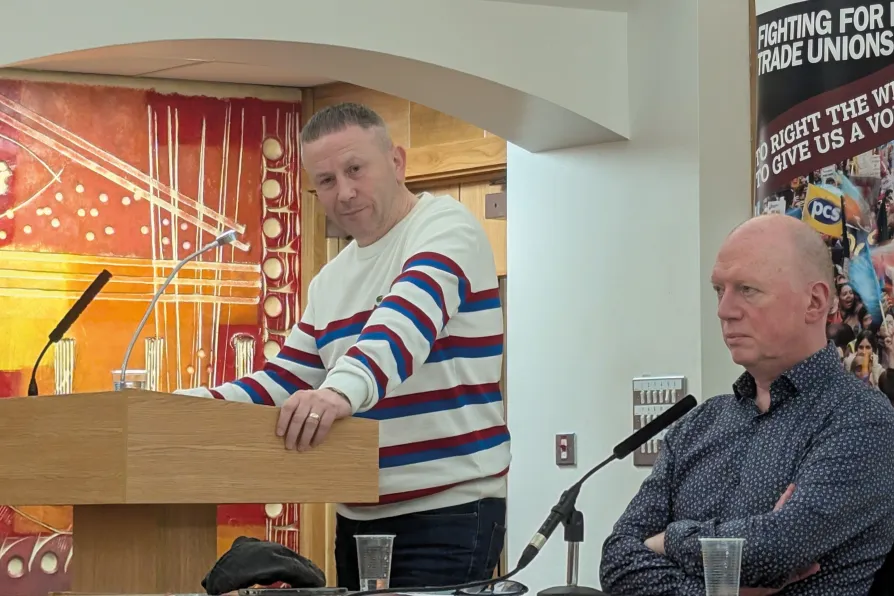 PRESSING FORWARD: Bin worker Mike Masters (left) alongside NASUWT general secretary Matt Wrack

Welsh wanderings showcase fiery destruction, alternative water ways and revive memories of a local mining legend, writes MARK SEDDON
As thousands die in the eastern DRC, a global health emergency is being starved of funds, says S KRISHNASWAMY
MAT COWARD explains how in the 17th century a row over whether to kneel at communion became a battle over religion, class and royal power
Renewed illusions in social democratic reformism are sprouting as a result of Andy Burnham’s rhetoric, but material conditions are already intruding into the debate, argues NICK WRIGHT
Andy Burnham could learn a few lessons from a previous Labour government in the pre-privatisation era on how to tackle water shortages, writes KEITH FLETT





A NEW urgency gripped debate at the workers’ rights rally called by the Campaign for Trade Union Freedom (CTUF) and Strike Map at the weekend.
The campaign for a second Employment Rights Bill cannot be put on the back burner amid war on Iran or because of the looming threat of Reform and the far right. These are exactly why Labour needs to act, veteran MP John McDonnell said.
“The war on Iran will have consequences for our economy. With the interrupted supply of fuel and gas inflation is increasing already. Interest rates will be frozen or increased and we’re on the edge of a recession.
“You know what happened last time when we had a crisis like this with Covid. In my constituency Heathrow Airport was the first to do fire and rehire, laying off virtually the whole workforce — BA participated as well.
“There will be employers who want to exploit this crisis. They’ll be looking at wage cuts, job cuts. We need this legislation in action as rapidly as possible.
“This is the most dangerous political moment in my lifetime,” McDonnell stressed. “I’ve been in politics 50 years, an MP for over 30. Before when we had the far right marching on our streets, there was never a threat that they’d be in government. Well, there is now.
“This government needs to indicate to working people that it’s on their side. What better way to indicate that than to deliver employment rights that defend people’s wages, jobs and basic security?”
McDonnell called on the TUC to press Labour for a reference to a new employment rights Bill in the King’s Speech in a few weeks’ time — “and if there isn’t one we kick off and start campaigning for its inclusion in the government programme in the coming year.”
Such a campaign, former RMT president Alex Gordon pointed out, could become a demand of any candidates vying to succeed the embattled Keir Starmer in return for trade union support.
The bigger picture, alluded to by Institute of Employment Rights president Professor Keith Ewing and by teachers’ union NASUWT leader Matt Wrack, is that far-right politics has historically thrived in deeply unequal societies — and inequality has risen in Britain in step with the five-decade assault on trade union rights and collective bargaining.
“Around the world the weakening of organised labour has led to a significant growth in inequality,” Wrack said. “It’s led to the growth of some appallingly powerful oligarchs and you can see their political influence in the United States and over here.”
That influence was not even confronted by government using obvious levers to impose commercial penalties on plutocrats openly demanding it be overthrown.
“How is it that Elon Musk can call for violence on the streets of Britain from a big screen in Parliament Square on a Saturday [at the massive far-right demonstration in London last September] and on the Monday Tesla is running autonomous road taxi trials in Swindon in [Transport Secretary] Heidi Alexander’s own constituency?” asked James Farrar of the Worker Info Exchange.
Ewing noted that while in the 1970s Britain was among the most equal western European countries, joining Sweden at the top of the list, now it sits at the bottom.
He and Lord John Hendy KC identified the cause in the collapse in trade union membership — from 13 million at its 1970s height to just six million today, in a much larger workforce — and in collective bargaining, with the proportion of workers whose terms and conditions are governed by a collective agreement falling from 82 to 26 per cent.
As Hendy noted, that same period has seen the share of British GDP paid in wages rather than taken in profits and rents drop from 60 to 50 per cent, a huge slice of national wealth taken from workers and handed to owners.
Would the Employment Rights Act reverse the trend? “The answer must be no,” Ewing argued, saying of its 320 pages, “never has so much been said to deliver so little.”
Nobody on the panel disputed the significant improvements in many individual rights the Act introduces. Rights to parental leave, whistleblower protections, sick pay are important; more workers will be protected against unfair dismissal, though not from day one as originally promised; some of the barriers raised against unions taking strike action have been taken down.
But many of its collective rights are less impressive than they appear. It says it gives unions access rights to workplaces, but “there is no way in which that law can be enforced,” Ewing pointed out. “You have a right but no remedy — a right of access provided the employer agrees, which is the position already.”
Collective bargaining has only been introduced for the social care sector and teaching assistants, and even there, as Unison general secretary Andrea Egan said, it isn’t really collective bargaining as the parties “cannot decide what issues they wish to discuss, and the minister can overrule decisions.”
There is a basic problem in the government’s entire approach to workers’ rights which Hendy summed up as one of “litigation not negotiation” — instead of giving workers real power by extending collective bargaining or making it easier for unions to organise, workers with grievances must try to assert their individual rights through employment tribunals, an extraordinarily slow and costly process. Cases are being scheduled now to be heard as late as 2029.
Nor does the 2025 Act address either of the two questions Britain is repeatedly pulled up on by the International Labour Organisation as violating its international legal obligations: the requirement to notify employers in advance of industrial action ballots (rather than action itself) and the total ban on secondary (solidarity) action.
As Public and Commercial Services union leader Fran Heathcote noted, the government won’t even lead by example by introducing collective bargaining across its own workforce — the Civil Service, where there are over 200 sets of pay negotiations. Nor does it require firms bidding for government contracts to recognise unions or collective agreements.
The meeting ended with a commitment to campaign for a second Bill to address the glaring omissions in the first.
Gordon summed up. “We need a single status of worker. We need sectoral collective bargaining, not lip service to it.
“We need a right to strike in this country — which we have never had — and a right to take solidarity action.
“And we want to move away from workers constantly being told they have to engage in individual litigation to solve contractual problems that should be solved through collective bargaining.”
___________________________________________
ANY IDEA that the Labour Party is a friend to workers was further shattered by the moving address from Birmingham bin striker and Unite rep Mike Masters.
Their dispute with a Labour council trying to cut their pay by as much as £8,000 has now lasted over a year.
“They’ve brought injunctions in, police infiltrating picket lines, sacked workers — me. A union rep in the middle of a dispute, sacked.
“Disciplined workers for doing what is their right, picketing. Tried to bring gross misconduct charges against them.
“Birmingham City Council, shame on you!”
Masters spoke of the strain of prolonged strike action on bin workers and their families, of the financial hit that meant no holidays or presents for kids, of a Christmas spent supporting a colleague who had become suicidal.
Labour were heading for a massacre at the local elections, he warned — and, just as we’d heard throughout the day, Labour’s betrayal of workers was opening the door to the far right.
Download the digital campaign pack at https://bit.ly/ERB2OrganisingPack26.
