Cuban trade union federation CTC leader OSNAY MIGUEL COLINA speaks to Ben Chacko about life and work under a crippling US siege


 Latest editorial
Violence against transport workers is rising. April 28 must be a turning point
On Workers Memorial Day, EDDIE DEMPSEY calls for immediate action on our railways to make the network safer for all
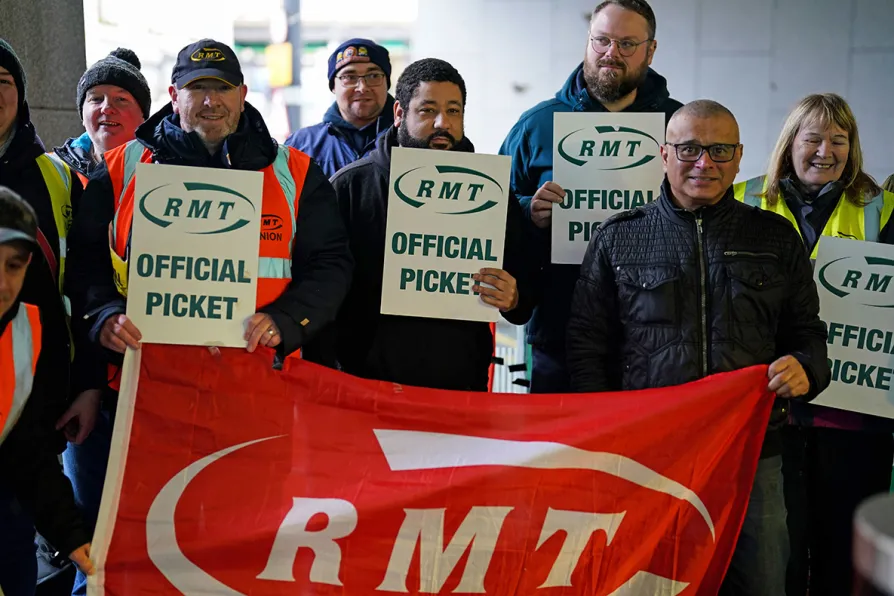 Members of the Rail, Maritime and Transport union (RMT) on the picket line outside New Street station in Birmingham, January 7, 2023

A part of the British empire’s network of slavery, today the Caribbean island of Nevis faces a new form of exploitation in the form of crypto-colonialism, CLAUDIA WEBBE writes
A new book by Victoria Holmes illuminates the many hidden histories of the oppression experienced by Gypsy/Roma/Traveller community, writes ROGER McKENZIE
Even the oligarchs of the artificial intelligence industries are warning that their creations have the capacity for the ultimate destruction of the planet and its population. ANDREW MURRAY suggests that there might just be other solutions
The Labour government must deliver on its commitment to bring back privatised services into the public sector. This not only saves money but also creates accountability and generates wider social benefits, argues ANDY MCDONALD MP
Public ownership of Great British Railways has enormous potential to improve our railway network, but that can’t happen unless jobs, employee rights and union recognition is at the heart of the transition, argues MARYAM ESLAMDOUST
Challenges from the unscrupulous misuse of AI to steal actors’ voice and physical likenesses is being met with a firm union response, writes LYNDA ROOKE





TODAY RMT members will be out across the country at stations, bus depots and ports leafleting and talking to passengers about the steady rise in violence and abuse against transport workers.
We have had recent high-profile incidents on the transport network, including the death of a member at Ilford station and the mass stabbing on the train at Huntingdon.
But far from these appalling events being isolated, according to surveys and personal testimonies from our members, it is clear the issue has become central to the daily reality of working in the industry.
The job has always carried an element of risk. Anyone working where they may interact with passengers on public transport can be forced to deal with difficult situations from time to time. But what we are seeing now goes well beyond that. Since the pandemic, there has been a clear shift in behaviour and abuse has become more frequent, more aggressive and more unpredictable.
Physical assaults have also become more commonplace and some of the recent incidents I’ve found shocking.
Over the Easter bank holiday alone, I received reports of serious assaults on our members who were trying to get passengers home during difficult engineering works.
This involved ferrying people into taxis with some intoxicated passengers setting about our members.
No-one should accept that as part of their working life and our union is not going to rest until we get some justice and better protections in place for our people.
At a recent RMT event in the Scottish Parliament, a guard with nearly 20 years’ experience described how the job has changed. She spoke about dealing with fare evasion and anti-social behaviour on a near-constant basis, about the stress of managing volatile situations, and about the fear that support might not arrive when it’s needed.
She also made a point that many rail workers have stopped reporting incidents altogether. They don’t see the point, she said and they have no confidence anything will be done.
Over recent years, staffing levels have been cut back across large parts of the network. Less visibility of staff means a weaker deterrence and fewer people available to deal with situations appropriately if they escalate. At the same time, lone working remains common in roles that involve direct interaction with the public. That leaves individuals exposed in circumstances where they should never be on their own.
If this was not bad enough, the British Transport Police (BTP), which is an essential presence on the network, has been gutted through poor funding and cuts to officers on the ground.
Members repeatedly tell us that response times are too slow when they are called, that incidents are not followed up, and that there is simply not enough of a visible BTP presence.
What our day of action today is seeking to do is not only highlight how dire the situation has become but to make concrete proposals which can be brought about almost immediately.
First, we need safe staffing levels across the network. Visible staff are the most effective deterrent to anti-social behaviour. They also give passengers confidence and ensure that transport workers are properly supported. We also need an end to corporate profiteering on public transport with outsourced security and enforcement staff being brought in-house.
Second, we need to end lone working in safety-critical and customer-facing roles. No worker should be expected to manage a potentially dangerous situation without back-up.
Third, we need a step change in enforcement, including sustained investment in the BTP and a clear expectation that incidents will be taken seriously and pursued.
And fourth, we need stronger legal protections.
In Scotland, there are now manifesto commitments and real momentum behind the introduction of a specific offence of assaulting a transport worker, ahead of the Scottish parliamentary elections.
That is a direct result of sustained campaigning by our union and it reflects a growing recognition that attacks on transport workers require a specific classification and punishment.
We are calling on all political parties in Scotland to commit to making that protection law in the next Parliament. And we are clear that the UK government must not allow itself to fall behind and bring about something equivalent in Westminster.
There is no reason why a worker in Glasgow should have stronger legal protection than one in London, Manchester or Cardiff.
These changes if enacted would create a wholly different environment on public transport and ultimately improve the levels of take-up by passengers.
If everyone feels safer on the network, it doesn’t take a rocket scientist to work out that more people will want to travel by public transport which would be beneficial to the economy and environment.
So if you are passing by a train station, an RMT bus depot or a ferry port, take a leaflet and speak with our activists about how together we can take effective action against assaults.
Eddie Dempsey is general secretary of RMT.
