


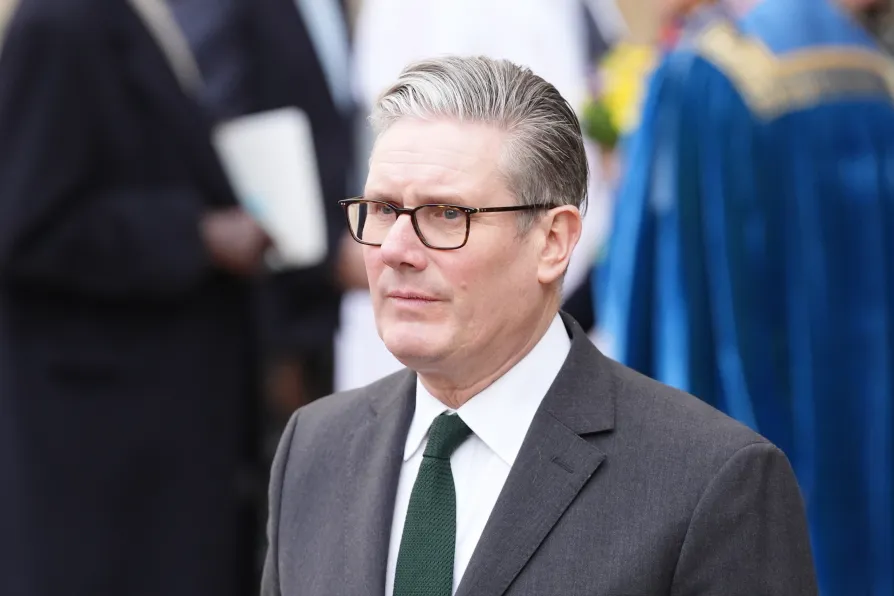
 Prime Minister Keir Starmer leaves after attending the annual Commonwealth Day Service of Celebration at Westminster Abbey, in London, March 9, 2026






THE Starmer government is on its last legs. The political project that created it is totally discredited: the Epstein-Mandelson scandal, departure of Morgan McSweeney and stench of fraud and deceit surrounding Labour Together exposed it as rotten to the core.
Donald Trump plunging the Middle East into war is a distraction for now — but can only worsen the government’s plight in coming weeks.
Keir Starmer was the most unpopular prime minister on record before the Mandelson crisis, and the US adage “it’s the economy, stupid” explains why: not because of the temporary ups and downs of the market but because of Labour’s inability to face underlying structural problems.
These include a manufacturing sector gutted by decades of Thatcherism, privatisation of the commanding heights of the economy removing most state levers to act in the public interest, and overdependence on a City of London ill-equipped for a world of great power rivalry, tariffs and trade wars.
All that spells long-term decline for living standards and public services. The inflationary crisis of 2021-23 may have slowed, but things are not back to normal: people are paying much more for essentials like food, housing and heating than they did just a few years ago.
We are about to get hit by another inflationary crisis courtesy of Trump’s illegal war. Nothing in Starmer or Chancellor Rachel Reeves’s record suggests they are capable of the action required to shield us from it: nationalisations, price controls or even delivery of their own old plans to roll out subsidised home insulation.
Humiliation at the local elections is all but certain. The Caerphilly and Gorton & Denton by-elections (both in seats regarded recently as impregnable Labour strongholds) show Labour can now lose simultaneously to its left and its right: that is existential, and MPs know it. It is hard to see Starmer lasting much beyond May.
Yet he is ploughing ahead with a ferocious assault on the democratic basis of the judicial system, trying to revoke the right to trial by jury in most cases.
He has no mandate for this policy. It has no credibility with the public and no support from the legal profession, with thousands of lawyers petitioning the PM to abandon the attack on jury trials.
He has no real power over MPs. A prime minister who will be gone in a few months is not a useful source of patronage or promotion. MPs are waking up to that, with dissent over jury trials and some other issues — Shabana Mahmood’s attack on the right to asylum is one — getting louder.
There is no excuse for any MP to back this policy any longer.
As the Morning Star has previously detailed, the huge courts backlog is a product of Tory austerity: the combined result of deep spending cuts (Ministry of Justice budgets are a quarter less in real terms than in 2008), legal aid cuts (slowing down trials and creating a shortage of criminal lawyers and judges) and asset sell-offs (England and Wales lost nearly half their court buildings from 2010-18).
Ditching jury trials will not solve those problems. The government pursues it because it resents the power juries give ordinary people to defy its authoritarian crackdown on protest, delivering not guilty verdicts in direct action cases relating to the climate crisis or Palestine solidarity.
That authoritarianism was on show today: in almost the same breath Courts Minister Sarah Sackman claimed there was no alternative to cutting jury trials and said she expects “the police and the Home Secretary to take the necessary action” to stop people opposed to the US-Israeli war on Iran from protesting in the streets, as they are “thoroughly anti-British.”
Sackman gave us a glimpse of the government’s true motivation. MPs cannot hide behind the courts backlog. They must be made to stop this so-called reform in its tracks.
