
The US administration is endangering lives by reversing environmental protection laws, CHAUNCEY K ROBINSON argues

Helen Crawfurd: the minister’s wife who became a suffragette and communist militant of Red Clydeside
KENNY MacASKILL looks at the extraordinary political commitment of a Church of Scotland minister’s wife
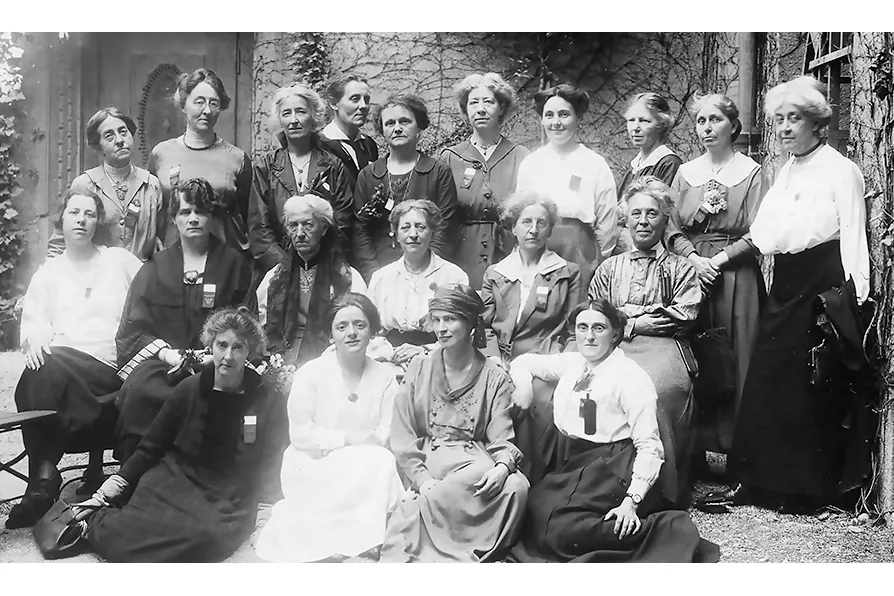
 INDOMITABLE: Helen Crawfurd (middle row, second from left) at the Women's International League for Peace and Freedom Conference, Zurich, 1919
It’s time to stop retreating and go on the offensive to promote working-class interests, argues DOUG NICHOLLS
Marco Rubio wants to defeat socialism in Nicaragua, not restore ‘democracy,’ writes JOHN PERRY
Believe it or not, there was a time when the US government built beautiful homes for working‑class Americans to deal with a housing shortage, writes ERAN BEN-JOSEPH
DIANE ABBOTT provides an analysis of the reasons for EU and British voters’ dramatic swing to the right
Train drivers’ union Aslef general secretary DAVE CALFE speaks to Ben Chacko about his hopes that Burnham’s devolution agenda will include the importance of the railway





THE image of a Church of Scotland Minister’s wife, especially in the 1900s, is of a prim and proper lady, demurring if not deferring to her husband.
Helen Crawfurd was such a wife, but also a leading suffragette jailed on five occasions, a housing campaigner during Red Clydeside and the famous Rent Strikes, as well as an executive member of the newly formed Communist Party of Great Britain in 1921.
This is the story of a remarkable lady who defied the stereotype and was both committed and courageous.
Born Helen Jack in Glasgow’s Gorbals in 1877, her father, a baker, was a staunch Presbyterian and a Tory, with her mother a Methodist.
Her childhood was largely spent in Ipswich where her father had moved before the family returned to her native city in 1894 when she was 17.
Living in the more fashionable West End of the city she was still shocked by the poverty she saw all around her in what was then the Second City of the empire.
In 1898 she married the Reverend Alexander Crawfurd whose parish was in Anderston, then the dock area of the city and one of its most deprived.
He was considerably older than her, having a daughter from an earlier marriage of a similar age. He was noted for his support for Temperance and trenchant anti-militarism. That undoubtedly made her position as the minister’s wife easier, but she still flung herself faithfully into the more usual roles in church life, including running the choir.
However, she also had her own political interests joining the suffragette movement in 1900. Apparently even hosting meetings in the Manse, doubtless a contrast to more usual church gatherings there.
The early attempts by suffrage supporters being ignored or coming to nought saw a militancy develop later that decade in which Crawfurd would be to the fore.
Joining the Woman’s Social and Political Union (WSPU) in 1912 she was involved in breaking the windows of the Ministry of Education home in London and was sentenced to one month’s imprisonment.
Her husband seems to have retired by then and died in May 1914. But it was still not the behaviour associated with a minister’s wife, even a retired one, let alone his widow and it was only to be the start of her confrontations with authority.
In 1913 she was arrested for smashing windows at an army recruiting centre in Glasgow and again sentenced to a month’s imprisonment.
The following year she was detained by police as she approached a royal procession in Perth and put in Perth Prison where she went on hunger strike. She was released under the Cat and Mouse legislation brought in to allow release of the women on hunger strike then re-arrest. She was arrested again a few months on, once again beginning her political fast and being released after three days.
Her next arrest was to be even more spectacular with Crawfurd accused of being involved in a bomb blast at the Botanic Gardens and sentenced to two years — and again going on hunger strike.
1914 also saw the outbreak of the WWI, as well as her widowhood. Women’s suffrage was overtaken by other issues, it also caused a divide in the movement, as it did within the left more generally, with Crawfurd among others disdaining Emily Pankhurst’s call for women to rally to the flag and take up work where men went to enlist.
Crawfurd would join the Women’s Peace Crusade, becoming its honorary secretary opposing the war and conscription. She also signed up for the Independent Labour Party (ILP) but it was in housing and the coming rent strikes where she would once again come to the fore.
As Glasgow was blighted by shameful poverty, it was also scarred by slums and Rachman-type landlordism. With men needing accommodation in the city for war work it wasn’t just the corporate barons in the shipyards and engineering works raking it in.
Crawfurd became secretary of the Woman’s Housing Association in the city and in that role would play a key part in the rent strike in 1916. Mary Barbour is the name most associated with the events, but the minister’s widow was once again a stalwart and to the fore.
Demonstrations and protests blocking bailiffs seeking to enforce court orders for debt or eviction were organised with kettles and pans being banged to rally the women from their homes.
The strike, which was backed by the shop stewards in the major factories across Clydeside, saw the government intercede to bring in rent legislation which would protect not just tenants in Glasgow but across the country, and for many years to come.
It was an integral part of Red Clydeside which would culminate in January 1919 with troops on the street and tanks despatched to Glasgow.
Crawfurd was then in the company of the likes of Maxton, Wheatley, Maclean and Willie Gallacher, as once she had been with parishioners and the Women’s Guild. It would also politically lead to the breakthrough of the Red Clydeside MPs in 1922 but by then Crawfurd had left to join the newly formed Communist Party.
A member of the “Left Wing Committee” of the ILP she had visited Russia as a party delegate to the Third International. On her return becoming secretary of the Workers International Relief Organisation, fundraising for famine in the Volga, along with campaigning in Scotland and Ireland.
Along with others in that left faction of the ILP she joined the newly formed Communist Party of Great Britain in 1921 becoming a central committee member, establishing the Women’s Section and contesting local and general elections. Still also having time to become secretary of Glasgow’s anti-fascist organisation.
Remarrying in 1944 she moved to Dunoon where she become the first woman elected to the town council. She died in 1954 and the funeral oration was delivered by Willie Gallacher. Not the usual service for a minister’s wife but one for a remarkable lady who deserves to be remembered.
