WILL STONE samples the 20th anniversary atmosphere of this eclectic end-of-season indie festival


 Latest editorial
Cuba’s LGBT revolution - another reason for solidarity
STEVE JOHNSON speaks to ANGUS REID about his new film — free to watch for Morning Star readers — that documents Cuba’s revolutionary new family code
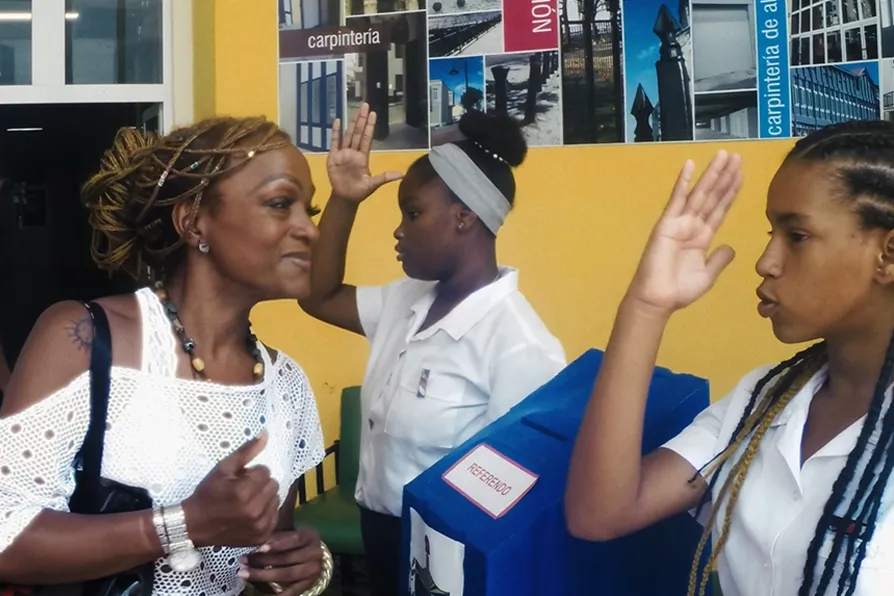 REVOLUTION IN ACTION: Trans activist Nomi Ramirez casts her vote in Cuba's Family Code referendum. [Pic: Speakeasy Pictures]

Comics are not just superheroes and spandex – it can be public art, telling public stories, suggests HARRIET EARLE
The bard serenades the Diggers of Wigan and their festive followers
ALEXEI SAYLE speaks to Angus Reid about a lifetime of protest, how to hone political art – and what to do now
ANDY HEDGECOCK, JAMES WALSH, LEO BOIX and MARIA DUARTE review Just An Illusion, Everybody Digs Bill Evans, Blue Film, Oasis: Don’t Look Back in Anger, and Runner
MARIA DUARTE recommends a nerve-wracking reconstruction of the 72 hours before the Normandy landings





AT a time when Cuba is under sustained attack by Trump’s tightening of the US blockade, with very little protest from European governments or supposedly liberal journalists who, in other contexts may like to pose as critics of Trump, it is important that we give as much coverage as possible to Cuba’s achievements in all aspects of social progress under the most difficult of circumstances.
This film by Scottish film-maker and Morning Star arts editor Angus Reid looks at the progress made by Cuba in advancing Family Law and LGBT rights. He visited the island in 2022 during the referendum on the adoption of Cuba’s new family code, the most progressive family code in the world.
“This was actually the third instalment — C for Cuba — in a trilogy of films called ABC of the revolutionary movement. The first one was A for Africa set in Burkino Faso, the second B for Bengal set in West Bengal. I had gone to Cuba at the time for a holiday with my then partner but the fact that I was there during the wide-ranging discussion on the family code gave me the chance, as a gay man, to explore what is was like to be gay in Cuba at the present time.”
Getting together with a Cuban film-maker, Hugo Rivalta, whom he had met at the Havana Glasgow Film Festival, it became possible to make a half-hour film, talking to people throughout the island about their thoughts on the proposed family code.
There has been much distortion in the Western press — including from supporters of “Rainbow Capitalism,” and in the established LGBT media — about the position of LGBT people in Cuba, based on positions taken in the early years of the revolution now long since abandoned.
The film does not shy away from acknowledging the negative impact of those past attitudes, with a representative of CENESEX (The Cuban National Centre for Sex Education) talking about a student in his care who committed suicide 20 years previously. However, on the basis that socialism is built by working-class people who often inherit prejudices from the past, the film also shows how involvement and participation can change people’s attitudes.
“In many ways,” says Reid, “the discussion on the family code and those changed attitudes reflect the impact of socialism on the working person, and the fact the Cuban Communist Party has ensured that the population understand secular values.”
There is a scene in a Catholic church in Havana where the Archbishop calls on his congregation to vote against the proposed code, and there was campaigning against the code both by the Catholic church and US-influenced evangelical groups, who contrary to another distortion in the Western media about persecution of Christians in Cuba, were not prevented from doing so.
However, the scene in the church also shows two young men hugging each other and, while we can’t draw any conclusions about sexuality in this encounter, it might indicate that many religious believers have a more relaxed attitude than their church leaders.
The strength of the film is that it shows conversations with people who have a range of perspectives, from a trans woman early on, to a conversation in a restaurant with a bus driver and tour guide where socially conservative attitudes are expressed, but also the acknowledgement that younger people see things differently.
The film ends when we find out the result of the referendum, with 67 per cent of the electorate voting to accept the new code in a turnout of 75 per cent. That shows that, of the entire population over 16, over half voted for it. Preparing the code, the government held over 80,000 public consultations and the public, in fact, made changes to half of the original proposals.
It was a magnificent exercise in participatory democracy — not centrally imposed but coming from the grassroots, something much of the Western left critics of Cuba’s alleged centralised bureaucracy would do well to learn from in their own internal organisations.
And it has produced the most advanced family code in the world, not just in the field of LGBT rights, but in women’s rights and children’s rights. In the experience of Angus Reid: “I felt safer as a gay man in Cuba than I do anywhere else.”
Currently the Cuban revolution is under heightened attack with the Trump administration openly admitting their aim is to starve the Cuban people into submission and roll back every advance they have made, including on LGBT rights — something many liberal media figures are choosing to ignore. There are even some so-called left groups calling for the overthrow of the Cuban government.
In this context it is vital to build solidarity, a process in which this film has an important part to play, and which is offered to Morning Star readers to see free on YouTube, and to share.
