ROB WARZYNIAK recalls the emblematic 1906 book, The Jungle, in its analysis of the crisis presently engulfing the US Food and Drug Administration


 Latest editorial

Dave Calfe: focused on the long-term vision for British rail
The newly elected general secretary of the Aslef train drivers’ union speaks to Ben Chacko about union wins, a welcome shift in approach to the rail sector and what still needs to be done
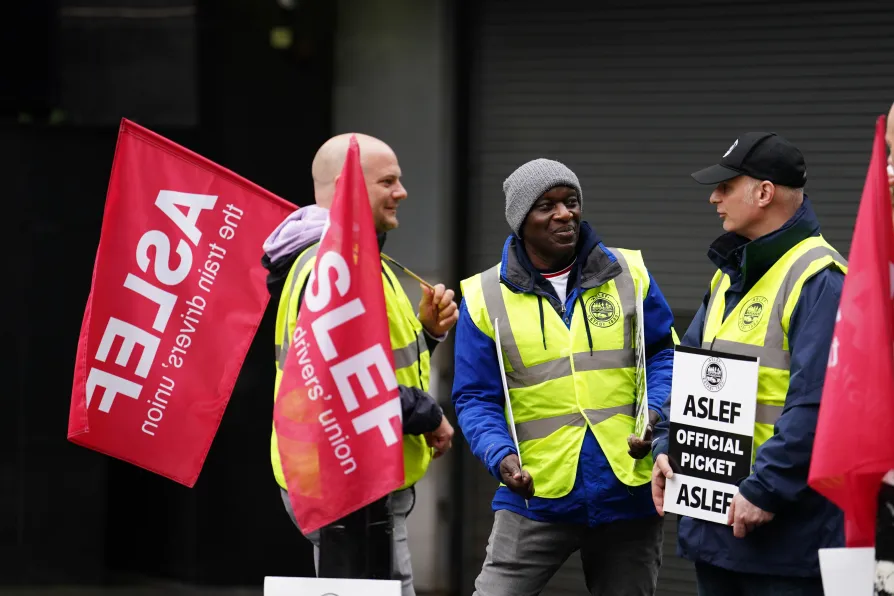 Train drivers from the Aslef union on the picket line at Euston station in London, April 5, 2024

Welsh wanderings showcase fiery destruction, alternative water ways and revive memories of a local mining legend, writes MARK SEDDON
As thousands die in the eastern DRC, a global health emergency is being starved of funds, says S KRISHNASWAMY
MAT COWARD explains how in the 17th century a row over whether to kneel at communion became a battle over religion, class and royal power
Renewed illusions in social democratic reformism are sprouting as a result of Andy Burnham’s rhetoric, but material conditions are already intruding into the debate, argues NICK WRIGHT
Andy Burnham could learn a few lessons from a previous Labour government in the pre-privatisation era on how to tackle water shortages, writes KEITH FLETT





DAVE CALFE has a spring in his step: the new Aslef general secretary heads a union that has been clocking up wins.
Some, like reducing the age at which you can start training to be a train driver from 20 to 18 — something the train drivers’ union has campaigned for for years — are essential for the sector’s future.
The Tories saw the future of the railway as one of managed decline, and 40 per cent of current drivers are due for retirement in the next five years. Besides a lack of interest from government, the logic of privatisation hit recruitment.
“Under privatisation, the model often relied on low headcount and high overtime, to maximise franchise returns. It’s cheaper to rely on overtime than to employ the full complement of drivers — but that creates instability.” Tied to short-term contracts, ensuring the sustainability of the railway over 20 or 30 years was not on their radar.
A lot of young people make important career decisions on leaving school, and Aslef has long argued allowing people to start training at 18 will increase overall recruitment and also demographic diversity, in what remains a disproportionately white and male union.
The training itself will not change in what remains one of the most testing occupations, a far cry from media stereotypes in which train drivers are dismissed as earning outsized wages for pushing buttons.
“When I joined British Rail [in 1985], you sat a simple maths and English paper, did a basic mechanics test, had an interview and a medical and that was it.
“Today there’s psychometric testing and a far more detailed process. Although the minimum age is being reduced, the level of competence required is exactly the same.
“Rules first, then traction in the classroom, followed by 225 hours on the road with an instructor… training lasts 12-18 months.
“It’s not just turning up to work and going home. There’s constant revision and study. The amount of knowledge drivers must retain and recall is substantial. Route knowledge and traction knowledge are critical. If you’re travelling at 125mph in fog, you need to know exactly where you are.”
The idea driving a train is an easy job suits well-heeled politicians and media magnates keen to discredit one of the last sectors of the economy where unions and unionised jobs, terms and conditions still dominate — but another recent Aslef victory shows it’s an illusion.
The union’s dignity for drivers campaign concerned toilet access — an unglamorous but essential requirement for workers’ dignity and health, which crops up across the transport sector (and in other contexts, given the withdrawal of most public toilet facilities over recent decades by cash-starved councils).
When Richard Hines, director of railway safety and chief inspector of railways, signed up to Aslef’s demand that every train and freight operating company provide proper toilets Calfe welcomed a decision meant “train drivers will — finally — have access to toilets at work and will no longer have to go more than four hours on duty before they have access to a toilet.”
The reality of life for drivers is one he stresses: “If your train arrives at 7.55am, your driver may have got up at 3.30am, travelled to the depot, prepared the train, brought it into service.
“The following week they might be working nights. Many don’t know their shifts for the following week until the Wednesday before.”
Calfe knows what he’s talking about — having been a train driver himself until December 12, when he drove his last train, the 8.47 from Birmingham New Street arriving at London Euston at 10.06. The train was met by applauding rail workers, including some he’d first met when starting on the railway four decades before.
He confesses to getting emotional about that. He’s upbeat, though, about the industry.
Labour are bringing rail back into public ownership; new stations and routes are being built in Labour-run Wales, though he wants “similar ambition for England”; a recruitment drive is taking place that convinces him this government at least thinks the industry has a future.
That recruitment, and increased capacity, are essential if Britain is to echo policies rolled out by France, Germany or Spain in subsidising unlimited monthly travel tickets to win people away from road transport, he believes. Living in Sheffield, he points to the slow journey times even to fairly close cities like Leeds and Manchester, and the scarcity of trains to smaller towns on branch lines.
When I ask if Labour lacks the “big vision” politics to revive a railway treated since Beeching as the poor relation of road, he demurs.
“The government’s plan for Great British Railways is promising. The railway should be run by rail experts, not micromanaged by the Department for Transport. For 30 years, rail has been run by contract, often prioritising shareholders over passengers and staff.
“A 30-year strategic plan is sensible. Rail has been heavily politicised since privatisation. HS2 is an example of how shifting political decisions can distort long-term planning.” The project was altered so many times between conception and delivery that it bore no resemblance to the original plan.
Calfe returns again and again to the evils privatisation has inflicted on the industry. The different rolling stock hired by different operators is an example: it’s hard to shift capacity from one service to another, to respond to changing circumstances or plan at all. The failure to bring rolling stock back in-house irks him, and he stresses the need for a fully nationalised railway.
On rail, Labour are moving in the right direction: “If government allows the railway to implement a long-term strategy without constant interference, it can benefit passengers and freight customers alike.”
But long-term strategies are optimistic in today’s Britain, where landslide majorities evaporate in a term and polls currently suggest Labour could fall at the next election to the anti-union, climate-denying Thatcherites of Reform.
Calfe is not blind to the danger, and joined other union leaders and left MPs in demanding a change of culture in Labour in an open letter last weekend, calling on it to stop the witch hunts and start listening to unions whose members understand the need for radical change.
He doesn’t see British politics as lurching to the right — “everyone talks about Reform, who’s talking about the Greens?” — but stresses that Labour have three years to make a difference to workers’ lives and had better use them.
The Associated Society of Locomotive Engineers and Firemen, established in 1880, was a founding member of the Labour Party. Calfe is clear that that relationship is not about to change: but some things at Downing Street need to if Labour is to convince people politics isn’t an insiders’ game.
He’s not about to walk away, though. “Our job is to keep delivering for members … and to stay engaged with industry and government. That’s how you deliver.”
