


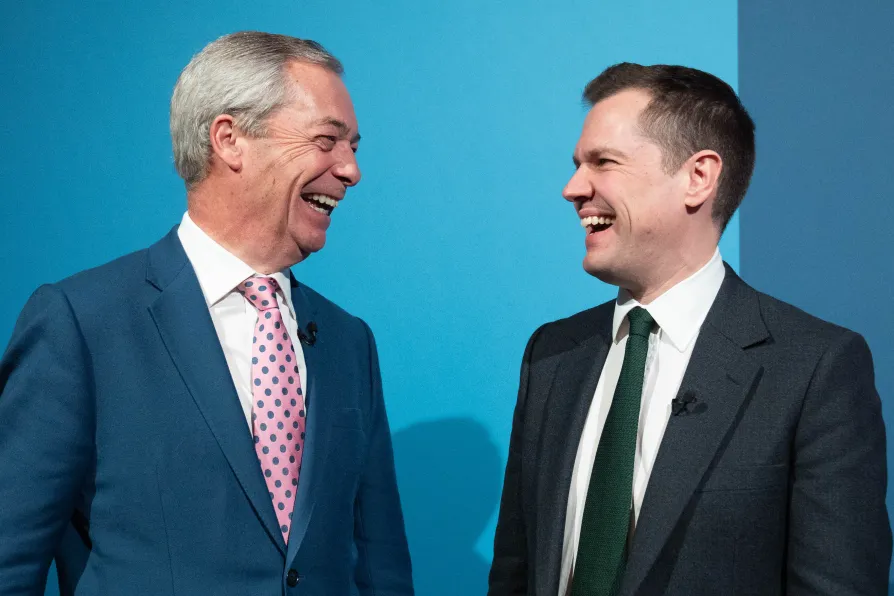
 Robert Jenrick making his first speech as Reform UK's Treasury spokesman at the LCW Plaisterers' Hall in the City Of London, February 18, 2026






ROBERT JENRICK’S confirmation that Reform UK will uphold the economic orthodoxy of Labour and Tory governments over the past several decades is a weakness we should seize on.
It is a confession that Reform, despite the branding, is not really about reform at all: it is a party committed to rule by the bond markets and the rich, to the market ideology of Margaret Thatcher that wrecked productive industry across Britain and depressed so many of the regions it now appeals to for votes.
Yes, most socialists are already aware that Nigel Farage is a dyed-in-the-wool Thatcherite, a former City trader and millionaire hostile to public ownership, economic planning and the welfare state. Yes, Farage himself began his political career in the Tory Party and so did almost all his Reform colleagues.
But the stampede of big Tory names to Reform make it easier to expose the party as one of continuity with the same political elite whose policies and conduct provoke near universal public disgust: the very disgust that feeds support for supposed “insurgent” parties like Reform itself.
It is one thing to point to the Tory past of figures always marginal to Britain’s “natural party of government” like Lee Anderson. It is another when Reform’s front bench begins to look and sound like the front bench of the Conservative government voters overwhelmingly rejected less than two years ago.
Jenrick, like Suella Braverman, is a familiar Tory minister in public memory. Indeed he is a minister mainly known for cruelty and sleaze.
Cruelty in ordering images of cartoon characters at a centre for unaccompanied child refugees to be painted over, since they might make these likely scared and vulnerable children feel unnecessarily welcome in Britain. Sleaze in fast-tracking approval of a housing development and saving porn and press baron Richard Desmond tens of millions in tax as a result, shortly before “Dirty Des” donated £12,000 to the Conservative Party.
At a time the Epstein files have exposed the power of abusive men linked by networking, back-scratching and greed, these cosy mutually beneficial deals done at public expense are hardly a good look.
And Reform’s function in recycling failed politicians whose former party is too unpopular to get them re-elected will entrench the sense that “they’re all in it together.”
The message that Reform are recycled Tories is an obvious attack line: even Keir Starmer’s Labour has grasped it, as have the Liberal Democrats and Scottish National Party.
But it’s weakened by the shared economic consensus that grips all three. Saying “Reform will just uphold the status quo” isn’t a knockout blow if that’s what you’re doing as well.
So the left should take issue with Jenrick’s pledges: to maintain the independence of the Bank of England and to keep the Office for Budget Responsibility (OBR) in place.
The OBR is an invention of George Osborne designed to give bankers and their tame economists a veto over fiscal policy, so an ideological opposition to public spending can be disguised as neutral advice from disinterested professionals.
Independence for the Bank of England removes monetary policy from the elected government’s control.
Together, these commitments hugely restrict the ability of any elected government to act differently from its predecessors: they ensure the bond markets, not the British people, call the shots.
The left must take the fight to the banks: build popular understanding that the policies that suit the City of London are the same that have impoverished working-class people and hollowed out public services for nearly 50 years.
The City’s seal of approval should be the kiss of death for any movement promising change. Let’s ensure that’s the case for the turquoise Tories of Reform.
