


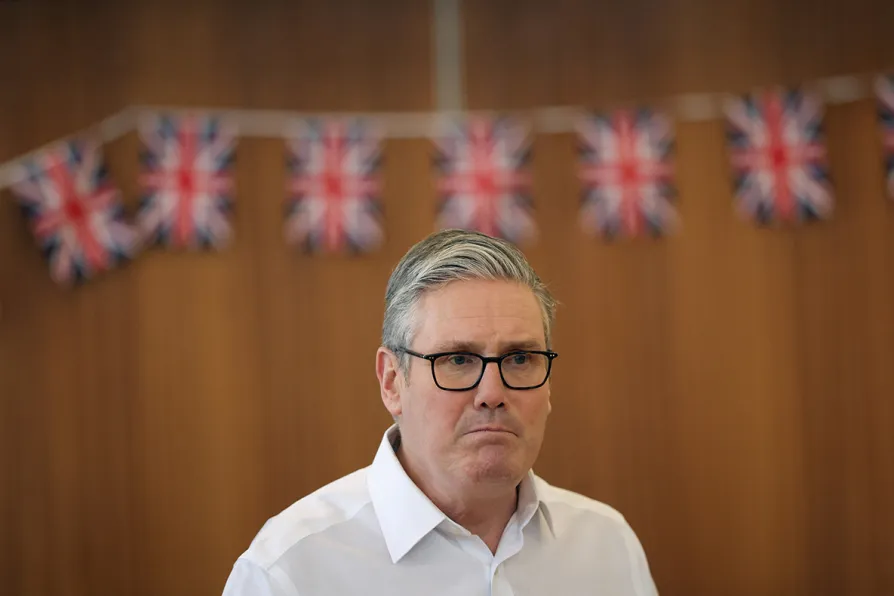
 Prime Minister Sir Keir Starmer during a visit to a community centre in Hertfordshire, February 10, 2026






AS THE Westminster political crisis unfolds, the hopes and fears of the capitalist class were spelt out plainly in two separate articles in The Telegraph, appearing on the same day this week.
The first was headlined “Why bond markets may be Starmer’s closest friend.” The Prime Minister has indeed run out of others.
The article’s argument was simple. The international money markets will rally to try to save Britain’s useless premier.
The omnipotent markets threw a wobbly when Rachel Reeves burst into tears at Prime Minister’s Questions last year, and they grow visibly restless every time Manchester Mayor Andy Burnham raises an eyebrow or another Downing Street functionary is carried out of No 10 feet first.
And, of course, they went into meltdown when Tory Party members imposed the apparently deranged Liz Truss on the country as premier and, together with chancellor Kwasi Kwarteng, started to drive a coach-and-horses through their idea of fiscal probity.
And when the money markets take fright they can rapidly increase the cost of borrowing, which is more than enough to terrify most leaders, no matter how large their mandate from the people.
What are they afraid of today? As per the Telegraph that “Sir Keir’s exit might invite political chaos, a power vacuum, left-wing fiscal profligacy or all of the above.”
In short, they fret that the government might shift towards the interests of working people. They are relying on the spectre of market chaos to exorcise that spectre.
Burnham, blocked from seeking re-election to Parliament and thus from entering any leadership race for the present in an exercise of brute authoritarianism which would now likely be beyond the diminished Starmer, has sought to call time on this logic.
He said this week that “the decisions of politicians from the 1980s onwards have left us in hock” to those bond markets, “with little headroom and room for manoeuvre.
“The time has come to call an end to this era in British politics, when politicians got too close to wealth, too seduced by the notion that deregulated markets would provide the solution when in fact they have been the problem for those on the lowest incomes,” he pointed out.
Those views are surely shared by millions. It is the unwillingness of successive government to challenge the power of international capital — indeed, it would be nearer the truth to say their active support for that power — which lies at the heart of our political malaise and the opening it has given to the frauds of the far right.
But Labour now perhaps has the faintest glimmer of an opening to go in an alternative direction. The obstacles in the way remain formidable, and the forces pushing for such an alternative still too incoherent and disorganised to readily overcome them.
Yet they should take encouragement from the second Telegraph article, by political commentator James Kirkup, again adequately summarised in its headline: “A populist left-wing Labour Party could be surprisingly popular.”
While intoning that being “spendthrift” has historically been Labour’s downfall, Kirkup warns that “for a striking number of voters, rejecting such economic orthodoxy would still appear attractive.” Indeed, the results of adherence to economic orthodoxy can be seen in the ruination all around us, in every sphere of society.
He cites polling indicating that 40 per cent of voters believe the economic system is broken and needs to be replaced entirely, while another 40 per cent see the need for significant reform. Only 2 per cent think it is working well.
There is the new emerging majority. The Labour left now needs to speak for it, and act boldly.
