


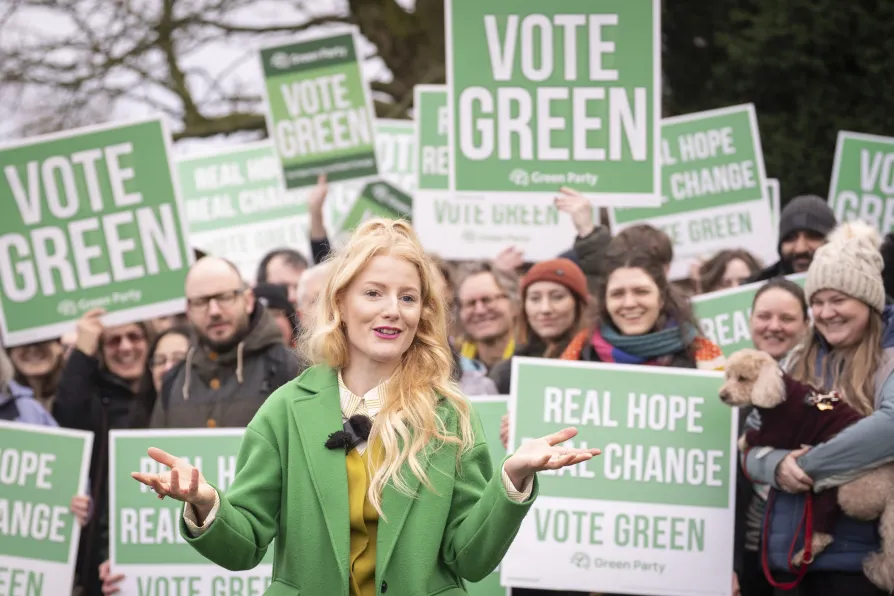
 Green Party Gorton and Denton by-election candidate Hannah Spencer speaking to Green Party volunteers at Granada Park in Denton, February 7, 2026






EVERY election in Britain is now held in the shadow of twin imperatives – blocking the advance of Reform UK towards government and shifting the Labour government to a focus on working people’s interests and priorities.
The two tasks are intimately connected. Only a new course by the government can offer an immediate alternative to the insurgent far right. The Starmer strategy of appeasing Reform by aping its prejudices has manifestly failed and is now played out.
The cabinet, including the “soft left,” fumbled the chance to make a fresh start last week when they gave the Prime Minister a stay of execution. They appear to be hoping, despite an absolute deficiency of evidence, for a new course from Starmer.
This vacillation only encourages the advance of Nigel Farage and his acolytes. So where Westminster has failed, the voters must step in.
Today that means above all the voters of Gorton and Denton in Manchester, who go to the polls to elect a new MP in a by-election next week.
Labour has done its best to hand the seat over to Reform. At Starmer’s bidding, the party blocked the candidate with the best chance of holding it for the party, Greater Manchester Mayor Andy Burnham.
Instead, working-class voters are invited to back Angeliki Stogia, a corporate lobbyist and champion of the privatisation of public services. It is a choice that speaks volumes about Labour’s priorities and principles.
As the Communist Party has noted “a Labour vote in this by-election is a vote for continuing outsourcing, privatisation and corruption.”
It is through such undemocratic decisions that the door is opened to Reform. An emboldened Farage is standing probably his most brazenly right-wing candidate yet, former academic Matthew Goodwin, whose stock-in-trade is attacking Muslims, who constitute nearly a third of the electorate in the constituency.
A victory for Goodwin would be a landmark in the advance of the far right and the legitimisation of racism.
The only other candidate with a serious prospect of winning is the Green Party’s Hannah Spencer. Many voters will doubtless decide to back whichever candidate appears best placed to see off Goodwin.
That candidate will likely be Spencer. The Green Party’s robust stance in opposition to the genocide in Gaza will commend itself to all progressive voters and Muslims in particular.
The Greens are also building a strong base among urban working-class voters, especially the young, who backed Labour under Jeremy Corbyn but have since become comprehensively alienated.
Spencer, known locally for her campaigning to take the water industry back into public ownership, has already secured the support of Your Party and of George Galloway’s Workers Party, which had its own strong potential candidate for the seat.
There are reservations about the national programme of the Greens. Their ambivalence over the European Union and Nato speaks to a confusion on international politics when the urgent need is for anti-imperialist clarity.
However, no united front has ever been built on a complete pre-existing unity of views. It involves tactical decisions in each given situation, within the overall context of building a fighting front against austerity and war.
In Gorton and Denton, that must mean a vote for the Green Party’s candidate Hannah Spencer. Her victory would constitute a major rebuff to Farage and the Reform Party racists and send the most powerful message to the Labour government that it must move to the left if it is to survive.
It may also galvanise the unions and left MPs to start tuning words into deeds and acting to give the government the new leadership which is the prerequisite for winning back working-class support.
