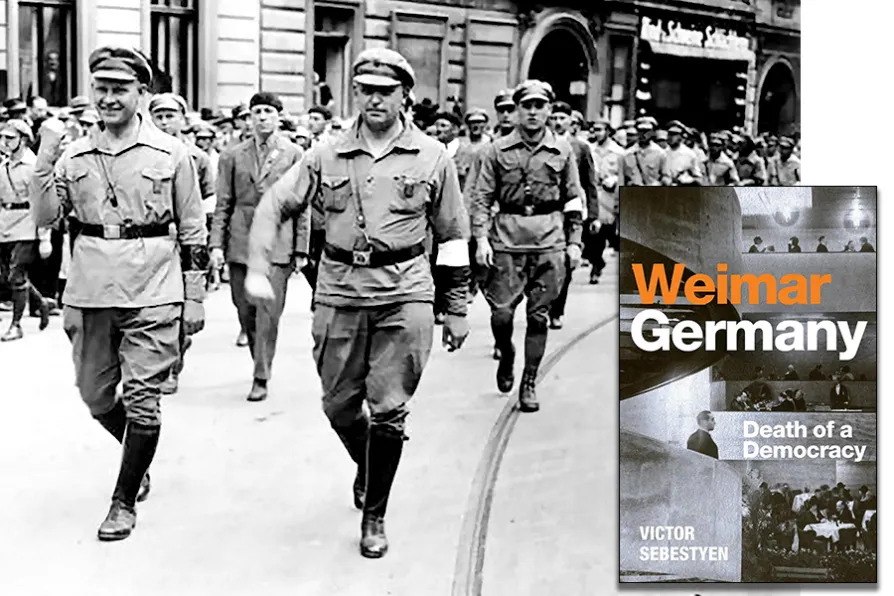
GORDON PARSONS recommends an entertaining account of the years between Germany’s defeat in WWI and Hitler’s seizure of power


 Latest editorial

The Birds, by Lee Garratt
The economy collapses and London is abandoned by the wealthy. Determined to survive, a working-class woman struggles with scarcity and dejection
 Illustration by Lewis Marsden
MIGUEL YOSHIDA explains the evolution and influence of the Cuban Casa De Las Americas in joining culture to the revolutionary struggle
ANDY HEDGECOCK is charmed by a skilful adaptation of Tove Jansson’s lyrical portrait of three generations of a family, overcoming grief
ALEX HALL treads warily through a messy, dialectical struggle fought in the mundane machinery of driving licences, criminal law, and birth registries
MICHAL BONCZA, FIONA O’CONNOR, JAMES WALSH and ANGUS REID review Atlas of Disappearance, Love Me Tender, Bouchra, and This Tempting Madness
Flitting between myth and the modern world, Medusa is determined to steer clear of human affairs. When her resolve crumbles, the result is petrifying in every sense





THERE used to be more people like Rob. People who, even when they did what they were told, kept something apart; in their smile, their walk. He used to whistle. Like a lot of what has happened, it is hard to say when that stopped.
Don’t get me wrong, I’m luckier than many. I did well at school and was heading to university till they were all closed down. But my job at the council is, as they say, “a good one.” Still, twelve-hour shifts, six days a week, by the time I get home I make my dinner as quickly as I can with my allocation of electricity, then I’m usually thinking of bed.
Winter is the worst. The streets are dangerous of course, especially for women like me, but at least in summer you can sit outside for a while. Listen to the birds that still sing. But the winters… They are warmer we are told, but 4 degrees under a blanket in the dark doesn’t feel a lot better than 3.
I observed Rob weeks before I ever talked to him. He had appeared on my street in Bermondsey one day in his van. In the old days, even a few years ago, he wouldn’t have been allowed to be sat there for so long, but now there seemed no-one left to care. He had one of those VW combi vans you used to see a lot.
In the early days, when the Crash was still referred to as austerity, lots of people, no longer able to afford property had moved to alternative ways of life. Canal barges, caravans, van life, they had all seemed the solution for a while. So, it was good to see him, a survivor of sorts and, at my curtains, I thrilled voyeuristically at the audacity of him. On my walk to work I heard him sometimes clattering around inside the van, but our paths never seemed to cross.
Looking back, I am amazed I did what I did. It was a lovely summer’s evening, perhaps that was part of it. Birds had been singing on the quiet streets all the way home – that was one of the few things I actually liked about the Crash. I had never noticed bird song before in the old days of cars and people and buses. Now, when you heard their clamour, that seemed hard to believe.
Still, the streets held other things than birds, so it was with a sigh of relief that I turned onto my road. And there he was, stood with the back of his van door open, organising things. I dawdled to observe, and he must have noticed me. We talked. I can’t remember now what exactly, but when I eventually closed the door to my flat, face flushed, heart beating, I realised he had told me he was going tomorrow into the countryside on a “supply run,” and would I like to come, and that I had said yes!
So, the next day as the sun broke, I found myself driving out through south-east London, further than anywhere I had been since my parents had died. Burnt-out cars littered the road. At New Cross they had been piled up to block the road meaning a diversion through a nearby estate where a few thrown stones clattered against the side of the van, but Rob seemed nonchalant.
We headed to a spot he knew. It was an old quarry outside of Maidstone. I suppose in the old days it wouldn’t have seemed special but to me it was paradise. The birds sang and all the wildflowers were out. He had brought a picnic which we ate on the grass meadow that had grown up around. And yes, we made love. It was all like a dream to me. I had forgot the world could be so beautiful.
Afterwards we turned off down a track stopping at a tumbledown farm, out of sight from the main road. An old man came out with a container of fuel — homemade, Rob told me — and that answered one of the questions I had. Most days there were power cuts so having electricity at all increasingly felt like a luxury no matter the price.
It felt like everything had broken down but maybe there was a root cause still?
Image
It was hard to know as there was little media left. There were still some stations, but they were increasingly restricted to one man on doom laden rants in a badly lit studio. Some of these talked about one final push in the east and Russia would be beaten. But others talked of China. Still others said they were winning. And how, actually, the West was losing. Still other rumours said neither of those wars mattered anymore there was something happening in Africa that was more important. One never heard of America anymore.
The internet too barely worked. It was slow to log on. Older people compared it to its earlier primitive days. And what content survived was broken and barely functional. Some porn still of course. That would be the last to go.
I didn’t see any money exchange. Rob said it was mostly useless anyway. He said he did jobs for the old man. When I asked what, he just smiled.
The next day I wasn’t going to go to work but Rob insisted. For “appearances” he said. And for a whole week life was like a dream. The sun shone as we spent our mornings lying together in each other’s arms. Like the films I remember watching as a teenager. He told me more of his life. He was part of a loose grouping he said. People who got together and shared ideas. He said it didn’t deserve the name “resistance” but that was what it was trying to be.
The next to last time I saw him I was hurrying home when, as I turned into our street, I saw him stood by his new van with a small group in a uniform I had never seen before. I looked down as I walked past and could feel Rob’s eyes on me, but he never said anything. Nor did I.
It had all been so sudden that my memories of Rob quickly seemed unreal. I wondered sometimes if I was mad. I had more time to wonder now.
One day at work we had received an email that informed us, in a desultory aside, that our shifts had changed with immediate effect because of ongoing “costs.” We were now working eight-hour days just four days a week. With less managers and more time — there was very little “work” to do anymore — we spent much of our days chatting, still furtively, but more and more open. Everyone said something different. Militias. Wars. Governments. It was all so confusing.
The last time I saw Rob, Summer had passed. Days of stifling humidity suddenly broke with the largest thunderstorm I had ever seen. For hours it rumbled and crashed overhead. Lightning must have struck a building in Peckham as I saw smoke rising. Perhaps the rain put it out — I never heard any fire sirens. Then it was cooler and wet and quickly it seemed autumn was here.
On a damp morning, there was another knock on the door. It was the same group again with Rob between them. His face was bruised, and his jaw was sagging in a strange way. I saw there were some teeth missing. They asked for my identity cards and were interested in my formal documentation from Southwark council. One of them, a woman, whistled between her teeth. “Still working. Not many of those.” This seemed to count in my favour and their aggression lessened.
“Do you know this man” one of them said. “He said he had stayed here.”
I looked at Rob. He didn’t seem present anymore. Somewhere else.
“I’ve seen him yes. He’s been on the street. Where you found him.”
“But he had never stayed here?”
I shook my head vigorously. “No,” I said. “Oh no.”
They came in and did a desultory search of sorts but of course they didn’t find anything. I had gathered up all of Rob’s belongings — his tattered old clothes, his books, his stained mug — in a bag and dropped it in the Thames the day before.
They soon left, Rob walking limply between them, and drove away.
And that was that. I don’t think I really had any choice. What he was doing was, of course, impossible and, I thought that night after the trip, he was putting me at risk too. I only have my work after all. Informing on him was easier than I thought. I mentioned him one day to one of the few bosses who still appeared. He was always hanging around my desk, but things hadn’t got that bad yet.
My days go on much as before. Sandra told me something interesting today though. She is the oldest person left in the office. The rich people, she said, they were the same as ever. Or nearly. Gated communities in the countryside. Plenty of food. Warmth. Austerity, she told me, was what all this had been called when it first started. “I knew it was a lie though. As soon as they said we were all in it together that’s when I knew.”
Life goes on. But I don’t seem to hear the birds sing any more.
Lee Garratt is a teacher living in Belper, Derbyshire. His most well-known book is Labour, the anti-semitism crisis and the destroying of an MP, his account of the events that unfolded concerning former Labour MP, Chris Williamson.
Stories, of up to 1,600 words, should be submitted to: Morningstarshortstories@gmail.com
