
PETER MASON applauds the revival, 39 years later with the same team and cast, of Manfred Karge’s version of Brecht’s 100-year-old play, Mann Ist Mann

A generous assessment of Gordon Brown
PAUL DONOVAN enjoys a somewhat rose-tinted survey of Brown’s achievements and legacy, as well as his moments of political cowardice
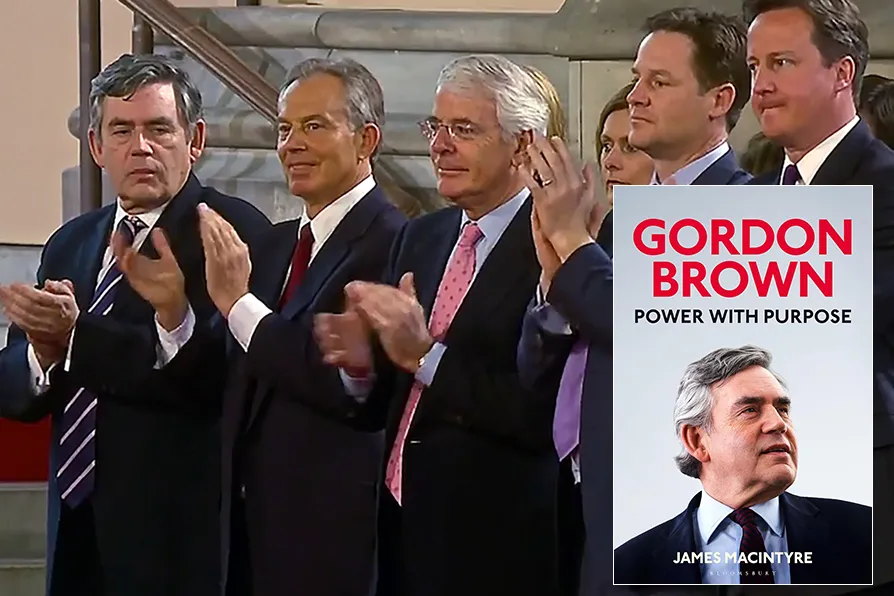
 IF LOOKS COULD KILL: Former British Prime Ministers Gordon Brown, Tony Blair, Sir John Major, Deputy Prime Minister Nick Clegg and David Cameron during Barack Obama's address to Parliament, June 2011 [Pic: White House/CC]

New releases from Biita Houdei, The Mary Wallopers, and The Tubs
New releases from Biita Houdei, The Mary Wallopers, and The Tubs
MAYER WAKEFIELD applauds a fearless attempt to bring to the stage the 1984 toxic gas disaster in Bhopal, India
ALEX HALL applauds the account of a dogged, traumatic and punishing campaign for justice that has lasted from 1998 to the present day
NICK WRIGHT laments the political bias of an epic attempt to tell the history of the liberation of France from the Nazis, that excludes both the decisive contribution of the Soviet Red Army, and of the French communist party itself





Gordon Brown - power with purpose
James MacIntyre, Bloomsbury, £25
WITH this book, James MacIntyre presents a comprehensive and complimentary assessment of the life and works of former prime minister Gordon Brown.
MacIntyre visits all of the usual landmarks of Brown’s life: the son of a Church of Scotland minister, emerging from the industrially run-down area of Fife in Scotland; the new Labour reforming agenda shaped by himself and Tony Blair; and the subsequent combustible relationship between the two men.
It was a close relationship at the start that drifted further and further apart in government, as Brown seemed increasingly to think he could not trust Blair.
The question of the leadership always rankled. Brown believed the deal to be that when he stood aside in 1994 for Blair to become leader, the latter would do likewise 10 years later in 2004.
The two men seem cordial today, although there is a great difference in their legacies. Brown has given much time, since quitting government, to charitable works, campaigning to eradicate child poverty and taking on the Murdoch press, while Blair seems to have focused on making money, from what have often appeared to be not very reputable sources.
This is a very favourable account of Brown, with much direct quotation from the man himself. No mention is made of things like the control-freak tendency that made sure he swept up enough MP nominations in 2007 to ensure that John McDonnell could not stand against him in a leadership contest.
That said, Brown’s achievements are substantial: almost halving child poverty, reducing pensioner poverty and the redistribution of wealth. Indeed, MacIntyre believes Brown the most redistributive chancellor since 1945. There were also his “save the world” actions during the financial crisis of 2007/8, the cancellation of debt for poorer nations, and his later efforts to achieve a “No” vote in the Scottish independence referendum.
There are some interesting insights, such as that among Brown’s close friends are Piers Morgan and Rowan Williams. Intriguingly, former Daily Mail editor Paul Dacre is also a close confidante.
On the Iraq war, MacIntyre reveals Brown to have been opposed but choosing not to come forward at the time. He even suggests that had Brown joined Robin Cook and Claire Short in resigning, Britain would probably not have gone to war.
So, yes, this is a comprehensive and very favourable account of Gordon Brown and his legacy. Something that has gained weight over the subsequent years.
During 13 years of Labour government,(1997-2010), there was 1.42 per cent GDP growth (the best among the G7 major industrialised nations), a 3 million rise in employment, the creation of Sure Start, the minimum wage and large amounts invested in public services like the NHS. Since then, there has been austerity, a botched Brexit and Covid — all of which has made the country poorer — and the poorest worse off still — as the shift of wealth to the rich has increased grotesquely.
No-one would say the years overseen by Brown and Blair were perfect but they look increasingly impressive, given what followed, right up to the present Labour government.
So a good read, that provides a decent perspective, if overly generous in places.
