TUC president and POA leader STEVE GILLAN speaks to Ben Chacko on the eve of Congress 2026


 Latest editorial
Mao, the peasants and the question of proletarian leadership
In the third of a series of articles, Storming the Heavens author JENNY CLEGG introduces the key themes of her book on the Chinese revolution
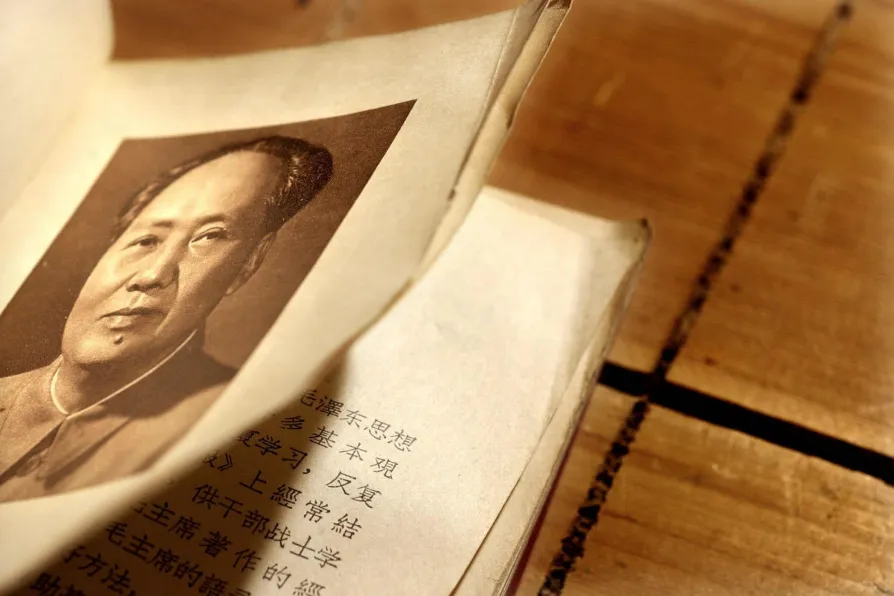 A rare first edition copy of Chairman Mao Tse-tung's ‘Little Red Book’ lies on a table at Bonhams auction house in central London

DOUG NICHOLLS welcomes a turning point at this year’s Congress, where many motions call for a co-ordinated plan to revive British industry, a perspective outlined in his new book
HOPE VIRGO of campaign Dump the Scales warns MPs voting today they should be alert to the threat legalised assisted death poses to people with eating disorders
The Together Alliance is hosting two summits, North and South, to build power and plan action against the scourge of racism peddled by the right. DANIEL KEBEDE urges mass participation
The drift toward militarisation in Europe is not inevitable, left-wing and peace movements can preserve sovereignty and prevent war, says DÁIRE HUGHES MP
Whatever differences exist among international sympathisers of the Bolivarian revolution about its current trajectory, they should unite against the imperialist power that is the source of an enforced retreat, argues ROGER D HARRIS
Trade unions need to step up and force a turn in the policies of the labour movement to effectively confront the far-right threat, argues NICK WRIGHT





DEBATES on the role of peasants in revolution can be traced back to the disagreements between Lenin and the populist neonarodniks. The question was whether the “middle peasants” were a class in disintegration, differentiating into a rural bourgeoisie and proletariat or a revolutionary force in their own right opposing the predations of both tsarism and capitalism.
Lenin saw the peasants as a whole as a force against landlordism but with the bourgeoisie and proletariat struggling for leadership of the movement. The role of the vanguard proletarian party was then to mobilise the poor peasants so as to pave the way to socialism. For the neonarodniks on the other hand it was the traditional village organisation, the mir, that provided the basis for a Russian-style socialism.
In China, the question of how to build a Communist Party in a country predominantly of peasants with a weak working-class base, is clearly a challenging one to answer. Was Mao just a peasant leader, and the CPC a populist party which rode to power on a wave of peasant unrest, as many in the West, both Sinologists and Marxists, have argued? Did the CPC impose its own ideas, methods and personnel from the outside into the peasants’ struggles? How were traditional rural protests transformed into modern revolution and peasant consciousness raised?
From the view of the urban-based nationalists and communists in the 1920s, the peasants were “clodhoppers” — a passive bastion of the Confucian state but also prone to wild excesses as in the Boxer Rebellion of 1899-1901. But Mao, following Lenin, was to argue in his early Analysis of Classes in Chinese Society (1926) that the peasants were the largest ally of the proletariat.
Observing the peasants organising in Hunan just months later, he was the first to grasp the significance of peasant power: although at first their demands for rent reductions were not that radical, he saw, as they paraded the landlords up and down in dunces’ caps, a bold challenge to the authority of landlord power.
China had a long history of peasant rebellions which tended to end in failure. The Taiping Rebellion (1850-64) for example spread over 17 provinces, but lacking a coherent programme beyond general calls for equal distribution of wealth, collapsed through internal disunity and leadership betrayal. Left to their own devices, peasant-based politics was bound to fail again: a different kind of leadership was needed.
When, after their 1927 defeat, the CPC retreated to the mountains in the south, the Comintern advised that to exercise proletarian leadership over the peasant movement, it should organise poor peasant leagues and co-ordinate simultaneous uprisings in the cities and the surrounding countryside. But this again failed disastrously.
Mao, struggling against workerist tendencies in the CPC, maintained that despite the 1927 defeat, the revolution was actually continuing independently of the workers’ movement, in the ongoing peasant struggles against the landlords for land. Grasping the key elements of peasant power and a Red Army, he found the way out of defeat through a strategy of protracted people’s war, with the countryside surrounding the cities bit by bit.
However, the fact was that the objective contradiction between landlord and peasant was not expressed directly in class struggle. The implementation of land reform was complicated on the one hand by the influence of traditional Confucian benevolence with landlord patronage embedded in kinship hierarchies and on the other by divisions among the peasants.
Peasant competition in conditions of scarcity under the overall constraints of monopoly rent, created divisions with some communities restricting access to land, adopting strategies of closure against outsiders, leading others to resort to predatory banditry for survival. Peasant protest was also deeply influenced by traditions of egalitarianism: the Taiping believed that “the land is for all to till, the food for all to eat, the clothes for all to wear, and money for all to spend” — their land system prescribed each household to keep five chickens and two mulberry trees.
As the CPC experimented with different systems of land reform, Mao began to reflect on his observations of village politics. In a rural upsurge, he noted, tendencies were unleashed to target not just the landlords but all surplus lands, causing the middle peasants to waver whilst the rich peasants were driven to the landlords’ side. These divisions left the poor peasants isolated as struggles ebbed, and the village landlords sought to restore their position using the influence of kinship ties and patronage.
Mao drew two conclusions from this: that the strength of the poor peasants lay not in their separate organisation — the poor peasant leagues — but in their ability to unite with the middle peasants who stood to gain from the redistribution of feudal holdings; and second, that the rich peasants had dual characteristics — although they had interests in using their capital to develop production, unlike the Russian kulak class, they also sought to gain in part from feudal exploitation.
Mao’s 1933 work How to Differentiate the Classes in the Rural Areas provides a systematic analysis of rural classes according to sources of wealth and conditions of production and livelihood. Integrating Marxist principles with China’s specific realities, it sets out clearly the different ways in which rural classes got rich: from own labour, from the implementation of means of production, that is capitalist exploitation, and from feudal forms of exploitation, namely rent and interest on debt.
Transcending simplistic traditional understandings of wealth, this enabled the CPC to exercise proletarian leadership, directing the otherwise chaotic peasant struggles towards feudal targets through the implementation of the mass line. This was not simply a populist unleashing peasant spontaneism — or a general “doing everything the masses want” — but a carefully calibrated method of organising the peasants along class lines. Recognising material differences in their production conditions, it looked to build unity between the poor and middle peasants while neutralising the rich peasants, disentangling them from the feudal system by opening new opportunities to develop their capital in line with the democratic goals of the revolution.
The peasants’ own consciousness-raising was dialectically interconnected with the CPC’s struggle to overcome its own organisational limitations through party rectification. Operating amid complex personalised village politics, the CPC was susceptible to landlord infiltration, but there were also tendencies to reproduce patterns of elitism and bureaucratism within its ranks, a danger inherent in forming a vanguard.
Some leaders advocated the study of Marxist theory to strengthen revolutionary commitment, but Mao was to advocate novel methods of party-building, evaluating practice through criticism and self-criticism among cadres while also practicing an “open door” policy. By running party rectification in parallel with village mass meetings to decide the redistribution of village land, party and peasant learned together in the process of revolution.
In this way, where past peasant rebellions had failed through disunity and leadership degeneration, the CPC sought to tackle the resilience of feudal power through handling the contradictions among the peasants. Neither populist nor dogmatically Leninist, the CPC, working closely with the peasants to apply the class line, was able to create a strong grassroots mass democratic movement to oust and replace landlord power, opening new ways for the development of the village economy.
Join Jenny Clegg and a range of experts for the book launch of Storming the Heavens at the Marx Memorial Library and online on Saturday February 14, 3-5pm; register at tinyurl.com/StormingHeavens.
Storming the Heavens is available from the Morning Star’s online shop.
