


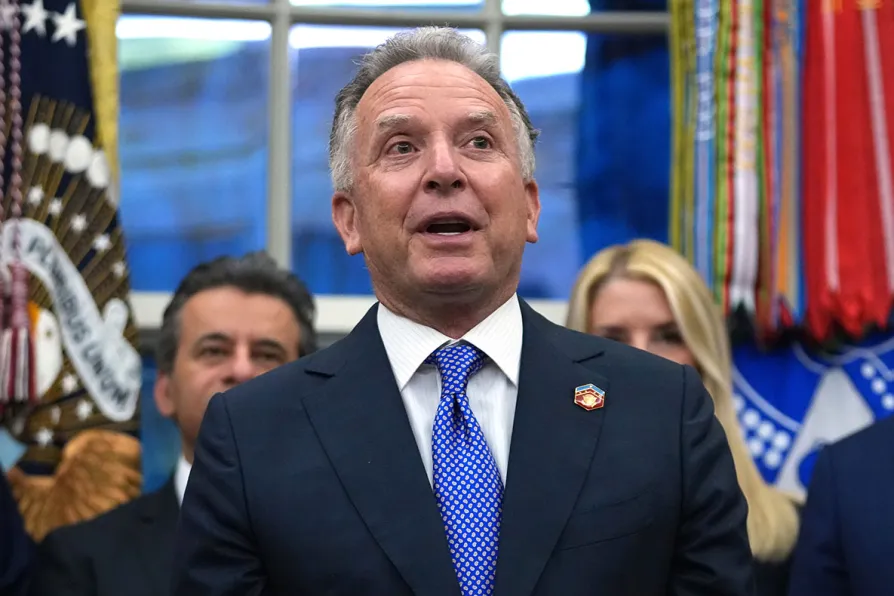
 White House Special Envoy to the Middle East Steve Witkoff speaks at an event in the Oval Office of the White House, January 29, 2026, in Washington





IRAN and the United States held indirect talks in Oman today, seemingly resuming their stalemate over Tehran’s nuclear programme.
For the first time, the US brought its top military commander in the Middle East to the table.
The presence of US Navy Admiral Brad Cooper served as a stark reminder of military tensions, with the USS Abraham Lincoln aircraft carrier positioned off Iran’s coast.
US President Donald Trump has repeatedly threatened to use force to compel a deal, amid threats of military action over Tehran’s bloody crackdown on nationwide protests that has killed thousands and saw tens of thousands of others detained.
The talks also follow renewed friction as, just days earlier, US forces had shot down an Iranian drone near the Lincoln, while Iran attempted to stop a US-flagged ship in the Strait of Hormuz.
“We did note that nuclear talks and the resolution of the main issues must take place in a calm atmosphere, without tension and without threats,” Iranian Foreign Minister Abbas Araghchi said, following the talks.
“The prerequisite for any dialogue is refraining from threats and pressure.
“We stated this point explicitly today as well and we expect it to be observed, so that the possibility of continuing the talks exists.”
The US delegation, led by special envoy Steve Witkoff and Jared Kushner, did not immediately comment on the talks.
Mr Araghchi later signalled the round was over, stating diplomats would return to their capitals for consultations.
He described today’s talks as taking place over multiple rounds and said they were focused primarily on finding a framework for further negotiations.
“We will hold consultations with our capitals regarding the next steps and the results will be conveyed to Oman’s foreign minister,” Mr Araghchi said.
“The mistrust that has developed is a serious challenge. We must first address this issue and then enter into the next level of negotiations.”
Omani Foreign Minister Badr al-Busaidi, who oversaw multiple rounds of negotiations before Israel launched its 12-day war on Iran in June, described the discussions as “useful to clarify both the Iranian and American thinking.”
He noted, however, that the goal was merely to find a foundation for future negotiations, not to reach a deal.
