ROB WARZYNIAK wades knee deep through a pile of ‘dead canaries’ of Trumpist policies which exacerbated the horrors of US capitalism domestically


 Latest editorial

Unions are battling an all-out assault on working-class education
DR GLYN ROBBINS ties fights at universities and sixth-form colleges to the consequences of the market system that began a generation ago with tuition fees
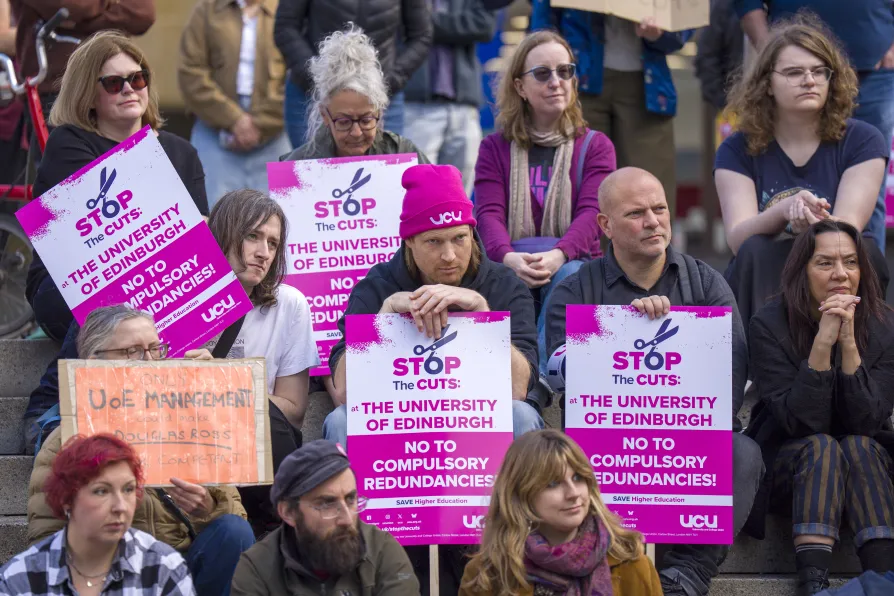 UCU members at Edinburgh University gather for a rally in George Square, Edinburgh, September 8, 2025


Without evidence or Nato consultations Berlin’s answer to the Leipzig incident is a rupture of relations. SEVIM DAGDELEN examines why
FRANCISCO DOMINGUEZ introduces the background to a conference on defending Latin America’s sovereignty
The glacier collapse in Nepal is yet another warning that a warming planet is making Himalayan disasters more frequent and destructive – but the countries facing the greatest risks are often those least responsible, says LI YANG
Nick Blair is set to benefit from a hugely lucrative contract to ‘virtually’ train the British army for its next war. Like father, like son, writes SOLOMON HUGHES
Even when tragedy strikes, Western media cannot resist the opportunity to turn it into a sordid propaganda opportunity, as the Nepal-China border tragedy shows, writes CARLOS MARTINEZ
Trade unions should be at the heart of the anti-racist push for reparations for the historic legacy and continuing impact of slavery, writes ROGER McKENZIE





RECENT months have seen a spate of strikes in further and higher education, and there are more to come. Around the country, workers at colleges and universities are resisting management attacks on pay and conditions. Already, hundreds of jobs have been lost. This is an all-out assault, not just on educators, but on the institutions that educate working-class students.
There have been disputes at BSix in Hackney, City and Islington College, Leicester and Dundee universities and more. Members of the NEU and UCU have fought back, winning some important battles. But the overall picture is an attempt to create a casualised, fractionalised workforce, within an increasingly corporate culture.
An ongoing NEU dispute at Access Creative College brings it all into focus. The sixth-form college in Tower Hamlets is owned by a private equity company Apiary Capital.
The chair of the board of directors is none other than Jo Johnson, brother of disgraced former PM Boris. As well as the London site, Access has a campus in six other cities.
On its website, Access says “our values are brought to life by our staff” and “we believe everyone should be treated equally.”
That’s not how workers at the Tower Hamlets site see it. They have rapidly unionised and declared escalating strike action in response to pitifully poor pay, with some vital support staff on the minimum wage, and serious concerns about basic contractual conditions, including health and safety.
The atmosphere on the vibrant NEU picket lines has been inspirational, generated by a group of young workers new to the union movement, but clear they’re being exploited by corporate greed, dressed up as philanthropy. But the Access dispute is indicative of the wider situation in post-16 education.
Next door to Access, on Commercial Road, is a campus of De Montfort University. Next door to that is a campus of Nottingham Trent University. These are outposts of organisations based 120 miles away!
Talking to some of the staff, it’s clear they are experiencing similar conditions to their neighbours at Access. But this is the franchise model of education that was the inevitable consequence of New Labour introducing tuition fees in 1998. It created a lucrative marketplace, where educational values are sacrificed for profit.
Less than a mile further along Commercial Road is London Metropolitan University. In early January, it announced its intention to make 120 teachers redundant.
It claims to be running out of money, but still pays 19 of its management team between £105,000 and £295,000 a year. Its vice-chancellor is on £341,000, substantially more than the Prime Minister!
While calling itself a “teaching first” university, it’s cutting teaching staff, but spending £20 million a year on building projects of dubious benefit to students. Whole subjects like Sociology are being decimated and the mentoring service that provides essential support to some students is being eliminated.
Like Access, London Met says it’s committed to social justice, but the cuts it’s planning will disproportionately impact people of colour and women.
London Met management blames falling student numbers, particularly from overseas, for its financial trouble. There’s some validity in this and it results from the government pandering to racist sentiment and restricting visas.
However, London Met, like most other universities, particularly the former polytechnics, has built its business plan on the assumption that foreign students, who pay higher fees, will keep coming.
International study is a good thing and should be encouraged. But institutions like London Met have built their reputation on providing education to local working-class communities, often offering vocational courses to people from non-traditional educational backgrounds.
It is a scandal that students paying £9,535 a year, loading themselves with debt that will take decades to pay off, now face courses and services being cut, while their lecturers face unsustainable workloads, or the dole.
But all this is the consequence of an ideology that does not value education, particularly for working-class people.
The intention of successive governments, as with other aspects of public policy, has been to unwind the post-war settlement.
They want a return to a time when education was a privilege, not a right. In one generation, we have gone from university students from working-class backgrounds receiving full grants, to them being saddled with massive debts.
In the process, universities have gone from being places that prioritised learning to places that prioritise profit.
It’s always been important to defend the right to education. But never more so than now.
At a recent UCU protest at London Met University, a student made a moving and profound point about “ignorance growing in the dark” and linking this to the rise of the far right.
As with the NHS and other vital pillars of the welfare state, the whole labour movement must get involved in a fight to resist the privateers, abolish fees and restore free, high-quality education for all.
At a time when we are constantly told Britain is in a “competition” with other nations (a phony, fatuous claim), investing in education is the essence of our “national interest.” As the saying goes, “if you think education is expensive, try ignorance.”
UCU members at London Met are fighting the cuts, For more information, email ucu@londonmet.ac.uk
The UCU and NEU, along with many other unions, are joining the Together alliance national demonstration on March 28, in central London.
Dr Glyn Robbins is a senior lecturer at London Metropolitan University and a UCU member.
