
The US administration is endangering lives by reversing environmental protection laws, CHAUNCEY K ROBINSON argues

In an age of strategic fragmentation, Britain and China should choose co-operation
YUBIN DU explains why Britain and China should be natural partners in a restless world
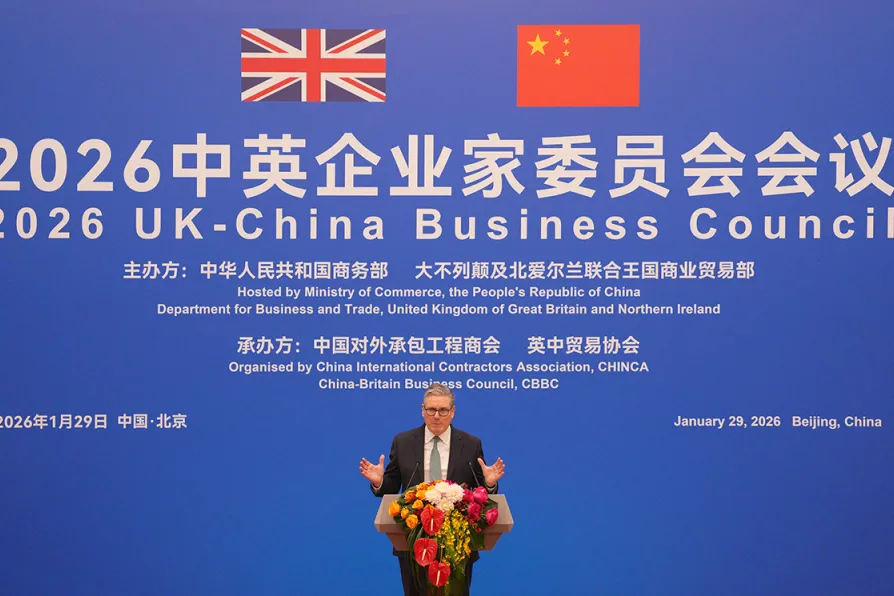
 Prime Minister Sir Keir Starmer speaking during the 2026 UK-China Business Council at the Great Hall of the People in Beijing, during his visit to China, January 29, 2026

It’s time to stop retreating and go on the offensive to promote working-class interests, argues DOUG NICHOLLS
Marco Rubio wants to defeat socialism in Nicaragua, not restore ‘democracy,’ writes JOHN PERRY
Believe it or not, there was a time when the US government built beautiful homes for working‑class Americans to deal with a housing shortage, writes ERAN BEN-JOSEPH
DIANE ABBOTT provides an analysis of the reasons for EU and British voters’ dramatic swing to the right
Train drivers’ union Aslef general secretary DAVE CALFE speaks to Ben Chacko about his hopes that Burnham’s devolution agenda will include the importance of the railway





LAST year, while retracing the footsteps of history as a journalist, I found myself immersed in stories that felt like echoes from a different era, yet remain profoundly relevant today.
I spoke with the descendants of the Lisbon Maru survivors, whose lives were saved by Chinese fishermen; I stood moved by the legacy of George Hogg, the Oxford graduate who dedicated his life to Chinese orphans during the darkest hours of World War II; and I reflected on Eric Liddell, the Scottish Olympic hero who chose to remain in China for relief work, eventually passing away in a Japanese internment camp.
These are not just footnotes; they are the “living sinews” of a relationship built on shared sacrifice. From the forgotten Chinese mariners of Liverpool to the intergenerational gratitude of British families, these stories remind us that even in an age of geopolitical turbulence, the bond between our peoples has always been defined by mutual support.
Today, we find ourselves in an Age of Strategic Fragmentation. As the United States increasingly pivots toward “willful unilateralism” and protectionist isolation, the global order is being pulled apart.
In this volatile landscape, the rationale for a pragmatic, deep-seated partnership between Britain and China has never been more compelling.
•The economic synergy: beyond the balance sheet
From a trade perspective, our two nations are not competitors, but essential components of a single, sophisticated ecosystem.
My six years in Britain have shown me a perfect complementary curve: Britain’s leadership in high-end services, green finance, and life sciences finds its most natural outlet in China’s massive consumer market and rapid industrial application.
Take the current shift in British infrastructure. As Britain moves toward the renationalisation of its railways, there is a golden opportunity for pragmatic co-operation. China’s high-speed rail expertise — unmatched in scale and cost-efficiency — can provide Britain with the technological blueprint for a cheaper, cleaner and more reliable public transport system.
This isn’t just about tracks and trains; it’s about meeting net-zero targets through proven, accessible technology. In fields like robotics, British “brains” (AI and sensor research) coupled with Chinese “limbs” (advanced manufacturing) are already creating tools that will define the next industrial revolution.
The cultural pulse: a two-way street of affection
Beyond the boardrooms, the heartbeat of our relationship is found in cultural resonance. In China, “Britishness” — from the craftsmanship of a Brompton bicycle to the heritage of Holland & Barrett — is synonymous with quality and trust.
Conversely, in Britain, I have seen a remarkable surge in “China-curiosity.” Mandarin has become one of the most sought-after languages in British schools, and the celebration of the Chinese new year is no longer confined to Chinatowns; it has become a fixture of the British festive calendar, from London’s Trafalgar Square to the streets of Manchester.
This grassroots enthusiasm for each other’s culture acts as a powerful buffer against political friction, reminding us that our societies are more integrated than the headlines suggest.
A shared responsibility for global order
Politically, both London and Beijing have a vested interest in maintaining a stable, multilateral world order. In an era where international norms are being challenged by “America First” impulses, Britain and China can act as anchors of rationality.
Whether it is upholding the Paris Agreement or safeguarding global supply chains, our co-operation is a prerequisite for global stability.
The “special relationship” with Washington need not come at the expense of a “pragmatic relationship” with Beijing. In fact, a Britain that engages deeply with China is a Britain that carries more weight on the world stage.
We owe it to the memory of George Hogg, Eric Liddell and the survivors of the Lisbon Maru to ensure that the bridge they built is not dismantled by the political whims of the present. As the world fragments, Britain and China have the opportunity — and the responsibility — to prove that co-operation is not a relic of the past, but the only viable path to a sustainable future.
Yubin Du is a CGTN journalist, who was based in London from 2019 to 2025.

Similar stories



A chance find when clearing out our old office led us to renew a friendship across 5,000 miles and almost nine decades of history, explains ROGER McKENZIE