The Defence Universities Alliance is a bit to co-opt higher education into the wider drive to war — we should resist as earlier generations of scientists did, argue say ROX MIDDLETON, LIAM SHAW and MIRIAM GAUNTLETT of SCIENCE AND SOCIETY


 Latest editorial

Bolivian government removes TeleSur from national television programming
Journalists and opposition politicians have described the decision to remove TeleSur from national TV programming as censorship against alternative and critical journalism, reports PABLO MERIGUET
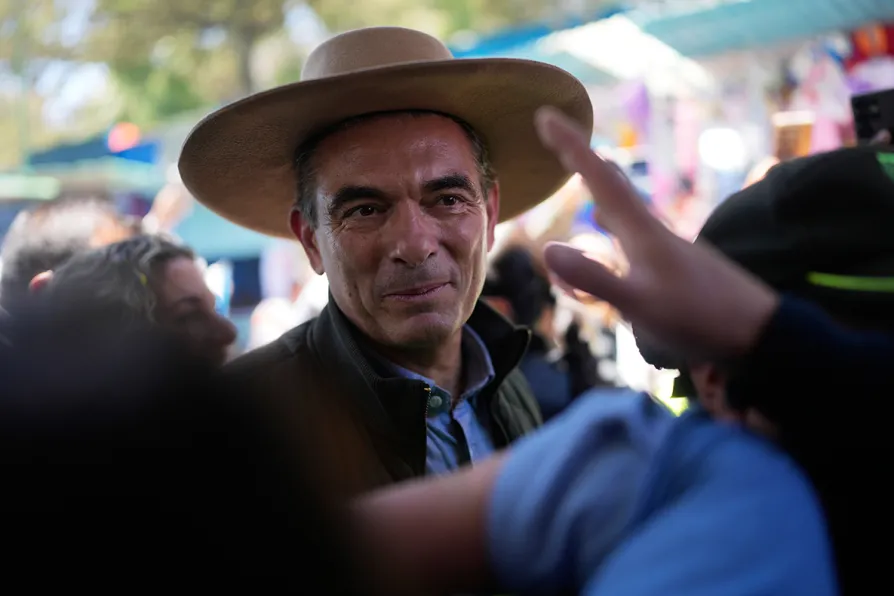 Bolivian President Rodrigo Paz attends the opening of the annual Alasita Fair in La Paz, Bolivia, January 24, 2026
In the third of a four-part serialisation from her new book No to Nuclear, LINDA PENTZ GUNTER explains how the world had a chance to build an energy system around renewables more than 70 years ago — instead, it chose nuclear
In the fourth and final part of our serialisation from LINDA PENTZ GUNTER’S book No to Nuclear, she asks how anyone can see nuclear as value for money given its constantly ballooning costs
Elon Musk says AI will make work optional. The world of abundance he predicts actually spells the end of the capitalist system, argues FAWZI IBRAHIM
CARLOS MARTINEZ responds to liberal hawk Simon Tisdall’s evidence-free China-bashing and asks whose agenda it really serves
Indian students have fought for the right to education, schooling us all in the process. Comrades from the Students’ Federation of India (SFI) — UK comment on the resistance and its ripples here





ON JANUARY 15, Bolivia’s National Telecommunications Company (Entel) announced: “Starting January 17 2026, the television channels Russia TV and TeleSur will be removed from the line-up of Fibre Optic Television Services, IPTV, Satellite Television, [among others].”
This is not the first time that the Bolivian right wing has sought to censor media outlets with political positions that differ from the official line. In November 2019, the government of Jeanine Anez, which came to power after what many considered a coup against Evo Morales, terminated the Bolivian state’s contract with TeleSur, claiming technical problems, although several analysts said it was a political decision.
The decision was reversed by Luis Arce’s government once the democratic order was restored. A year passed without the Bolivian state allowing TeleSur to broadcast on television.
However, the recently inaugurated Paz administration has now decided to cancel TeleSur’s signal again. In this regard, the president of the Venezuelan network, Patricia Villegas, stated on Telegram: “As predictable as it is reprehensible: the Bolivian government is removing our signal from the Entel platform. There are no reasons; what [the Bolivian government] has put forward does not fool anyone. Bolivia, you know it, we are still together.”
For his part, former Bolivian President Evo Morales (2006-2019) criticised the Paz government’s decision: “Following instructions from the United States government and flagrantly violating the Bolivian people’s rights to information and communication, the government has decided to censor the international networks TeleSur and RTV.”
In addition, the Indigenous leader stated that the decision reveals the authoritarian nature of the new government: “This constitutes a serious violation of the Political Constitution of the State and a clear sign of submission and lack of dignity. It is irrefutable proof that Bolivia is living under an authoritarian regime, where plurality of information and freedom of expression are not respected.”
Several journalist organisations have joined in the criticism, stating that this decision “affects citizens’ right to access pluralistic and diverse information.” The International Press Correspondents Association said in a statement: “The insufficient explanation provided both in the company’s official statement and by customer service raises legitimate suspicions that this is an unacceptable act of censorship and a violation of freedom of expression.”
Furthermore, the association stated: “We warn that the arbitrary silencing of media outlets and journalists could lead to a spiral of serious consequences for freedom of expression, extending censorship practices to levels that are difficult or even impossible to reverse… We urge the Bolivian government to fully guarantee the exercise of freedom of expression, ensuring respect for the plurality of voices…”
TeleSur, founded in 2005 by then-Venezuelan President Hugo Chavez, has become one of Latin America’s most prominent news outlets, offering alternative and distinctly progressive coverage of global and Latin American news.
For this reason, several right-wing governments have attempted to remove TeleSur from their respective national television networks.
This trend was initiated by the Argentinian government in 2016, under the administration of Mauricio Macri.
Likewise, the then Ecuadorian president Lenin Moreno (2017-21), whose government would soon make a radical shift from the centre-left to the right, also removed TeleSur’s news signal from its respective open television channels.
Now, Bolivia joins the controversial list of countries governed by right-wing administrations that indirectly show, under technical or administrative pretexts, that TeleSur is an inconvenient media outlet for the interests of those in power.
This article is republished from peoplesdispatch.org.
