
A California union’s decision to host a meeting about US policy towards Cuba has prompted a congressional probe and renewed attacks on international solidarity, writes CAMERON HARRISON


A last chance to reclaim Scotland’s radical economic tradition
From the radical promise of early land reform to today’s cautious Community Wealth Building Bill, Scotland’s Parliament has lost sight of its founding ambition to shift power and ownership, writes RICHARD LEONARD MSP
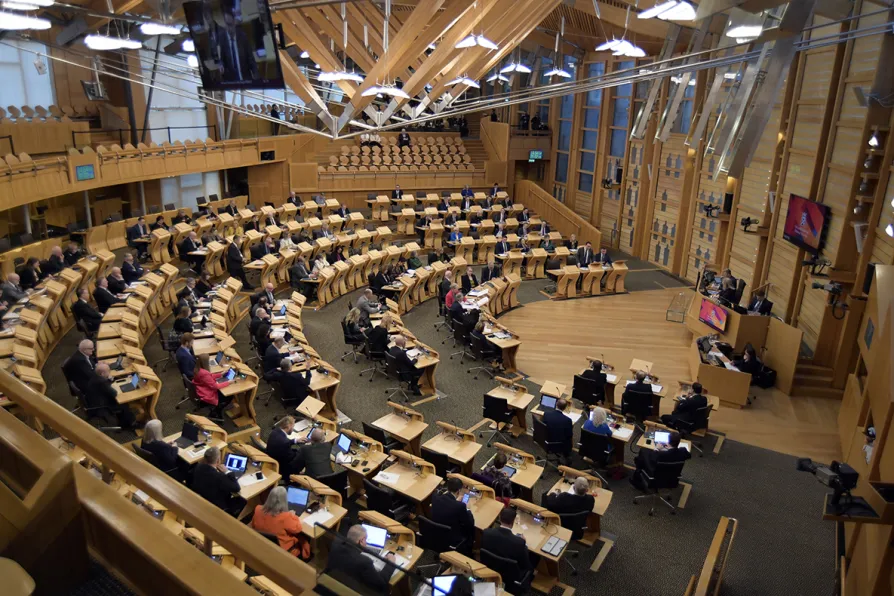
 MSPs at the Scottish Parliament as Finance Secretary Shona Robison announces the draft Budget for 2026-27 in Holyrood, Edinburgh, January 13, 2026

The Baltic state is set to reverse its constitutional prohibition on nuclear weapons and foreign bases as part of accelerated Nato war preparations, warns TOM UNTERRAINER
Long-term underfunding and state neglect, while simultaneously probation services have been undermined, have intensified the prison crises, argues SOLOMON HUGHES
Holyrood incompetence has cost jobs and put the future of Clydeside’s Ferguson Marine shipyard into jeopardy. Its future should have been assured, argues KENNY MACASKILL
With the agitated debate now raging in the media about the early release schemes, Prison Officers Association general secretary STEVE GILLAN gives the view of those who work in the sector
The hounding of the late Jason Arday is an all too familiar experience for many black people. ROGER McKENZIE calls for collective action to combat what can feel like personal isolation





IN THE early days of devolution, the Scottish Parliament passed two land reform Acts which abolished feudalism and bestowed on local communities a preferential right to buy an estate of land when it is put up for sale.
State funding was made available to support communities to exercise those new rights, aimed at a redistribution of wealth, ownership, and of power.
It was a radical, even a potentially revolutionary idea but in practice has only made very limited progress. Two decades on, 432 wealthy families and individuals still own half of all private land in Scotland.
Nonetheless it was a clear statement of intent, offering at least a vision of hope, reform and real change.
It is in stark contrast to what is happening in the Scottish Parliament now. A rather tame new land reform Act was passed at the end of last year which will do little to advance community ownership, let alone challenge the concentration of these natural assets in the hands of the old aristocracy and the new billionaire class.
And over the coming weeks, MSPs will vote on a Community Wealth Building Bill, which despite being years in the making doesn’t do much more than require local bodies like councils, colleges and NHS boards to come up with an action plan once every five years, and a government minister to come up with a statement to Parliament at the same infrequent interval.
It is a Bill bereft of vision and lacking in ambition. It is a proposal built on the shifting sands of words rather than the solid foundations of deeds.
So drawing on my own experience I have sought to amend it, introducing the principle of labour hiring capital, rather than the reverse, through measures to support employee ownership and worker co-operatives.
So we could give workers a statutory preferential right to buy an enterprise when it is put up for sale, facing closure or takeover, in the style of the Italian Marcora law. This would be a significant step in the making of a democratic economy. It would also revive the spirit of those early land reform Acts.
Waking the sleeping giant of local government pension funds could significantly aid the retention of wealth in communities by targeting investment in local and regional economies.
In-sourcing services currently outsourced by the public sector highlighted recently in a report commissioned by the Scottish TUC should be a central part of any community wealth building strategy and be included in this Bill.
The promotion of credit unions and local banking networks, a proactive role for the publicly owned Scottish national investment bank and the redrawing of public procurement rules to reserve contracts for inclusive and democratic business models, would be practical reforms that would bring about change.
So far, the SNP and the Tories have formed an unholy alliance to block and vote down my proposals.
Policy initiatives which the SNP government considers to be tangential to community wealth building are actually axiomatic.
And what these attempts to amend the legislation have shown is that there is an alternative to extractive capitalism, and the massive over-reliance on foreign direct investment which has rendered Scotland a branch plant economy, all too often on the receiving end of decisions taken in faraway board rooms.
They demonstrate that there is an alternative to an economic model where speculative investors are richly rewarded, wealth is extracted from communities and long-serving workers are dispossessed. That the call of socialists down the ages: why shouldn’t those who create the wealth own the wealth that they create, still endures.
It is also a reminder to Scottish Labour that instead of simply saying how incompetently the SNP is managing the economy and running Scotland’s public services, and that after 20 years in office it’s time for a change, it could spell out what that change is.
Scotland, the home of Robert Owen and the birthplace of the Fenwick weavers, could become a centre for co-operative development, a Mondragon of the north.
Rather than the SNP’s green industrial revolution leading to our renewable energy resources and our new industries once again being colonised by multinational corporations, we could be building a democratic economy based on strategic state intervention and common ownership.
The Scottish Parliament began its existence understanding that at its very essence was the need to shift the balance of power in Scotland. Along the way, those horizons have been closed when they should have been opened up. Nowhere is this more evident than in the economy.
In the coming weeks members of the Scottish Parliament will have one final chance before the May election to radicalise the Community Wealth Building Bill.
To mould it so that it becomes a new path to those old ideals of co-operation, solidarity, of economic democracy.
In short, one final chance to make it a Community Wealth Building Act worthy of the name.
Richard Leonard is a Scottish Labour MSP for the Central Scotland region.
