Andy Burnham’s message of hope will defeat Reform if Labour delivers the New Deal for Working People in full, says JOANNE THOMAS


 Latest editorial
Paul Robeson: the revolutionary who taught us to organise
ROGER McKENZIE pays tribute to a communist, internationalist and organiser, who endures, 50 years after his death, not just as a towering artist but as a master teacher of struggle
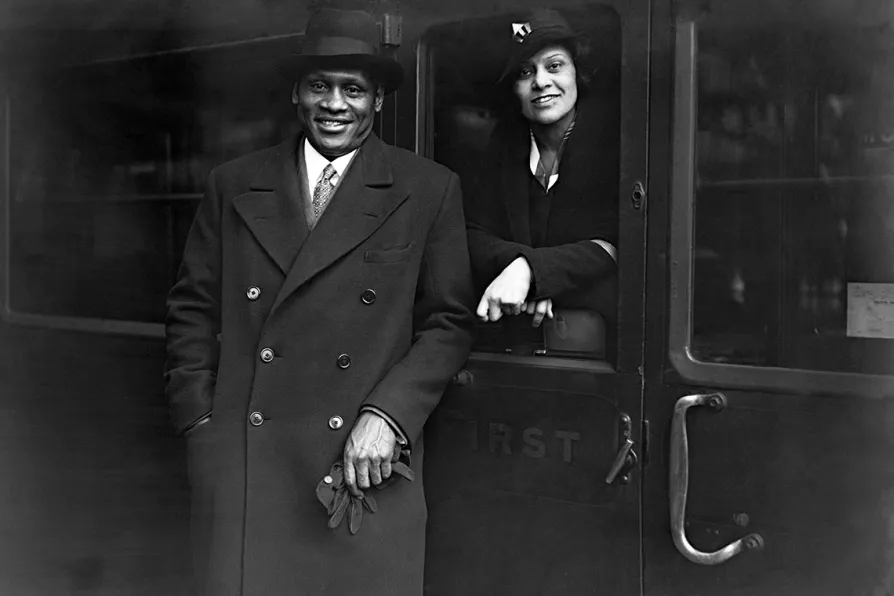 American singer Paul Robeson at Waterloo Station, leaving for Hollywood to act in his first film, May 1933

The government’s latest asylum proposals abandon labour movement values and fuel division by aping Reform UK, writes DIANE ABBOTT MP
IAN LAVERY MP warns that decades of neoliberal policies have left former industrial communities behind — but a renewed Labour commitment to working people could change the political landscape
We need a government that invests in saving lives not destroying them, argues SOPHIE BOLT
HENRY FOWLER outlines the GFTU’s new 2026-27 education programme and argues that investing in trade union education is essential to building worker power, developing leaders and strengthening collective action
PAOLO SANTALUCIA reports on how an Italian region defies US pressure to end a Cuban doctors programme





FRIDAY is the 50th anniversary of when the legendary communist Paul Robeson went on to enrich the ancestors.
He was the classic example of an artist as revolutionary.
Robeson, the son of a former enslaved African, was also a child of the 19th century, having been born on April 9 1898. Although he transitioned on January 23 in 1976, I never had the honour of seeing him perform live.
Regardless, Robeson was a presence with his voice and sheer presence for almost my entire childhood.
There were no LPs or cassettes (remember them?) of Robeson in our house. His just wasn’t the sort of music we listened to in our Jamaican household. But we all knew in our house of his importance to the black community and, of course, were familiar with his deep baritone voice singing the classic, Ole man River.
It wasn’t until much later that I got to know the revolutionary songs he sang and his bravery in standing up for his principles as a communist.
The fact that Robeson was a communist was something I learned more about later. But it was never an impediment in our house to hinder our admiration.
It was also much later before I learned that Robeson familiarised himself with over 20 languages. This is hard for me to imagine in this age of Duolingo when the sort of language support available to us simply wasn’t available or even dreamt of for Robeson.
His language skills were so good that it allowed him to sing his 1949 concert in Moscow in seven different languages — English, Russian, French, Italian, Spanish, Chinese and Yiddish.
Welsh, the language of the western European country that appears more than any other to have adopted Robeson as one of its own, was not one he ever learned, but he was known to sing the English language translations of its national anthem, Land Of My Fathers.
Robeson was known to as many people for his acting as he was for his outstanding singing voice.
I’ve already mentioned his singing of Ole Man River from the musical Showboat, but his stage appearances have become something of legend.
His role as the lead in Othello is arguably what every other performance in the role is measured against.
I found myself doing it last week when I went to see Othello at the Haymarket Theatre in London. It was a good performance by David Harewood in the role but my mind kept comparing him with Robeson’s height, voice presence and ability. All of this without ever having seen him live in the role.
It’s amazing how legend and reputation can take over one’s thinking!
Before he was known to me and my family as an imposing actor he had already been a leading college American football player, athlete and lawyer. But he was always a stand-out against the rampant racism and anti-communism that to this day infects the US.
I began to read more and more about Robeson, including his inspirational autobiography Here I Stand. It was finding this book in my late teenage years, around about the same time that I discovered the autobiography of Angela Davis (my favourite book).
It was these two books, perhaps more than anything, that guided me towards reading The Communist Manifesto by Karl Marx and Friedrich Engels and developed my own thinking as a socialist.
Perhaps one of the least known aspects of Robeson’s roles was his founding of the monthly newspaper called Freedom.
The newspaper was founded in 1950 with another giant of the 20th century, WEB Dubois.
Robeson wrote a column for the front page each month for the five years of the paper’s existence.
The motto of the paper was “Where one is enslaved, all are in chains.”
The paper concentrated on issues facing African-Americans and was not shy in showing its communist sympathies at a time when doing so painted a target on your back.
In much the same way as the Morning Star does, Freedom covered trade union struggles, particularly of left-led unions, and the anti-colonial struggles that were raging at the time. This of course included the fight against the racist settler-colonial apartheid regime in South Africa.
Also perhaps little known is that the brilliant left-wing Tony Award winning playwright Lorraine Hansberry, the author of A Raisin in the Sun and the subject of the song To Be Young Gifted and Black, written by the great Nina Simone, worked as a subscription clerk at Freedom soon after its founding.
Hansberry, encouraged and mentored by Robeson, progressed to become a formidable associate editor who covered both national and international issues for the paper before going on to pursue her playwriting career.
Led by Robeson, the paper consistently opposed the Korean war. The editorial line of Freedom was clear that the war in Korea was a colonial venture.
On Vietnam, one front page of Freedom by Robeson described the country’s revolutionary leader Ho Chi Minh as the “Toussaint L’Ouverture of Indo China.”
L’Ouverture was the leader of the successful revolt of enslaved Africans in what is now known as Haiti from 1791 to 1804.
In one edition of Freedom, Robeson asked: “Shall negro (sic) sharecroppers from Mississippi be sent to shoot down brown-skinned peasants in Vietnam — to serve the interests of those who oppose negro liberation at home and colonial freedom abroad?”
Amid the misogyny that too often permeates the left and, sadly, the black liberation movement, Robeson promoted and supported women.
There were, unusually for the time, women on the editorial board, and among the paper’s contributors. He encouraged articles from women such as leading black communist Vicki Garvin.
In the first issue of Freedom Garvin wrote: “If it is true, as has often been stated, that a people can rise no higher than its women, then negro people have a long way to go before reaching the ultimate goal of complete freedom and equality in the United States.”
Garvin, not spoken of enough, was one of the leading black revolutionaries of the 20th century. Amongst other things, she went on to play a leading role working with Malcolm X as his political trajectory moved leftwards and Pan-African.
My comrade Nigel Flanagan has long advocated for the tactic of “spider-webbing” as a means of organising. Robeson was a master of this approach.
Far too often his contribution on the left is characterised by his huge artistic talent, his support for the Welsh miners, his support of China and the Soviet Union and, of course his disgraceful persecution at the hands of the US state — all very important to understand and learn from.
But this can all too easily individualise his contribution. Robeson was, as actor Ossie Davis said of Malcolm X at his funeral, a “master teacher.” His singing, acting, writing and activism were all teaching us to go on to agitate and organise in our own right and not to lionise him as an individual.
At least that’s what I take from the life of Robeson which I will continue to remember and celebrate.
