DOUG NICHOLLS says the parasitic finance markets must be challenged or another British government could be toppled


 Latest editorial

Iran’s blood and oil – create the crisis in order to exploit it
Trump threatens war and punitive tariffs to recapture Iranian resources – just as in 1953, when the CIA overthrew Mossadegh and US corporations immediately seized 40% of the oil, says SEVIM DAGDELEN
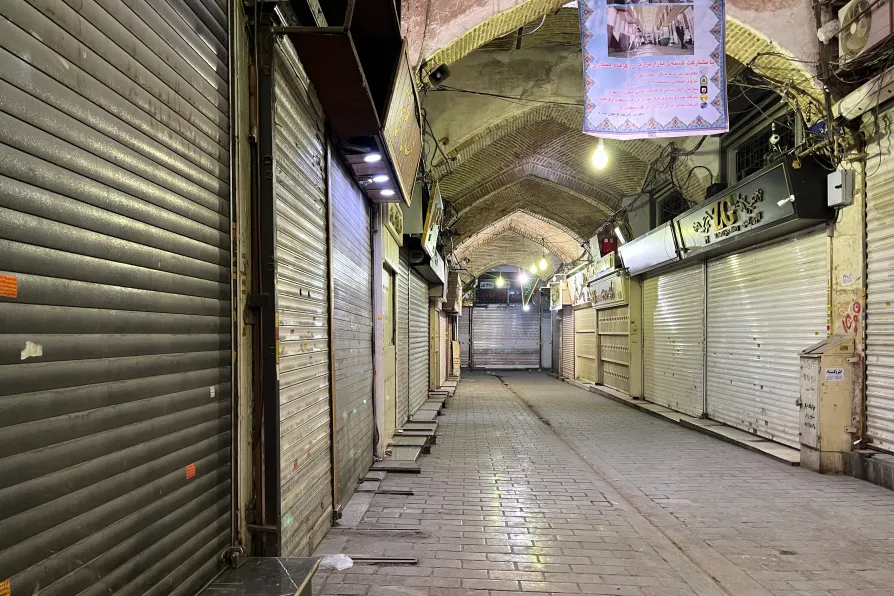 Shops are closed during protests in Tehran's centuries-old main bazaar, Iran, January 6, 2026
The late country singer’s Imagination Library has put hundreds of millions of books into children’s hands. We should build on that legacy by defending the libraries at the heart of our communities, says BRENDA AITCHISON
Deprivation is a fundamental factor in criminal behaviour that must be addressed but, KENNY MacASKILL argues, there needs to a major rethink in sentencing to tackle overcrowding
MML director MEIRIAN JUMP outlines the recently refreshed library’s busy autumn schedule that ranges from book sales, archival exploration, community work with online education and the ever popular site tours
Some thinkers and authors on the right are openly discussing the possibility that the historically successful party of the British ruling class may be exhausted
Class struggle is the motor of history but the direction and detail of change at any time and place is the outcome of many factors, suggests the Marx Memorial Library and Workers’ School
TONY BURKE surveys the shifting political landscape and the challenges Labour needs to address if it is to prevail in the 2028 federal elections





WHAT do Venezuela and Iran have in common? Both countries rank among the top five nations with the largest oil reserves. Then there are Canada — which US President Donald Trump would like to integrate as the 51st US state — the model democracy Saudi Arabia, and Iraq, where since the US war of aggression in 2003 — ostensibly to eliminate weapons of mass destruction — oil companies like ExxonMobil and Chevron have regained access.
In Iraqi Kurdistan, an autonomous region of Iraq, Hunt Oil and other US companies benefit from the Ceyhan pipeline, reopened through US mediation.
In Iran, as in Venezuela, it is about oil for the United States. At the same time, an inconvenient geopolitical competitor in the region is to be eliminated. In Iran’s case, it would not be the first time in history that Washington has used regime change to guarantee its oil companies privileged exploitation conditions. This also appears to be Trump’s concept: with the help of open predatory capitalism, he wants to cheaply cover the enormous increase in US energy demand driven by artificial intelligence.
1953 to today – the blueprint of the coup
Back to regime change in Tehran. In 1953, the United States supported a CIA coup against Iran’s democratically elected president, Mohammad Mossadegh; as a result, the Shah — who established a bloody dictatorship in the country — was installed as head of state by the military. The Iranian secret service Savak built a reign of terror with the help of the CIA and Mossad.
Today, the dictator’s son Reza Pahlavi, even if US President Trump has so far avoided joint photos, is considered the favourite of the United States when it comes to bringing the monarchists back to power in Iran once again.
The advantage of his father’s rule was obvious for US oil companies. Just one year after the 1953 coup — which had also been provoked by paid thugs — predecessor companies of Exxon and Mobil, as well as Texaco and others, secured 40 per cent of Iranian oil; another 40 per cent went to the British, including Shell.
Sanctions, chaos, war – the current script
US analysts such as Jeffrey Sachs are already warning of a new CIA playbook for a coup in Iran in 2026. Through increasingly harsh US sanctions, it has been achieved that ever less oil can be exported for ever fewer foreign currencies — resulting in dramatic currency devaluation and massive price increases for the population. The sanctions are not solely responsible — mismanagement and corruption also play a role — but they act as the decisive escalation driver.
This is precisely the cynical standard pattern of US sanctions policy: the United States uses its superior financial power to economically strangle countries like Iran, Syria, Cuba or Venezuela — allegedly to protect democracy and human rights.
The self-inflicted suffering — hyperinflation, medicine shortages, hunger, collapsing health systems — is then presented as proof of the incompetence and brutality of the respective governments.
In short: Washington creates the crisis — and abuses it as propaganda for even more pressure.
The bloody suppression of protests in Tehran with an unknown number of deaths is now being used by the United States as a welcome pretext to openly threaten an unprovoked, illegal war of aggression — loudly seconded by the Israeli leadership. Once again, it is Israeli Prime Minister Benjamin Netanyahu who is trying to talk the United States into an attack.
Even the simplest mind should notice that something cannot be right when a man wanted by The Hague with an arrest warrant for genocide, a suspected war criminal and a US president who commits one violation of international law after another suddenly appear as protectors of human rights.
In any case, Iran continues to refuse to open the country to US oil companies. That is the only crime that the US president cannot forgive. Washington is still hesitating, still wants to wait and see whether the sanctions will cause even greater damage, whether the economic situation in the country will deteriorate further and whether destabilisation will progress.
To achieve this, Trump is even risking the ceasefire in the trade war with China, which freezes tariffs for many products at 10 per cent until the end of 2026.
Anyone who trades with Iran will in future have to pay a 25 per cent punitive tariff on imports into the US, according to the US president.
If Iran can hardly sell any more oil abroad, the currency will completely collapse. A financial collapse of the country instead of a costly war would fit better into Washington’s calculations. But even though Iranian oil exports to China have already fallen sharply, Beijing will not bow to US dictates. In addition, the last armed confrontation with Iran ended at best in a stalemate.
The crucial question is whether ground troops are needed for a successful US military intervention. The mobilisation of armed militias recruited from ethnic minorities appears little promising due to the numerical weakness of the units alone.
Meanwhile, the conservative newspaper Jerusalem Post reports on attempts by Israeli intelligence to gain more influence over the protests in Iran.
German Foreign Minister Johann Wadephul denied the “regime” in Iran any legitimacy, but is relying on even harsher sanctions to bring about regime change. In contrast, Turkish Foreign Minister Hakan Fidan reaffirmed his criticism of the Mossad’s attempt to bring about a coup in Iran.
Hypocritical reasons for war and the true threat
Another argument for a US war could be the fight against Islamism. But even here, a look at Syria is enough: there, the sole ruler Al-Jolani has Kurdish civilians massacred in Aleppo by Islamist terror groups after being courted by both Washington and Brussels — making it clear that the alleged fight against Islamism is simply not meant seriously. In Berlin this week, the former al-Qaida man will also be rolled out the red carpet.
Anyone who falls for Trump’s war propaganda risks paving the way through stupidity for an illegal US war and bears responsibility for plunging an entire region into chaos. Around one million people paid with their lives for the US attack on Iran’s neighbour, Iraq, back then.
It would be particularly tragic if this history were to repeat itself. The same applies to attempts to create a justification for war through the dispute over Iranian uranium enrichment. The accusation that Iran wants to acquire weapons of mass destruction is made precisely by Israel — as a close ally of the US and Germany in the region — a country that has neither signed nor ratified the nuclear Non-Proliferation Treaty and, according to estimates by the Stockholm International Peace Research Institute Sipri, possesses 90 nuclear warheads.
It remains: the greatest threat to international security and world peace is the United States, which together with the German federal government was prepared to support a genocide against the Palestinians in Gaza. But Trump is prepared to do anything — no-one should harbour any illusions — including spilling a great deal of blood so that US oil corporations can finally get their hands on Iran’s black gold again.
Showing the red card to the renewed US imperialism in Europe means demanding the withdrawal of the approximately 100,000 US soldiers and leaving Nato, because it exists solely to establish US hegemony in the North Atlantic and to serve as an instrument for global escalation in the interest of billionaires in the United States.
Sevim Dagdelen was a member of the German Bundestag from 2005 to 2025 and is currently a member of the federal executive board of the German party BSW.

Similar stories
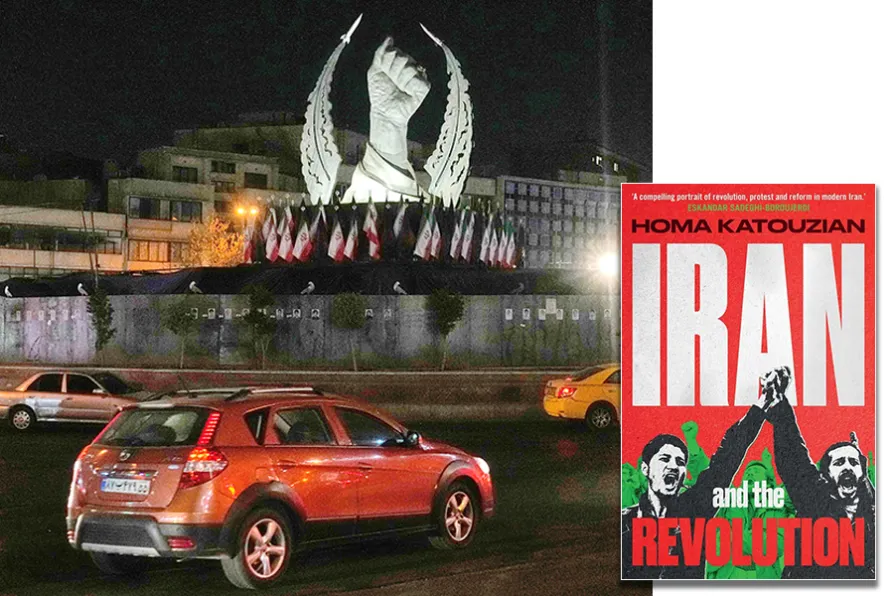
BRENT CUTLER searches a new history of contemporary Iran for an understanding of the Islamic Republic, finding both interesting detail and glaring omissions
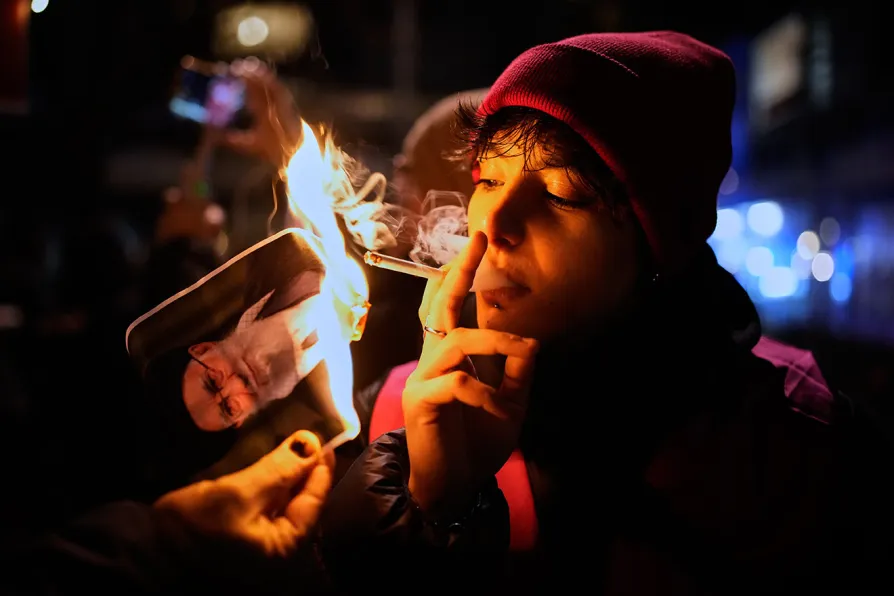
MOHAMMAD OMIDVAR, a senior figure in the Tudeh Party of Iran, tells the Morning Star that mass protests are rooted in poverty, corruption and neoliberal rule and warns against monarchist revival and US-engineered regime change
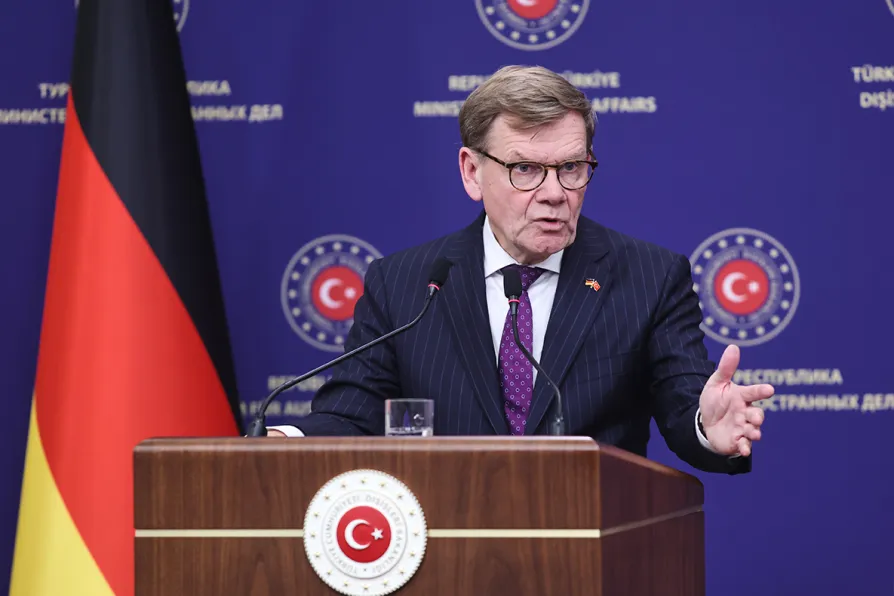
The cancelled China trip of the German Foreign Minister marks a break with Helmut Schmidt’s China policy and drives Germany further into Washington’s confrontation course, warns SEVIM DAGDELEN
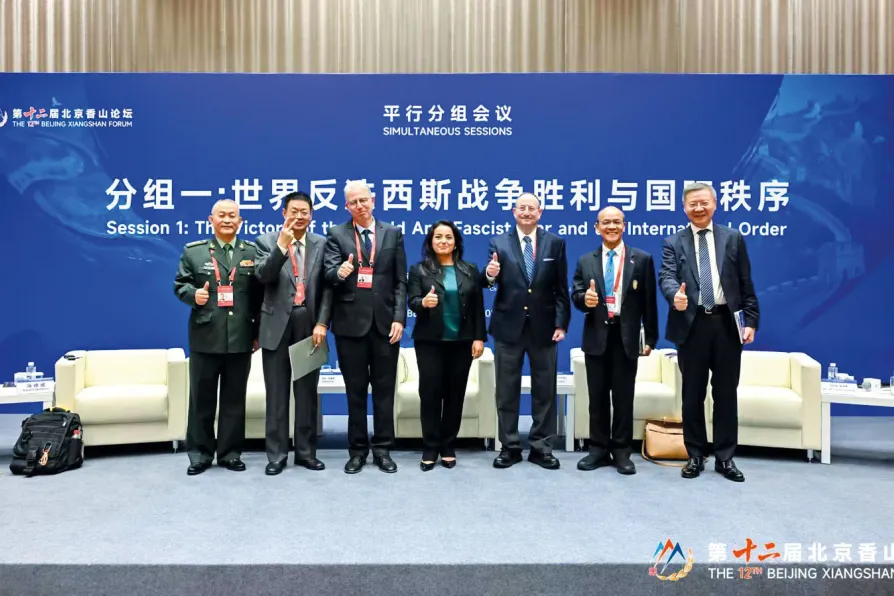
In a speech to the 12th Xiangshan Forum in Beijing, SEVIM DAGDELEN warns of a growing historical revisionism to whitewash Germany and Japan’s role in WWII as part of a return to a cold war strategy from the West — but multipolarity will win out