WILL STONE samples the 20th anniversary atmosphere of this eclectic end-of-season indie festival


 Latest editorial
AI: Plagiarism software
DENNIS BROE surveys the new wild west: a technology that aims to “innovate” so fast that no government regulation or union negotiation can keep up
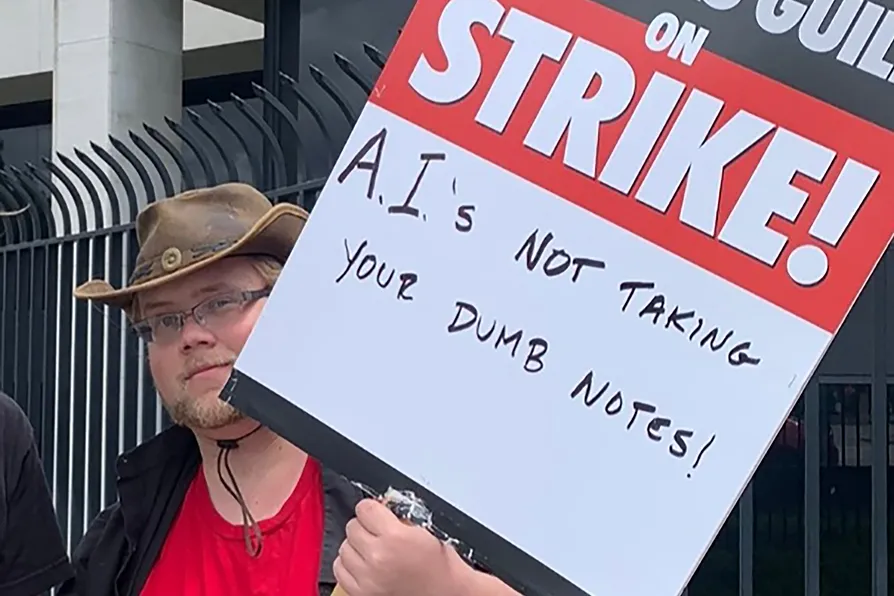 COLLECTIVE ACTION AGAINST AI: A picket at the 2023 Writers Guild of America strike that lasted for five months in 2023 [Pic: David James Henry/CC]

Comics are not just superheroes and spandex – it can be public art, telling public stories, suggests HARRIET EARLE
The bard serenades the Diggers of Wigan and their festive followers
ALEXEI SAYLE speaks to Angus Reid about a lifetime of protest, how to hone political art – and what to do now
ANDY HEDGECOCK, JAMES WALSH, LEO BOIX and MARIA DUARTE review Just An Illusion, Everybody Digs Bill Evans, Blue Film, Oasis: Don’t Look Back in Anger, and Runner
MARIA DUARTE recommends a nerve-wracking reconstruction of the 72 hours before the Normandy landings





WE all know about the miracle of AI, supposedly the software that will revolutionise existence, make all our lives easier and point the way to a brave new world.
It is very important to understand that much of this is hype, selling and boosting shares in a multibillion-dollar industry that is the last best hope of Western capitalism, dictated by US tech lords in Silicon Valley for the purpose of domination of the need for, and profits from, the digital economy. And it is important to lock up, make obscure and keep behind closed doors the secrets of this industry so the IP (intellectual property), in this case the source code of the industry is kept private and can generate endless profit.
A crucial aspect of AI and IP is how AI is being constructed. It cannot reason. What it can do is absorb a massive amount of data and correlate that data, sometimes in meaningful ways, sometimes not. This has given rise to a characterisation of the technology as “plagiarism software,” since it is being fed massive amounts of data from as many sources as the companies can muster, with often the companies just stealing this source material from which they will then profit.
The New York Times is currently suing OpenAI partnered with Microsoft to create its Microsoft Pilot programme, charging that the company used millions of Times articles without paying a penny for them. This largescale theft goes unremarked by the AI companies.
There are further nefarious uses of AI, equally prominently in the entertainment industry.
The actor Scarlett Johannsen criticised OpenAI for using an approximation of her voice as she crafted it in the film Her to create its female voice Sky, its version of Siri and Alexa. The company had approached the actor and asked to use her voice, but she refused so they used an AI approximation.
Johannsen claimed that her husky, sexy voice is her creation which she worked on developing over the course of her acting career and the company had to withdraw the voice. Johannsen has a valued place in the Marvel Universe as the Black Widow, a deadly assassin and she was asked if OpenAI president Sam Altman would make a good Marvel villain. Altman is famous for surviving a revolt led by OpenAI workers, upset by his imperious rule, and then privatising more aspects of the company. Would he be a good Marvel villain? She replied, “I guess, maybe with a robotic arm.”
Needless to say, the last actor’s strike was all about protecting actors, whose voice and mannerisms are their IP, from having each stolen by these companies.
A more insidious use of AI IP was uncovered by the writers in their strike. Here, the goal of the streamers and studios is to have AI write the first draft of a script and then only hire writers to come in afterwards and edit it. The property then would belong to the studio, generated by its AI. The writers cancelled out this use, but no doubt it will emerge again in the upcoming contract negotiations this year and shows how the technology is envisioned to be employed by the companies as a way of regaining control of the writers share of IP based on their scripts.
This attempt to reclaim IP from the writers, and even to duplicate actors’ bodies and voices, is active in the music industry as well. The top Country Music song in 2025 for two weeks — Walk My Walk — was generated by AI and indicates again that the record companies are also attempting to eliminate human interaction and claim the IP proceeds for themselves. These are battles and issues the entertainment unions all must confront.
Not to mention the deskilling of a work force necessary for their elimination and there is a notable example in the music industry. The producer Timbaland, who has an AI-created song (Glitch X Pulse) by an AI artist (TaTa Tatumi), says that “Basic skills have diminished as digital music evolved.
“You don’t have to know how to play chords. You’ve got a chord machine. People aren’t making drum loops because they’ve already got drum packages you just drag and drop.” With AI this deskilling proceeds to the point where “musicians” no longer need to know how to play music.
Of course, the AI battlefield is shifting constantly, and that, as Shoshana Zuboff says in The Age of Surveillance Capitalism, is the point. One goal of the tech industry is to, as they describe it, “innovate” so fast that no government regulation or union negotiation can keep up. This is a huge challenge for both.
The leader in AI regulation, in maintaining the IP integrity of artists, has been Europe, but the Trump administration is attempting in its tariff negotiation with the EU to halt this regulation, as impinging on the profits of US companies.
The goal of Silicon Valley and their Wall Street investors in this form of fin-tech, the melding of the financial and technology industries, is to create a new Wild West, where rules, regulations and unions are off the table as these digital pioneers shoot it out to see which gunfighter will survive with nary a care given to the innocent bystanders, that is, the rest of us, caught in the crossfire.
