TUC president and POA leader STEVE GILLAN speaks to Ben Chacko on the eve of Congress 2026


 Latest editorial
Hunger strikes and the British state’s long war on dissent
From Chartists and Suffragettes to Irish republicans and today’s Palestine activists, the treatment of hunger strikers exposes a consistent pattern in how the British state represses those it deems political prisoners, says KEITH FLETT
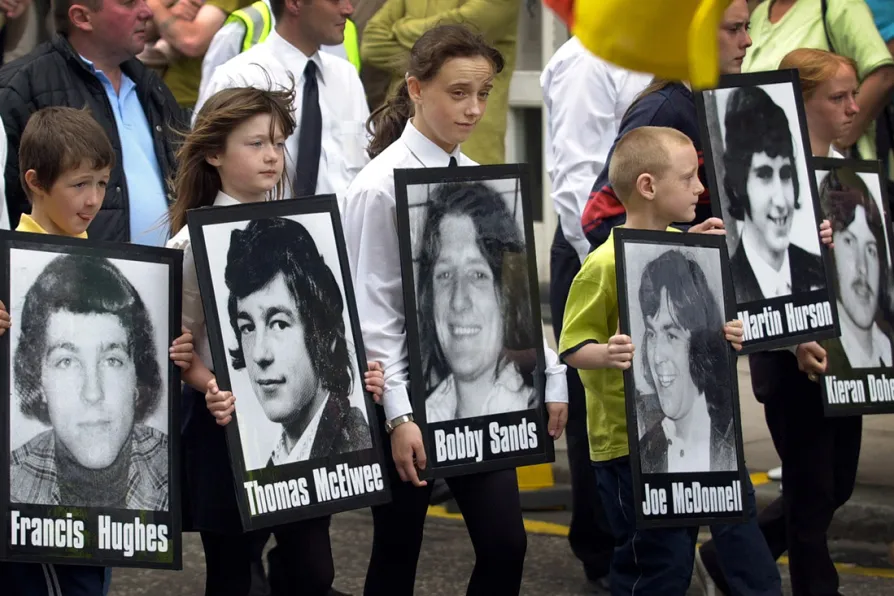 Children in Glasgow city centre carry pictures of the hunger-strikers, during a Republican rally to commemorate the 20th anniversary of the IRA hunger-strike at the Maze prison in Northern Ireland, May 2001

DOUG NICHOLLS welcomes a turning point at this year’s Congress, where many motions call for a co-ordinated plan to revive British industry, a perspective outlined in his new book
HOPE VIRGO of campaign Dump the Scales warns MPs voting today they should be alert to the threat legalised assisted death poses to people with eating disorders
The Together Alliance is hosting two summits, North and South, to build power and plan action against the scourge of racism peddled by the right. DANIEL KEBEDE urges mass participation
The drift toward militarisation in Europe is not inevitable, left-wing and peace movements can preserve sovereignty and prevent war, says DÁIRE HUGHES MP
Whatever differences exist among international sympathisers of the Bolivarian revolution about its current trajectory, they should unite against the imperialist power that is the source of an enforced retreat, argues ROGER D HARRIS
Trade unions need to step up and force a turn in the policies of the labour movement to effectively confront the far-right threat, argues NICK WRIGHT





THE case of supporters of Palestine Action who have been on a continuing hunger strike over the Christmas and new year period is a reminder of the long history of how the British state treats those it categorises as political prisoners.
The stated view of the government is that it is entirely a matter for the courts and ministers do not get involved. Historically that has never been the case and it isn’t now.
Notably when Keir Starmer decided that intifada, a general term for an uprising, was now on the list of words he does not wish to hear, the following day the Met Police were arresting people who used it.
The most recent and well-known case of political hunger strikes in Britain was that of Bobby Sands MP, who was among 10 Irish Republican prisoners who died in the “dirty protest” in 1981.
Their core demand was that they be treated as what they were, political prisoners. Margaret Thatcher claimed they were criminals and Labour backed her. However the outcome was a political crisis for the British state.
The other best known example of the brutality of the British state towards political prisoners came with the Suffragettes held in Holloway Prison. The Cat and Mouse Act was passed by a Liberal government in 1913. When Suffragette prisoners went on hunger strike, they were temporarily released, when their condition became debilitating.
The idea was that they would then recover and subsequently be forced to return to jail, where they resumed hunger strike. Again it turned into a political crisis for the state as many of those released disappeared into a network of safe houses.
We can trace the state’s treatment of political prisoners back to the Chartist period in the 1840s. John Baxter has recently published a book on the Sheffield Chartist Samuel Holberry. Arrested and jailed for conspiracy to riot in 1840 he was sent to Northallerton jail and illegally forced to work on the treadmill. Transferred to York he died aged 26 in 1842 the authorities having both caused and then ignored his deteriorating health. Some 50,000 supporters turned out for his funeral.
Keeping protesters in jail at Christmas is not a new thing for the British state as December 23 1843 issue of the Chartist paper the Northern Star underlined. Chartist leader Feargus O’Connor appealed for funds to make sure that the families of those Chartists in jail could have a decent Christmas.
In a case with striking contemporary relevance the left Chartist leader, and friend of Marx and Engels, Ernest Jones was jailed for two years in 1848 for making seditious speeches. While in jail he wrote a poem, The Revolt of Hindostan, in his own blood on pages torn from a prayer book.
A case which should resonate with the current Justice Minister David Lammy is that of the black leader of London Chartism in 1848, William Cuffay. He was sentenced to be deported to Tasmania in October 1848 for his alleged role in a Chartist rising in central London.
In December 1850 leading Chartist Thomas Martin Wheeler raised an appeal in the Northern Star, noting that nothing had been heard from Cuffay, while the Chartists transported with him had been given tickets of leave.
Cuffay’s wife, in Chatham Workhouse raised the issue with the government. At least in 1850 officials did reply noting that if Cuffay was found to be of good behaviour he might also get a ticket of leave.
A political prisoner he was discriminated against both for his politics and his colour. Some 175 years later the brutality of the British state to those whose views it doesn’t want to be heard maintains.
Keith Flett is a socialist historian.
