WILL STONE samples the 20th anniversary atmosphere of this eclectic end-of-season indie festival


 Latest editorial
Traditions are reclaimed and fear meets fun
ANDY HEDGECOCK picks out his cultural highlights of 2025
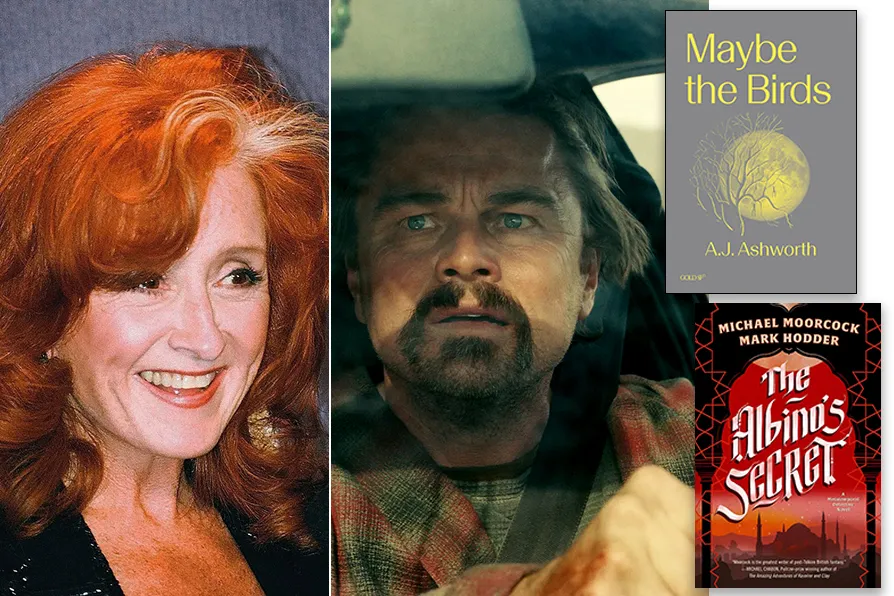 (L) Bonnie Riatt; (R) Leonardo Di Caprio in One Battle After Another [Pics: John Mathew Smith & www.celebrity-photos.com/CC; IMDb]

Comics are not just superheroes and spandex – it can be public art, telling public stories, suggests HARRIET EARLE
The bard serenades the Diggers of Wigan and their festive followers
ALEXEI SAYLE speaks to Angus Reid about a lifetime of protest, how to hone political art – and what to do now
ANDY HEDGECOCK, JAMES WALSH, LEO BOIX and MARIA DUARTE review Just An Illusion, Everybody Digs Bill Evans, Blue Film, Oasis: Don’t Look Back in Anger, and Runner
MARIA DUARTE recommends a nerve-wracking reconstruction of the 72 hours before the Normandy landings





ON the surface, The Albino’s Secret (Gollancz, £10.99), a novel by Michael Moorcock and Mark Hodder, is a postmodern homage to the action-packed storytelling of the interwar period. Set in Istanbul in an alternate version of the 1930s, it involves lost religious artefacts and the schemes of those pursuing them — government agents, counterspies, a cabal of assassins, an anarcho-syndicalist, a sadistic Nazi and a debonaire criminal mastermind.
The narrative has other layers. The protagonists, “metatemporal” detectives Sir Seaton Begg and Dr Taffy Sinclair, solve mysteries while preserving the balance of order and chaos across time and the multiverse. There’s a metafictional aspect too, with some characters having avatars in other books. Embedded in the thrills and fun is a robust strand of ethical reflection — on inequality, colonialism, fascism, cultural change and the upheavals of technological transformation.
It’s an impressive demonstration that deftly crafted and accessible genre fiction can confront complex and harrowing issues to powerful effect.
Paul Thomas Anderson’s latest film, One Battle After Another, offers a similar mix of moral seriousness and entertainment. Freely adapted from Thomas Pynchon’s Vineland, it’s a parable of power, resistance, betrayal and violent counter-revolution. Where Pynchon satirised the culture wars of the Reagan era, Anderson tackles the toxic authoritarianism of Trump’s US.
Leonardo DiCaprio is Bob Ferguson, a stoner living off-grid, but formerly a member of a revolutionary group that freed migrants from internment camps. Bob’s nemesis, Colonel Lockjaw, played by Sean Penn, works for a wealthy and secretive white supremacist group.
Often funny, sometimes provocative and always tense, the narrative centres on Lockjaw’s pursuit of Bob and his teenage daughter Willa (Chase Infiniti). There are encounters with revolutionary nuns, an undocumented community, led by a martial arts sensei, and a bounty hunter with complex ethics. The performances are compelling, and Anderson’s ideas are niftily integrated into his pell-mell plot.
Maybe the Birds (Goldsmiths, £17.99), a genre-blending collection of 14 tales by AJ Ashworth, wanders into territories of impermanence, loss, love, transformation and the abuse of power. Ashworth’s prose is muscular but meticulous; stark and poetic by turns. Her settings shift from quotidian to fantastic, from speculative to grittily familiar.
In the title story, which explores the consolations and power of the creative imagination, an artist and her dog have survived some kind of apocalypse, a calamity alluded to but never clearly articulated.
Mirrors is a cleverly constructed, lyrical and fragmented vampire story: the unsettling nature of the narrative is echoed in both language and form. Small Feather Falling is a longer, perfectly paced tale that brilliantly subverts the tradition of the situational thriller; while Monolith is a perfectly crafted blend of humour, menace, pathos and absurdity.
Bonnie Raitt’s setlist at Nottingham’s Royal Concert Hall (June 8) included gospel, blues, country, soul, pop and British folk-rock. An accomplished songwriter, Raitt played little of her own material, revealing she finds more joy in interpreting the music of others.
There were striking, sometimes surprising, versions of songs by Richard Thompson, Annie Lennox, John Prine and John Hiatt; and numbers by half-forgotten soul and blues musicians such as Little Willie John and Sippie Wallace.
Her contralto voice, which has retained its range and precision into her mid-seventies, was complemented by inventive and expressive slide guitar work. She also impressed on piano and acoustic guitar. It’s a tribute to the skill and confidence of her band that she was able to lead them into an unrehearsed number on a whim.
In the dark days of Trump’s second term, Bonnie Raitt’s performance was a timely reminder of some inspirational strands of US culture.
