PAUL DONOVAN applauds an intriguing multi-layered depiction, dominated by a stunning impersonation of Marilyn herself


 Latest editorial

Sci-fi with Mat Coward: March 10, 2026
Tyrannosaurs in Thailand, colonialism as videogame, and a feminist gem from 1936

LEO BOIX applauds an audacious, self-questioning film about grief, friendship and film-making
MARY CONWAY admires a brave and topical study of Armageddon that is, unfortunately, unable to come to a conclusion
ANDY HEDGECOCK, JAMES WALSH and JAMIE BRITTON review Hanging by a Wire, I Want Your Sex, The Pout-Pout Fish, and Rise of the Foot Soldier: Retribution
Chris Searle speaks to US pianist RAN BLAKE
The Bard hands out medals for his Edinburgh campaign and urges us to support The Men They Couldn’t Hang





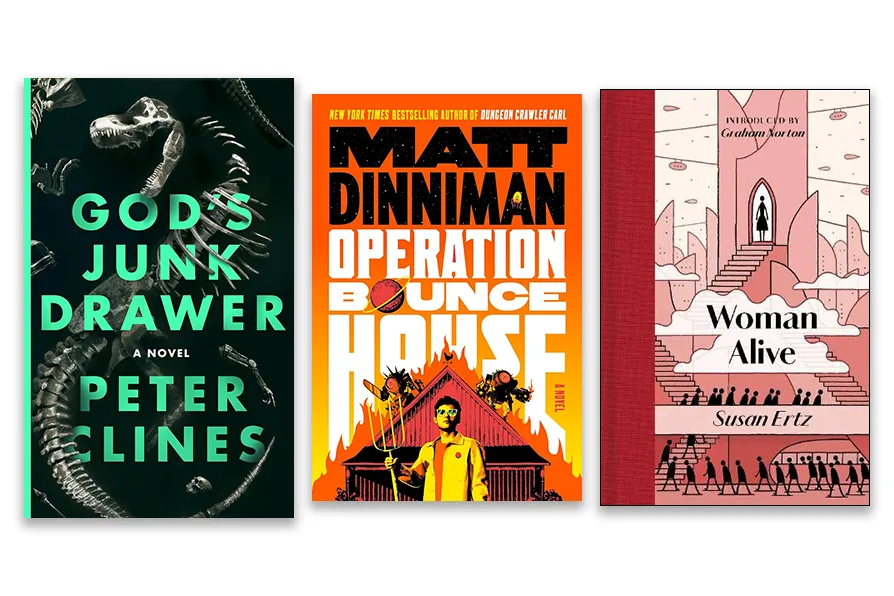
FOR all the futurism of their reading preference, science fiction fans can be a nostalgic lot and the phrase “Do you remember when SF used to be fun?” is often heard in their gatherings. A solid answer to that complaint arrives in the form of God’s Junk Draw by Peter Clines (Blackstone Publishing, £23).
It starts in the 1980s with an American family disappearing during a white water rafting trip. Five years later a survivor of that disastrous holiday, young Billy, turns up alive in Thailand. His explanation of where he’s been, and what became of his father and sister, is fantastical: they’ve been living in a cave in a valley full of dinosaurs and Neanderthals, where his dad was eaten by a Tyrannosaurus.
Poor “Dino Boy” spends years being laughed at and pitied, as therapists try to break through what is obviously a psychological coping mechanism to get at the truth. But 40 years later a group of astronomy students find themselves trapped in Billy’s impossible valley.
Non-stop action, chewable scientific speculation, and big characters having big adventures against big monsters — it turns out that SF can still be fun.
The monsters in Matt Dinniman’s exciting and inventive Operation Bounce House (Michael Joseph, £22) are ones we’re more familiar with: colonialism and privatisation. The corporation tasked by an Earth government with cleansing a colony planet of its inhabitants has come up with a great scheme for earning double-bubble. As well as being paid by the feds to kill the people of New Sonora using remote-control robots, the company also charges gamers on Earth for the opportunity to drive the robots.
On a planet devoid of middle-aged people, a group of young and old farmers must find a way to fight back against a distant enemy — preferably without turning into the “terrorists” that their opponents have labelled them.
Woman Alive by Susan Ertz (Manderley Press, £19.99) was first published in 1936 and has since been more or less forgotten.
It’s narrated by a London doctor whose mind is sent forward to 1985, to inhabit his own future life. There he finds a Britain which is almost a kind of social-democratic utopia. Economic planning has banished unemployment and poverty, slum housing and pollution. But recently, an eight-minute war between two factions of the United States of Europe has led to a final disaster: a man-made disease which kills only women — and all women.
Except one, as it turns out, a very ordinary young woman who had been subject to a unique medical experiment which by chance has left her immune to the plague. But is she willing to play the part of Eve in rebuilding a civilisation which she despises? “You got the world into this mess, you men,” she tells the prime minister, “and you can just stay in it.”
Irresistibly readable, with its unpretentious prose and sharp humour, this rediscovered pacifist, feminist fantasy from a decade so horribly similar to our own is a peculiar and unforgettable gem.
