
PETER MASON applauds the revival, 39 years later with the same team and cast, of Manfred Karge’s version of Brecht’s 100-year-old play, Mann Ist Mann

Theory and practise of the citizens’ revolution
GAVIN O’TOOLE welcomes a coherent and radical call to arms against the failed model of networked neoliberal capitalism
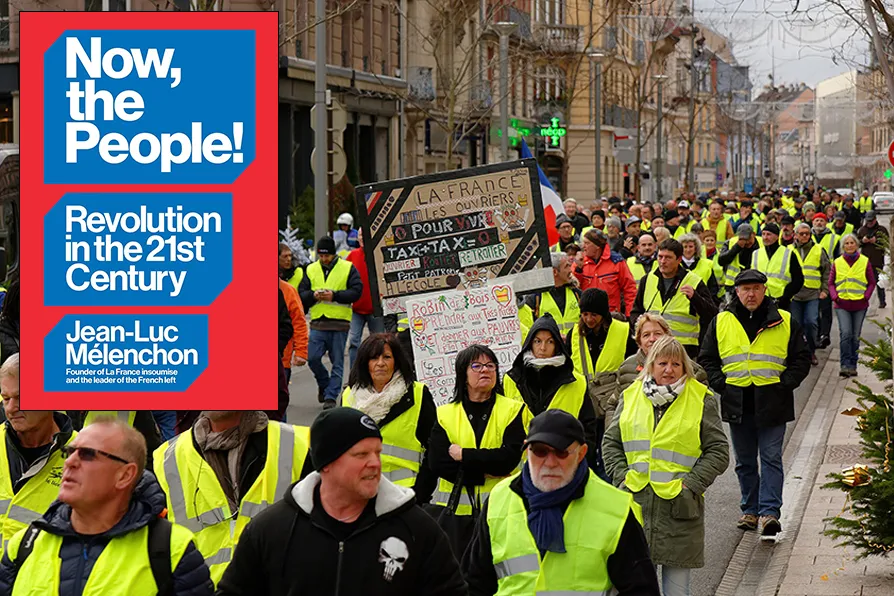
 TO RIDE THE WAVE OF POPULAR DISCONTENT: Demonstration of the Gilets Jaunes movement, in Belfort, December 1, 2018. [Pic: Thomas Bresson/CC]
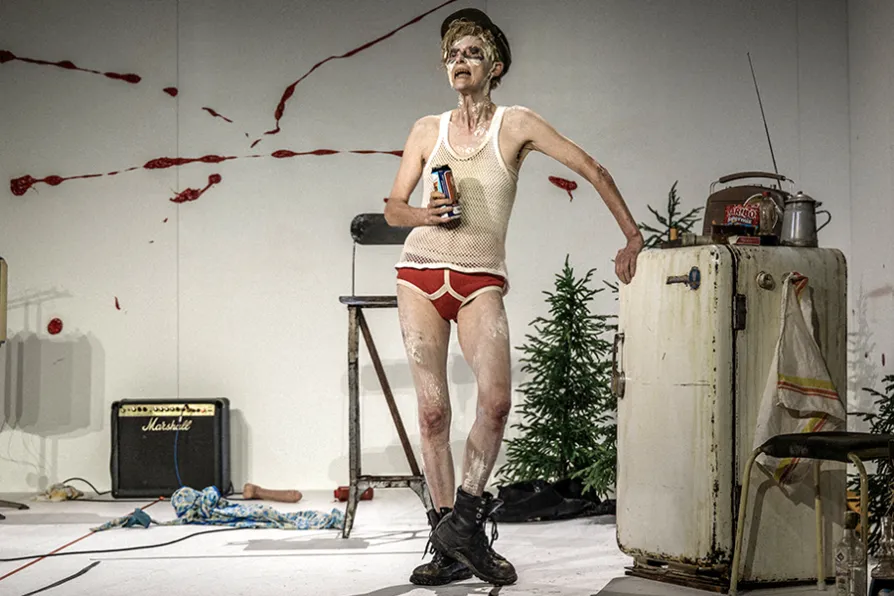
New releases from Biita Houdei, The Mary Wallopers, and The Tubs
New releases from Biita Houdei, The Mary Wallopers, and The Tubs
MAYER WAKEFIELD applauds a fearless attempt to bring to the stage the 1984 toxic gas disaster in Bhopal, India
ALEX HALL applauds the account of a dogged, traumatic and punishing campaign for justice that has lasted from 1998 to the present day
NICK WRIGHT laments the political bias of an epic attempt to tell the history of the liberation of France from the Nazis, that excludes both the decisive contribution of the Soviet Red Army, and of the French communist party itself





Now, the People! Revolution in the 21st Century
Jean-Luc Melenchon, Verso, £14.99
READING Jean-Luc Melenchon’s discourse on revolution in France, one is reminded of the relationship in 19th-century Britain between the demand for democracy and the emergence of socialist ideas.
Marx and Engels, for example, were both supporters of the Chartists and considered this mass working-class campaign for a democratic revolution as, by default, the precursor to a broader social transformation.
Nonetheless, the connection between democracy and socialism can be as contradictory as it can be complementary, and an underlying focus of Marx’s thought was bridging the divide. For Marx, democratisation and socialism were indivisible — and his task was, in effect, to integrate these concepts seamlessly in the ultimate pursuit of “true democracy,” a socialist society that would make the bourgeois state an anachronism.
Melenchon, founder of La France Insoumise, is acutely aware of the distinct genealogy of democracy in French history and how the most enduring experiment to align this with socialism — social democracy — has run its course.
The veteran French leftwinger has returned to the original concept of “the people” as the protagonist of “citizens’ revolutions” across the world in response to the exhaustion of parties that seek to tame the untameable capitalist beast.
Now, the People! Revolution in the 21st Century is a series of reflections from Melenchon’s lifetime of experience on the left by which he presents an analysis of global change. His aim is to show how the marriage of social democracy to a failed model of networked neoliberal capitalism has brought us full circle, back to a clamour for popular sovereignty — one manifested on the streets in a new form of insurgent politics.
He finds signs of this everywhere — from the “Gilets Jaunes” to the Arab Spring to uprisings in Latin America — and the actors in these dramas are the same, jaded citizens bled dry by a parasitic state infected by viral neoliberalism.
To ride the wave of popular discontent requires original thinking and courage, a willingness to step outside traditional boxes on the “left,” and even to dispense with the use of such a label itself and embrace terms such as “populist.”
If France is the cradle of Europe’s revolutionary tradition, Melenchon is clearly one of its most eloquent champions, able to tap that past in order to offer a coherent understanding of the present.
From the evisceration of public services to the commodification of air and water, from the gig precariat to the digital plutocracy, from the implosion of the bureaucratic, self-serving left to the rise of the radical right, he delineates the pathology of a globalised capitalist crisis.
The sun king at the heart of France’s empire of woes is Emmanuel Macron, a discredited and roundly despised president who grows more authoritarian by the day.
If this sounds familiar to us here in Keir Starmer’s Britain, that is because the same processes are at work: a crisis of authority of the old order.
Now, the People! argues that this crisis is the inevitable product of the new material foundations of society — population explosion, urbanisation, ecological collapse — which are generating unique tensions. These are exposing not only the illegitimacy of contemporary capitalism, but of the political parties serving it on left and right clothed in the productivist logic of endless growth.
As a result, we are witnessing a historically novel social conflict unfold in which the antagonists are no longer bourgeois versus proletariat, but “us” versus “them.” It is a new age in which the “people” reclaim their vocation as the principal revolutionary actor.
A loyal historical materialist, Melenchon is also a creative thinker whom we should listen to in Britain. We should do so not from the lure of French theoretical abstraction — there is none of that in this accessible book — but because of his concrete record. His vision has taken him to the brink of power in the face of the same demonisation confronted by Jeremy Corbyn, and it was La France Insoumise that rallied the left to defeat the far-right in Macron’s disastrous 2024 elections.
One might even go so far as to say that, through his fiery oratory and steely conviction — and through the imagination on display on every page of this book — Melenchon saved France. He could yet save us all.
