Andy Burnham’s message of hope will defeat Reform if Labour delivers the New Deal for Working People in full, says JOANNE THOMAS


 Latest editorial
US power play in the Caribbean: Washington’s new Monroe Doctrine
As the Trump administration escalates military pressure on Venezuela, a growing number of Caribbean governments are lining up behind Washington’s show of force, writes ROGER McKENZIE
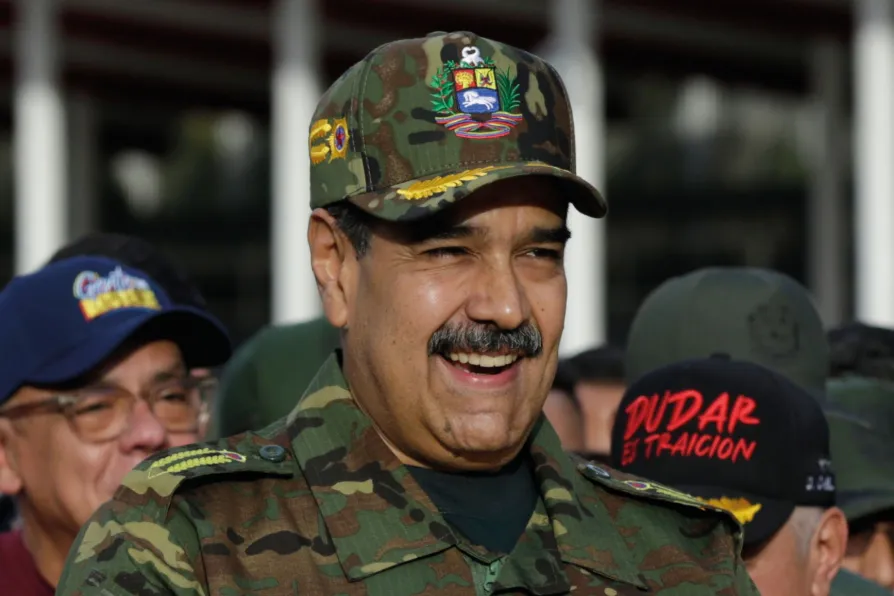 TARGETED: Venezuelan President Nicolas Maduro takes part in a government-organised civic-military march in Caracas, Venezuela, Tuesday November 25 2025
The government’s latest asylum proposals abandon labour movement values and fuel division by aping Reform UK, writes DIANE ABBOTT MP
IAN LAVERY MP warns that decades of neoliberal policies have left former industrial communities behind — but a renewed Labour commitment to working people could change the political landscape
We need a government that invests in saving lives not destroying them, argues SOPHIE BOLT
HENRY FOWLER outlines the GFTU’s new 2026-27 education programme and argues that investing in trade union education is essential to building worker power, developing leaders and strengthening collective action
PAOLO SANTALUCIA reports on how an Italian region defies US pressure to end a Cuban doctors programme





WE HAVE grown used over the years to client regimes in the Middle East and parts of Africa doing the bidding of the various colonial rulers.
Sadly, these “misleaders” are not restricted to those regions. We are seeing the same spectacle playing out across the Caribbean as the United States looks to cement its control over what it patronisingly regards as its “backyard.”
The far-right government of US President Donald Trump has ramped up pressure on Venezuelan President Nicolas Maduro.
The US military has conducted bomber flights right up to the coast of Venezuela, to simulate an attack and strike fear into the hearts of Venezuelans.
The US has sent the USS Gerald R Ford, the world’s largest and most expensive aircraft carrier, to the Caribbean. This comes with a carrier strike group with 4,000 sailors and dozens of military aircraft aboard the lead shift.
This massive force was added to what was already the largest US armada assembled in the Caribbean Sea near Venezuela in generations.
The Trump administration has also carried out a series of strikes on small boats in the Caribbean Sea and eastern Pacific Ocean that it accuses of ferrying drugs to the US, killing over 80 people in total since the campaign began in early September.
This is certainly a message to Venezuela that the US could launch an air attack or, though less likely, a ground force into their country. But it would be a grave error to believe that this is not also a message to the rest of the Caribbean to stay under “manners.”
This is all an expression of the infamous US Monroe Doctrine.
The Monroe Doctrine — essentially to boost the commercial and security interests of the US in the western hemisphere — emerged from three paragraphs in president James Monroe’s annual address before the US Congress on December 2 1823.
The doctrine addresses how the United States would conduct foreign relations with newly independent nations in Central and South America and how to curb European ambitions in western hemisphere territories.
Between 1810 and 1822, 15 Latin American colonies declared independence from the Spanish empire; 10 alone between 1821 and 1822.
Monroe’s administration was unsure of its ability to control the newly independent governments and hesitated in recognising the new nations.
But the interests of the US also included guarding against the threat of recolonisation. The US could not allow the centre of power in the region to revert back to Europe.
But it wasn’t until the late 19th century that US hawks began to openly argue for the use of the doctrine as a justification for direct intervention in Latin America and to use it as a means of increasing the country’s influence in the western hemisphere.
It’s difficult to imagine given where the world is now but the US military was nowhere near as powerful as we know it today.
Enforcing the doctrine was a problem for the US until after the country’s civil war.
After that the US was able to build up its armed forces and, at the same time, expand its diplomatic, including its intelligence networks, in the region and the rest of the world.
US control of the region stems from its need to control unfettered access to trade routes and the mineral resources required by US monopoly capital — and the cheap labour that goes with it. That helps us understand the actions of client regimes in the region.
A number of nations in the Caribbean region have humiliated themselves by showing that their allegiances lay with the US empire rather than their people and their most immediate neighbours.
These client regimes have given diplomatic support to the US and even allowed themselves to be used as aircraft carriers for the massive US military build up in the region.
Oil-rich Trinidad & Tobago, only seven miles from Venezuela, has declared full support for US military bullying.
In October the US navy destroyer USS Gravely carried out military drills in Trinidad & Tobago for several days, a move denounced by Venezuela as a “hostile provocation” as they suspended existing bilateral gas agreements with the Trinidadians.
The Venezuelans rightly described Trinidad & Tobago as being an “aircraft carrier of the US empire against Venezuela.”
Guyana, which is experiencing a record-breaking oil boom, bought into the whole US lie that Venezuela is somehow a key player in organised crime — particularly the drugs trade.
The Guyanese made it clear they were backing the US military deployment in the region to “tackle transnational organised crime.”
In early November, a US air force military gunship was spotted by satellite imagery in El Salvador’s Comalapa Co-operative Security Base.
Until recently this base was only used for unarmed aircraft. The location of the base near the coast is strategically important for the US in the Pacific, as the reach of the bases in the Caribbean is limited.
It is worth remembering that the US sided with right-wing Salvadorean President Nayib Bukele over the removal of presidential term limits.
Bukele is a big fan of US President Donald Trump and is likely to side with Washington.
Panamanian President Jose Raul Mulino has endorsed military training exercises with the US but has denied that his country is participating in any “hostile act against Venezuela.”
He claims unconvincingly that the manoeuvres are part of existing bilateral co-operation agreements with Washington.
Panama has hosted military exercises every year since the US invasion of the country in 1989.
The military co-operation with the US appears to be deepening, with Panama agreeing in April to a greater US military presence on its land.
The Dominican Republic President Luis Abinader recently said his country will allow the US to operate inside restricted areas in the country to help in the fight against drug-trafficking.
For an unspecified period, the US will be allowed to refuel aircraft and transport equipment and personnel at restricted areas with the San Isidro Air Base and Las Americas International Airport.
Not to be left out, Puerto Rico, a self-governing US territory, already contains the most US military bases in the Caribbean.
There is of course Guantanamo naval base on a US-occupied section of Cuba, plus the air base the US has in Honduras staffed by more than 500 personnel.
US client nations across South America, such as Argentina and Paraguay have also given their support to the ramped up presence from Washington in the region.
The US is using its full military and economic power to bring other nations on board within the region. To be fair, they didn’t need much persuasion. This is, after all, really about propping up the increasingly fragile US empire.
The (mis)leaders of the region must be removed and replaced with people who serve the interests of the people and not US monopoly capital.
This fact will become increasingly clear to the people if the US eventually unleashes its military might against Venezuela. It is likely already crystal clear.
