
A California union’s decision to host a meeting about US policy towards Cuba has prompted a congressional probe and renewed attacks on international solidarity, writes CAMERON HARRISON


There’s still time to save what’s left of Scottish shipbuilding
Holyrood incompetence has cost jobs and put the future of Clydeside’s Ferguson Marine shipyard into jeopardy. Its future should have been assured, argues KENNY MACASKILL
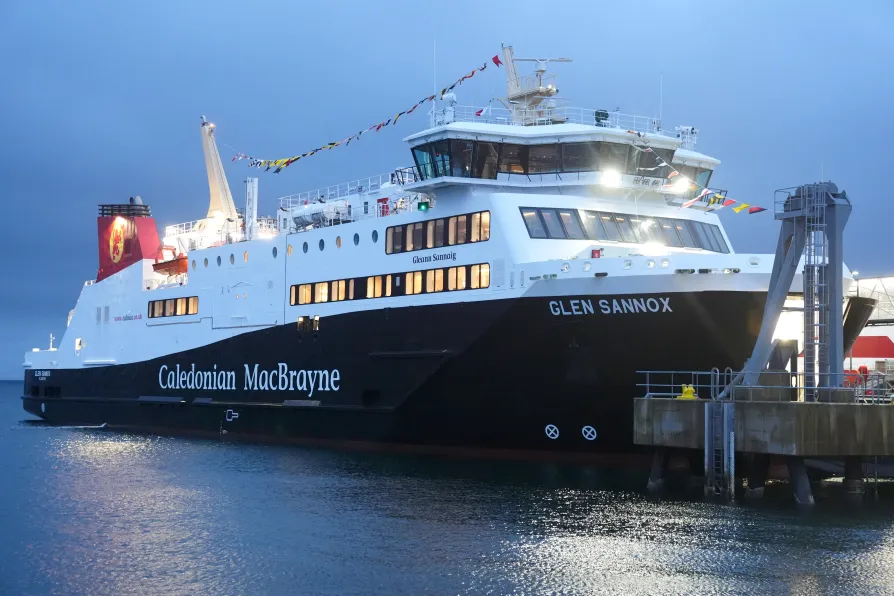
 The Glen Sannox ferry journeys from Brodick on Isle of Arran to Troon on its first official day in service. The ferry was built at the Ferguson Marine shipyard in Port Glasgow. Andrew Milligan/PA Archive/PA Images

The Baltic state is set to reverse its constitutional prohibition on nuclear weapons and foreign bases as part of accelerated Nato war preparations, warns TOM UNTERRAINER
Long-term underfunding and state neglect, while simultaneously probation services have been undermined, have intensified the prison crises, argues SOLOMON HUGHES
With the agitated debate now raging in the media about the early release schemes, Prison Officers Association general secretary STEVE GILLAN gives the view of those who work in the sector
The hounding of the late Jason Arday is an all too familiar experience for many black people. ROGER McKENZIE calls for collective action to combat what can feel like personal isolation





THE loss of jobs and the threat to Ferguson Marine Shipyard in Port Glasgow on the south bank of the River Clyde is a blow to the workers and a knife at Scotland’s industrial heart. Yet it could have been so different. The shipyard was set to close in 2014 when Alex Salmond’s government persuaded billionaire Jim McColl, of the hugely successful Clyde Blowers engineering business, to take it over.
Then, as now, it was situation critical for the workers, the community and even Scotland. It’s the last shipyard on the Lower Clyde, a river once synonymous with the industry and where the words “Clyde Built” testified to the skills of generations of workers.
Yet the demand is out there and the work is badly needed. It’s absurd that Scotland, a nation surrounded by water with islands all requiring maritime transport should need to import vessels. At the same time, new opportunities from offshore wind energy facilities require construction and servicing, with waterborne transport again playing an essential role. But where will the vessels come from if the shipyards are not here to build them?
McColl saw those opportunities. The Caledonian MacBrayne (CalMac) ferry fleet which services Scotland’s coastal communities was ageing. Several vessels needed to be built each year for decades to come. These in turn would require eventual replacement. There was also demand for vessels to service the renewable energy revolution, just as decades before the yards had turned to the construction of rigs for oil and gas. Beyond that, international orders could be obtained, as had once been the case for “Clyde Built” ships. Thoughts turned not just to protecting the existing yard but, in due course, to expanding it and even opening other yards elsewhere on the Clyde. But those dreams, from both the businessman and the workers, soon turned to dust.
Very early on, ships were required for the CalMac passenger/car ferry service for the Isle of Arran on the Firth of Clyde. The first ship was named the Glen Sannox. Discussions began between the yard and the procurement agent Caledonian Marine Asset Limited (CMAL). The former were keen to obtain the order, but the latter were certainly not supportive of the yard getting the business. However, a Scottish National Party (SNP) conference was approaching and the then new First Minister, Nicola Sturgeon, was keen for a flagship announcement. What better than a new ship, for a hard-pressed island community and from a Scottish yard too.
The announcement was made without the precise terms of the work being agreed and with the overseeing body objecting. Compounding those issues was the argument that the proposed vessels were the wrong type. The word on the street, not just in the yard, was that CalMac didn’t want them. Officially the company denies that. But the vessels were to be dual-fuel, marine diesel/liquefied natural gas (LNG) powered, a technology largely untried on ships of this size. Infrastructure storage for LNG didn’t exist in Scotland, with supply coming from the Isle of Grain in Kent. The use of LNG within urban ports is proscribed, rendering the ships unsuitable for several key routes. Finally, the LNG system was unusable for much of the Arran route. The difficulties faced by the ferry service today, after a delayed completion which was originally slated for 2018, is evidence that these misgivings were well founded.
Costs rose, which was understandable given the complexity of the work and that precise terms had not been ironed out. The relationship between McColl and CMAL soured. The businessman tells of a meeting with Derek McKay, the Scottish government minister in charge of the project, who said that he couldn’t intervene as the CMAL board would resign en masse.
The whole of Scotland, not just workers at Fergusons and CalMac, would have cheered such an outcome. There is no purpose for an agency, such as CMAL, which was an EU-inspired organisation meant to oversee privatisation of public services and the compulsory tendering of routes. In any event CMAL was a board stuffed with corporate suits rather than naval uniforms or boilersuits. Of course, McColl didn’t get everything right but most of the blame lies elsewhere.
It seems that the minister worried that in resigning the board would say that it was because they had been forced to order against procurement rules. McKay folded, the situation worsened as costs rose and delays on delivery lengthened. Rather than step in and abolish CMAL, the Scottish government effectively took over the yard.
Nationalisation was to prove no salvation. The underlying problems with the Glen Sannox remained. Worse still, the Scottish government then signed off the construction of a sister ship the Glen Rosa with the same specifications. A textbook example of the definition of madness, repeating the same failure. The Glen Rosa now having no more joy than the ill-fated Glen Sannox.
It need not have been this way. Contracts hadn’t been signed and alternative models were available. A catamaran which outperformed the dual-fuel model on every index from cost, fuel economy, environmental impact, to passenger and vehicle carriage, was offered. It came from an overseas Scot with a booming business in Australia and Asia. From Clydeside originally, he grieved at what was happening in his native land and offered the license for a song. CMAL refused, arguing that catamarans were unsuitable for the weather although as Stuart Ballantyne, the designer and owner, stated his ships sailed the seas around the Philippines where typhoons raged.
In between these stormy periods, some orders for small vessels have gone to Fergusons. They are more suitable given the lack of a large hangar, which has hampered work for the yard on the larger Glen Sannox and Glen Rosa vessels. But the orders are not nearly enough. Instead, yards in Turkey and Poland got the business. Meanwhile, work has declined at Port Glasgow and some orders have yet to be formally approved. Hence the layoffs.
Blame rests not with the workers or the billionaire but with the Scottish government and its quango. The skills and demand remain, the dream should be made reality. The yard, the Clyde and the country deserve no less.

Similar stories
Building is the solution for much of our housing crisis – and will also help to address poverty, ill health, and even anti-social behaviour and alienation, writes KENNY MacASKILL