A California union’s decision to host a meeting about US policy towards Cuba has prompted a congressional probe and renewed attacks on international solidarity, writes CAMERON HARRISON


Privatisation undermines safety and security in British prisons
Long-term underfunding and state neglect, while simultaneously probation services have been undermined, have intensified the prison crises, argues SOLOMON HUGHES
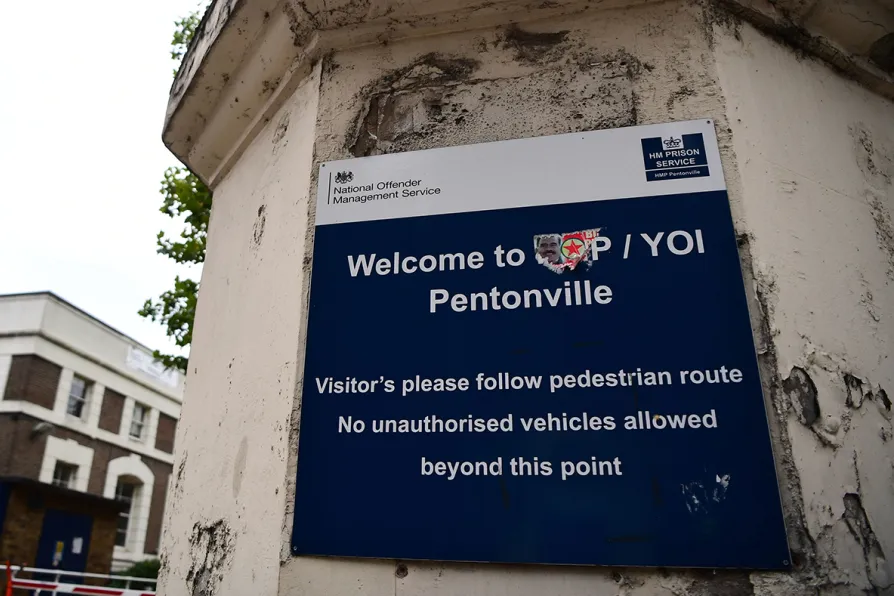
 HMP Pentonville, north London. The prison, one of Britain's oldest, is overcrowded, crumbling and porous to drugs, weapons and mobile phones. (Victoria Jones/PA Archive/PA Images)

The Baltic state is set to reverse its constitutional prohibition on nuclear weapons and foreign bases as part of accelerated Nato war preparations, warns TOM UNTERRAINER
Holyrood incompetence has cost jobs and put the future of Clydeside’s Ferguson Marine shipyard into jeopardy. Its future should have been assured, argues KENNY MACASKILL
With the agitated debate now raging in the media about the early release schemes, Prison Officers Association general secretary STEVE GILLAN gives the view of those who work in the sector
The hounding of the late Jason Arday is an all too familiar experience for many black people. ROGER McKENZIE calls for collective action to combat what can feel like personal isolation





REPORTS in mainstream media of the prison crisis flip between two apparently opposed narratives: first, prisons are so full that they are close to collapse; second, certain categories of prisoners must not be released as the government tries to avoid prison collapse.
Most media outlets prefer the latter version. It is full of shock, shame and “human interest.” Solely discussing which prisoners are too extreme to let out is a way of avoiding how we got into this state in the first place. This is a massive failure of the most basic aspects of the state.
Examine the prison crisis and you repeatedly find two themes — underfunding and privatisation.
The basic problem brewed in the long years of austerity. Then the Tories put more people in prison for longer, under tough-sounding “law-and-order” policies, while refusing to build enough new prisons or maintain existing decrepit jails to create the places to put them.
I want to start at one of the best possible ways out of the crisis — probation. Prisons take money and a long time to build. But hiring and training probation officers could be quicker and less costly. Properly supervised probation could be a safer and more humane way to deal with the large numbers of offenders overwhelming the jail system.
The prisons crisis is a Tory-made problem, but Keir Starmer’s Labour was also irresponsible. It knew it would be forced to release offenders early to stop prison collapse but did not make a large enough investment in probation.
Instead, it allowed the probation system to continue its drift into crisis. Last October, spending watchdog the National Audit Office (NAO) examined probation and painted an ugly picture. Probation had already suffered badly when three-quarters of the service was privatised in 2014. Huge sums were paid to multinational corporations such as MTC and Sodexo to run probation. However, the NAO found privatisation “achieved poor value for money for the taxpayer,” which is a dry way of saying the contractors’ work was so bad that even the Tories were driven to end contracts early and renationalise the whole service in 2021.
However — and this is a warning for future nationalisation programmes — renationalisation alone didn’t fix the damage. After the privatisation rip-off came public underfunding.
The NAO found “the probation service has remained under significant strain, with staffing shortfalls, increasing pressures and continuing poor performance.”
Using the NAO’s work this February, the public accounts committee of MPs declared that probation was being “pushed to the brink of collapse.”
Conservative MP Geoffrey Clifton-Brown, who chairs the MPs’ committee, said: “It was deeply alarming to hear of probation staff working under immense pressure in a seemingly toxic environment, in a culture built on emotional strain and trauma.” The vacancy rate for probation officers increased from 14 per cent in 2021 to 21 per cent in 2025.
So, just at the point when the prison crisis meant the government needed to release prisoners, the probation service, which will manage these early releases, is also close to collapse.
There is another layer of privatisation. Probation relies increasingly on electronic tagging to monitor released offenders. Numbers tagged are expected to double to around 22,000 this year.
Electronic tagging, which costs around £133 million a year, is outsourced to Serco. However, an NAO report from this July reveals Serco gave “poor performance” on tagging.
After initial failures, the Ministry of Justice managed to get Serco to meet its “key performance indicators” (KPIs) but they still allow Serco to meet these targets while offenders remain untagged.
“Serco’s tag-fitting KPI measures whether it has made two attempts to tag an individual within the required time period for 95% of cases, not whether those attempts are successful at fitting a tag.”
In a typical month, Serco met this 95 per cent target but was only successful in fitting a tag for 62 per cent of the individuals it visited after those two attempts. So almost half remained untagged. Serco operates the control room that shows if tagged offenders breached their conditions, but as the NAO notes: “Serco’s contract does not require it to provide officials with details of an individual’s breach until 29 to 53 hours after it occurs.”
Serco gets paid even when offenders aren’t tagged and their breaches go unreported.
Privatisation is no solution
Going back to the prison segment we also find underfunding and privatisation. The underfunding of prison places and repairs are well known. Privatisation has been offered as a solution.
In March 2025, Home Secretary Shabana Mahmood announced that “this government is fixing the broken prison system we inherited” by opening a private prison run by outsourcer Mitie.
Readers may remember at the time, I argued Shabana Mahmood was wrong to rely on Mitie, given its poor record of running migrant detention. Now the Telegraph reports that the 1,500-cell Millsike prison has 350 empty cells. According to the Telegraph’s source, Mitie is “struggling to staff the prison” with too many officers leaving and not enough being recruited. Worse still, in January, the Independent Monitoring Board (IMB) raised “serious concerns” over Millsike. IMB members, made up of lay visitors to prison, are a key, historic part of the justice system.
The IMB found that “staff shortages” meant some prisoners spent up to “23 hours per day in their cell.” Food “portions are reported to be small, meals are often served late, sometimes as late as 8pm, with the food frequently having been left standing for many hours on end.” Also “prisoner-on-prisoner assaults are reported to be high.”
“Drugs are easily available within Millsike and the instances of prisoners found under the influence are numerous,” with prisoners “easily making illicit items from items supplied by the prison, such as floor cleaner.” They also found “levels of use of force” by guards “are high, with frequent reports of batons being drawn.”
The IMB also found it “deeply troubling” to have “been informed that it is accepted “by the government “that new prisons may take three to four years to stabilise.”
The IMB said: “Prisoners should not be expected to bear the consequences of prolonged operational immaturity, particularly where this results in restricted regimes, compromised safety and inconsistent access to basic services.”
The IMB’s job here is to see whether prisons are humane and safe. But it is also showing that the government thinks a private prison can be badly run for years, which also means it doesn’t have enough places. This is just one more contribution to the prisons’ crisis.

Similar stories
With the agitated debate now raging in the media about the early release schemes, Prison Officers Association general secretary STEVE GILLAN gives the view of those who work in the sector