CLAUDIA WEBBE speaks out against the lethal mechanics of Britain’s culture-war press


 Latest editorial

Jason Arday and the human cost of workplace and public racism
The hounding of the late Jason Arday is an all too familiar experience for many black people. Roger McKenzie calls for collective action to combat what can feel like personal isolation
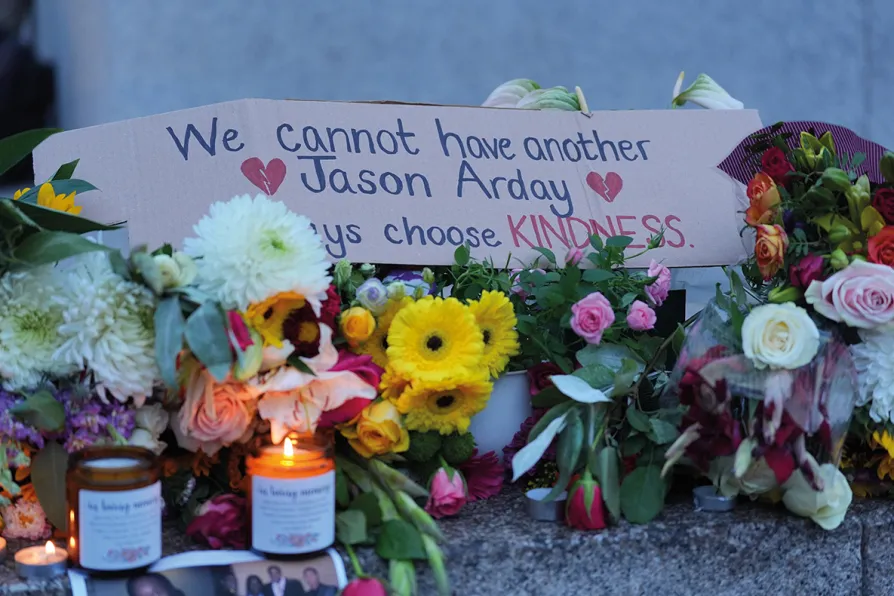 Tributes left after a vigil, organised by campaign group Stand Up to Racism, for Professor Jason Arday on the steps of the National Gallery in Trafalgar Square, central London
Powerful agribusiness interests are trying to overturn efforts by the Lula government to protect the environment and indigenous peoples of the Amazon region, writes GABRIELA SA PESSOA
Trade unions and community groups are mobilising to push back against Trump’s racist raids after new revelations of spying on legal protesters. MARK GRUENBERG reports from the US state of Minnesota
The best wildfire service may begin with the community, argues KOMAL RAJ ARYAL
The evolution of the Scottish nationalist leadership into cheerleaders for Nato has led the party to betray its pledges on Palestine and social spending, writes COLL McCAIL
While riding the No 3 bus in Glasgow MATT KERR has ample time to dissect the moribund Scottish Labour decline into near oblivion and watch intriguing bus passenger dynamics





I WAS going to start this column by saying I couldn’t believe what has happened to Cambridge University Professor Jason Arday, but sadly I can and so can many black people who have held senior positions in an organisation or found themselves in the public eye.
I’m not speaking for all black people in that position but from my own experience and in the light of the tragic passing of Professor Arday.
I never met Arday but want to convey my heartfelt condolences to the partners and two small children that he left behind. It is hard to imagine the grief they are experiencing.
What is often left out of the discussion, or sometimes vitriol, about racist attacks or harassment is the real impact that it has on the person on the receiving end.
Over time, it erodes you on the inside. No matter how much you try to show a brave face, lift your head and straighten your back to the outside world and even your own family. It eats away at you on the inside in a way that can cause irrecoverable damage.
I dare say this is what has happened to Arday. Having to justify your existence every day is no small feat. There are countless black people who will know exactly what Arday went through and fought with themselves over whether or not to take the same tragic step that he did.
Arday had been accused of plagiarism in his PhD. He denied the accusation and Liverpool John Moores University found against the complaint and upheld the award of his doctorate.
But these complaints never seem to go away if you are black.
The witch-hunt against Arday followed him around in a way that it rarely does for anyone else.
He then faced harassment over his charity fundraising, his running and over other details of his early life.
Anything that could be dug up, with any substance or not, was used to harass Arday.
I really have no idea about any of the accusations against Arday but I entirely understand how racism works and the pile-on against him was just that – racist.
On the academic side, the fact is that accusations of plagiarism are not uncommon in academia. What is entirely unusual is the amount of attention paid by the corporate media to the allegations against Arday.
Using the word “allegation” is incorrect in this instance. It was nothing short of a public lynching of Arday.
Simply put, Arday was held to a different standard than others at the university and across academia in a frenzy of racist jealousy.
In the same year that Arday was appointed at Cambridge, another professor was found to have plagiarised work but kept his job. Few reading this would have even heard that such a thing took place.
In that case, the university concluded that any “intellectual theft” was “the product of negligent acts but was not deliberate.”
One of the figures who pushed the accusations against Arday was Nathan Cofnas, a former Cambridge academic and self-described “race realist.”
Cofnas once wrote: “In a meritocracy, Harvard faculty would be recruited from the best of the students, which means the number of black professors would approach 0 per cent.”
He added: “Blacks would disappear from almost all high-profile positions outside of sports and entertainment.”
I’ve seen no evidence that Arday had been found guilty of plagiarism but those behind the campaign of vilification were not prepared to consider that there was any doubt.
I have no idea of the truth of what has occurred here. That will no doubt come to light over time.
But there is a pattern of the sort of hounding of black people in senior positions or the public eye. If you don’t believe me, go and talk with Diane Abbott, the first black woman elected to Parliament. Clearly she was one too many for some people.
Last year, in another example, a black fire-chief, Wayne Brown, took his own life because he “couldn’t take it any more” after months of alleged harassment and questions over his qualifications, an inquest was told.
Brown was found dead at his flat in Birmingham by police in January 2025.
If I had enough time and space, I could no doubt find and list many other examples.
Taking a personal example, I recall having to make a formal complaint against a colleague who clearly thought he should have been appointed to a role I had got.
I was the first black person ever to hold that specific role in the long history of that particular organisation. I like to think I was appointed because of the skills and expertise I had accumulated over many years.
My colleague took it upon himself to tell anyone prepared to listen that I had only been appointed because I was black.
The organisation investigated and gave the colleague a slap on the wrist. I was told by the senior manager who was investigating my complaint that “You didn’t expect us to do anything more than that did you?” My answer was of course I didn’t – because I certainly did not expect them to take firm action.
That is the experience of many black people in the workplace. Our complaints about race-related matters are often dealt with in a way that is designed to make the problem go away, rather than dealing with the underlying issue of racism.
Unfortunately, it was not the first or last time that a similar questioning of my skills and expertise has taken place. I also know from speaking with other black friends and colleagues that this is far from an uncommon experience.
With respect to Cambridge University, we do know that they have only ever appointed a very small handful of black professors.
In 2024, only 0.3 per cent of Cambridge professors identified as black. This is roughly 2-3 individuals out of 759 professors.
Some 1.4 per cent of all academic staff were black.
Arday was appointed as the youngest black professor at Cambridge (age 37) in 2023.
Later, in 2025, Dr Ola Osman was appointed as an Assistant Professor (not a full Professor), becoming the youngest black lecturer in Cambridge’s history.
Being the “first black” anything is, I can assure you, not a bed of roses.
Not only is there resentment from those who think you only got the job because of the colour of your skin but also an over-the-top expectation from some other black people as well as probably well-meaning liberals.
You are often expected to bring about major changes to institutions that have developed structures and cultures designed over many years, and, in the case of Cambridge, centuries to resist change.
In many ways, you just can’t win as a black person in public life. They say we should aspire to high office but as soon as you do you face unprecedented attacks that serve to warn anyone even dreaming of following you what the likely consequences might be.
A more collective approach to rooting out racism that does not reduce someone at work to the colour of their skin but appreciates their skills and expertise is what is needed.
Racism is real. It is not a figment of our imagination as black people. Racism has consequences. Sometimes that means some of us believe we simply can’t face it any longer. More of us have faced the same dilemma as Jason Arday than many can ever imagine.

Similar stories

Tackling climate change is not just an urgent environmental necessity but provides an opportunity for economic restructuring in the interests of the Welsh people, argues KIERA MARSHALL
CLAUDIA WEBBE speaks out against the lethal mechanics of Britain’s culture-war press