The UK Prime Minister may have the regal touch in northern England, but he’s been wrong-footed on the constitutional challenges posed by the Celtic Alliance of first ministers from Scotland, Wales and Northern Ireland, argues KENNY MacASKILL


 Latest editorial
The world has money for war. Why not for Ebola?
As thousands die in the eastern DRC, a global health emergency is being starved of funds, says S KRISHNASWAMY
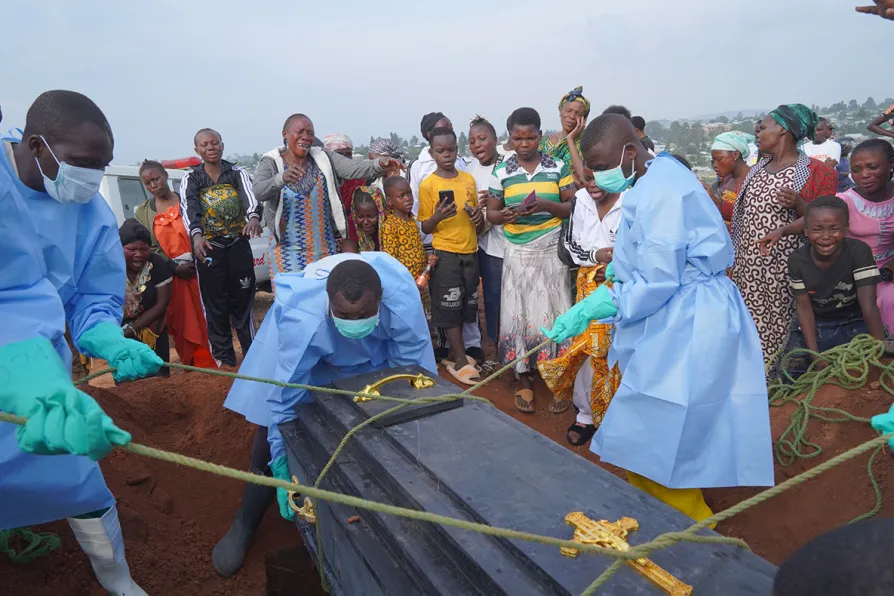
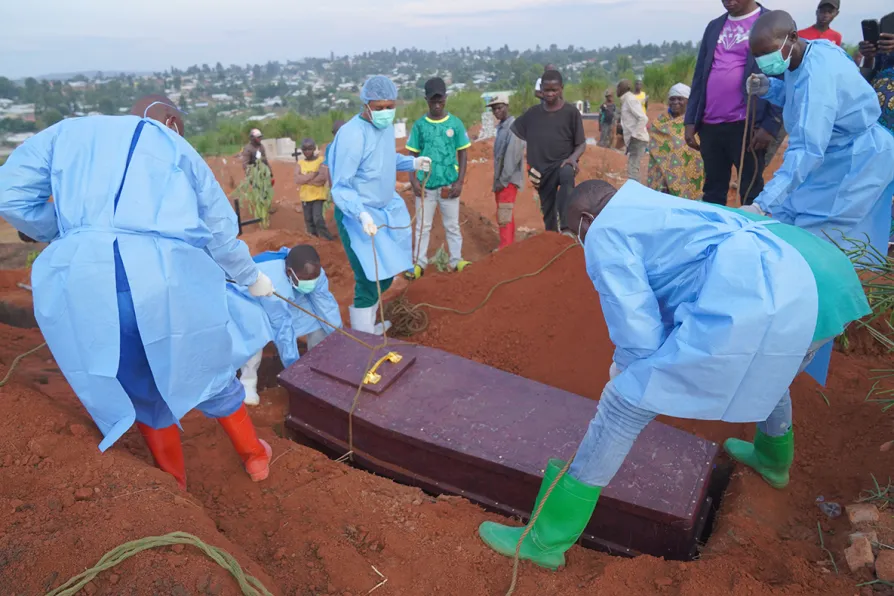 People dressed in protective gear lower into a grave the coffin containing the remains of 6-year-old Baudjo Baraka Jules, who died of Ebola, in Bunia, Ituri province, eastern Congo, August 18, 2026
NEIRLAY ANDRADE, a member of the Communist Party of Venezuela’s political committee, outlines her party’s position on the crisis facing the country
A look at Taylor Wimpey’s accounts shows why Labour’s market-led housing strategy won’t deliver more, cheaper homes, as promised, says SOLOMON HUGHES
DAVID HORSLEY remembers the remarkable life and death of US black revolutionary George Jackson, whose politically passionate prison letters were published as Soledad Brother
Cuban trade union federation CTC leader OSNAY MIGUEL COLINA speaks to Ben Chacko about life and work under a crippling US siege
A part of the British empire’s network of slavery, today the Caribbean island of Nevis faces a new form of exploitation in the form of crypto-colonialism, CLAUDIA WEBBE writes
Challenges from the unscrupulous misuse of AI to steal actors’ voice and physical likenesses is being met with a firm union response, writes LYNDA ROOKE





THE 2026 Ebola outbreak unfolding the eastern Democratic Republic of Congo (DRC) is a forgotten front line with global consequences.
It is already past the 2,299 who died in the 2018-20 outbreak. The virus is not remaining confined. It has now spread to 54 health zones in six provinces, well beyond the original three hotspots.
“We need speed, scale and solidarity before this virus gets even further ahead of us,” said Tom Fletcher, the UN humanitarian affairs co-ordinator.But that is not what we are getting. We are getting the opposite. And honestly, this stops being a health crisis somewhere along the way. It is the cost of the rich world that stopped giving a damn about anyone but itself.
Virus unchecked
The Bundibugyo species of the Ebola virus is the cause of the current outbreak. Unlike the Zaire strain that ravaged west Africa from 2014 to 2016, there are no approved vaccines against Bundibugyo virus or specific treatments for the disease it causes.
On August 7, the WHO’s technical advisory group recommended that Ervebo, the only licensed Ebola vaccine (effective against Zaire), be prioritised for a randomised clinical trial against Bundibugyo virus disease (BVD).
The recommendation came after animal studies indicated that three of four non-human primates vaccinated with Ervebo survived exposure to Bundibugyo virus. But a trial is not a solution.
Two potential Bundibugyo-specific vaccines are in early stage human trials, but they will not arrive in time to help the thousands already infected. The case fatality ratio has risen from about 20 per cent in early June to 46 per cent.
Nearly one in every two confirmed cases is now fatal.
“Normally, as an outbreak progresses, the case fatality ratio should fall,” said Thomas Parisch of Medecins Sans Frontieres.
“Instead, we’re still seeing many cases detected very late, when treatment is less likely to succeed, with many identified only after they have died in the community.”
At its current pace, the WHO warns, this outbreak is on track to eclipse the 2014-16 west African outbreak, which killed more than 11,000 people.
On August 10, the journal Nature Medicine published a study based on 21 usable viral genomes from patients in the DRC and Uganda. And the takeaway is not reassuring.
This outbreak is not the 2007 Uganda variant or the 2012 DRC one making a comeback. It is a brand new spillover. Recently, the virus has jumped from an animal into a human, with no links to past flare-ups.
That matters because we are dealing with an unknown. They have already detected 25 mutations, with nine bearing the fingerprints of host-dependent RNA editing, which is a telltale sign that this virus is adapting to humans.
The virus is fine-tuning itself to humans, even as we struggle to respond effectively. And it does not stay put. The study confirmed cross-border spread. Every Ugandan case traces back to a single transmission chain that started in the DRC.
The authors put it bluntly: no approved vaccine, no specific treatment for this strain. We are flying blind.
A tale of two responses
The contrast between the US response in 2014 and today is staggering. When the Zaire Ebola strain threatened west Africa, president Barack Obama mounted a “whole-of-government” response.
By October 2014, the US had committed more than $350 million, with the Department of Defence prepared to spend over $1 billion. Thousands of troops were deployed, including 700 from the 101st Airborne Division.
The US promised to construct 17 Ebola treatment units in Liberia, set up mobile testing labs that reduced diagnosis time from days to hours, and trained up to 500 healthcare providers per week. Today, the US is building a facility in Kenya not to treat Congolese patients, but to quarantine US people who are affected.
The European response in 2014 was similarly robust. The EU pledged over €500m. The 2014 outbreak acted as a catalyst for major institutional reforms: the WHO launched its Health Emergencies Programme in 2016, the Africa Centres for Disease Control and Prevention was established in 2017, and the Coalition for Epidemic Preparedness Innovations (CEPI) was founded.
These institutions were built precisely for moments like this. And now, lack of funding is undermining them.
In this 2026 Ebola outbreak, Uganda confirmed 20 cases and two deaths. The last case was discharged on July 16. Uganda succeeded because it has a functioning state. The government could mobilise resources, enforce quarantines, and trace contacts.
The DRC failed for the opposite reason. Armed groups control vast swathes of land; the government’s authority extends only to a few cities, and conflict displaces millions.
Why is the DRC so weak? The DRC remains weak because Western extractive interests have systematically ensured it stays that way. The DRC is one of the richest countries on Earth in terms of mineral wealth: cobalt, coltan, gold, diamonds, and copper.
Western corporations and governments have spent decades ensuring this wealth flows outward. And not to its people. Those who gain from the chaos fuel its civil wars. In the eastern DRC, the M23 rebel group, which Rwanda — previously a darling of the US and Britain — funds, has caused significant destruction.
The war catalyses the virus’s spread. Ebola is a disease that thrives in collapsed states. The 2014 outbreak devastated Guinea, Liberia, and Sierra Leone. All of these countries were emerging from decades of war. The current outbreak unfolds in eastern DRC, which has known nothing but conflict for the last 30 years.
Money for war, not for vaccines
On June 1 2026, CEPI announced urgent funding for three vaccine candidates targeting the Bundibugyo virus, developed by IAVI, Moderna, and the University of Oxford.
Each uses a different validated vaccine technology. CEPI’s own estimate shows that emergency funding of $270m is urgently required, with roughly half having been pledged, leaving a $135m gap.
The total programme cost is estimated at $525m. Even in the best-case scenario, vaccines will not be available for emergency use for many months. By then, thousands more, of course Africans, will have died.
The World Health Organisation, which is specifically designed for moments like these, has been systematically undermined by the United States, under the new US slogan “USA First and Last.”
The WHO has warned that under a severe scenario, this outbreak could last for nine to 12 months. By then, it may well surpass the 11,000 deaths of the 2014-2016 epidemic.
CEPI’s funding appeal is $270m, less than the cost of a single advanced stealth fighter jet. To put the current situation in perspective, the war against Iran cost the US an average of over $1bn per day. Yet CEPI’s request is being treated as an impossible ask.
The world has money for war, for walls, and for borders. But for vaccines, treatments, and the basic infrastructure of global health security, there is not enough. In 2014, the US was prepared to spend over $1bn to fight Ebola in west Africa. Today, it has effectively abandoned the WHO and all those who have travelled to the DRC, Uganda or South Sudan within the previous 21 days are completely barred from entering the US. The institutions built after 2014 are being starved of resources just when needed most.
The virus is not malevolent. It is indifferent to human suffering. The malevolence belongs to us — to a global response that treats an African catastrophe as a distant tragedy until it threatens Northern shores.
This indifference is a response to leaders who build walls while the pathogen finds every crack. This is a system that possesses the resources to save lives but instead opts to safeguard borders.
A response that echoes the chilling indifference of the French monarchy to the suffering of its people: “After me, the deluge.”
This article first appeared at peoplesdemocracy.in.

Similar stories