Supporters from both sides prepare to stand together against season ticket threats and exploitation, writes JAMES NALTON


 Latest editorial
When survival matters more than victory
From Frazier in Manila to Wardley in Manchester, the decision to stop a fight remains boxing’s greatest moral test, writes JOHN WIGHT
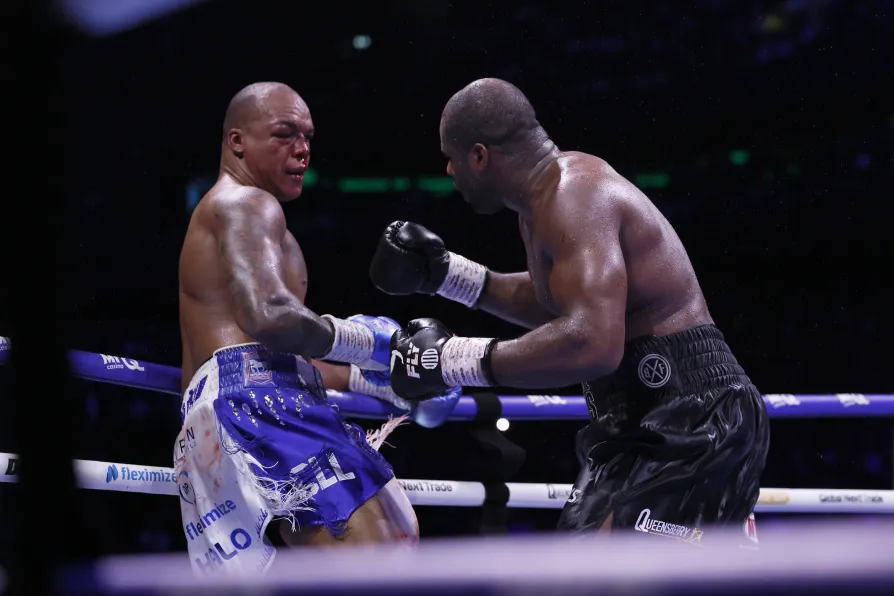 Fabio Wardley (left) and Daniel Dubois during their WBO heavyweight title bout at Co-op Live, Manchester, May 9, 2026

French federation withdraws support as pressure mounts on Fifa president





“SIT down, son. It’s all over. No-one will forget what you did here today.”
These words were spoken by trainer Eddie Futch to Joe Frazier at the end of the 14th round of arguably the most punishing heavyweight fight ever fought. This was when Frazier faced his boxing nemesis, Muhammad Ali, in Manila on October 1 1975. Billed as the Thrilla in Manila, Futch’s words at this critical point in this most consequential of heavyweight battles have more than earned their place in boxing folklore as the most profound example of a trainer saving a fighter from himself.
The courage displayed by Futch in pulling his fighter out at such at late stage was only matched by the courage displayed by Frazier in this, the final bout of the trilogy he fought against Ali.
Frazier never forgave Futch for pulling him out of the Thrilla in Manila with just one more round left to go, which is tragic on its own terms.
Futch’s decision to pull Frazier out of a fight of such magnitude with just one round left has been brought into particularly sharp focus this past week, in the wake of the all-British brutal domestic heavyweight clash between Daniel Dubois and Fabio Wardley.
Unfolding at a sold-out arena in Manchester was less a world title fight with sport in mind, and more a test of human will with survival at stake. Wardley went in as WBO champion and left the victim of a vicious beating that may well have ramifications for his health, never mind wealth, going forward.
By the time referee Howard Foster stopped the fight in the 11th round, Wardley’s face was a mask of blood, with much of it splattered on Foster’s own shirt. In the aftermath, a chorus of voices within the sport have lamented the decision of Wardley’s trainer, Ben Davison, to allow the action to continue for so long. The consensus is that he should have pulled him out three rounds before Foster stepped in, in order to spare his fighter the punishment he sustained towards the end.
Taking a broader view, within boxing the decision by either the referee of a fighter’s corner to stop a fight constitutes a moral conundrum. This is where the trainer-fighter relationship is so critical. If a fighter feels that his trainer has pulled him out of any fight — but especially a world title fight — too early, then the trainer can expect to find himself being fired.
The consequences of not pulling his fighter out at a certain point are clear and obvious too, though. Eddie Futch understood this well, when he said years after the Ali-Frazier fight in Manila: ‘“I thought, ‘He [Frazier] is a good father and I want him to see his kids grow up.’”
Futch is credited with developing Frazier’s bobbing and weaving style, utilising his relatively small stature as a heavyweight to his advantage by coming in low to force his larger opponents to punch down and thus lose a significant portion of their power. In so doing, Eddie Futch did much to turn Joe Frazier into the ring legend he became.
But even ring legends are human, with the failure to recognise the fact the reason why so many ex-fighters find themselves a physical and cognitive shadow of the person they once were. Whatever happens now with Fabio Wardley’s career, he may well live to regret not having an Eddie Futch in his corner against hard-hitting British rival Daniel Dubois in Manchester last weekend.
Speaking of ring legends, Nikolay Korolyov qualifies for this accolade on multiple levels. Born in Moscow in 1917 — the most tumultuous year in Russian history and one of the most important in world history — Korolyov entered the world of work at the very point at which the Soviet Union’s programme of rapid industrialisation was at its zenith in the mid 1930s.
Nikolay, though, was marked out for a different path in life when while working out at his factory gym one evening, he caught the eye of Ivan Stepanovich Bogayev, one of the pioneers of Soviet-style boxing. Not long thereafter, Korolyov entered the Stalin Technical School of Physical Culture, where he rapidly became a leading light.
Fighting as a heavyweight, Korolyov became Soviet champion for the first time towards the end of 1936. The following year, 1937, he took gold at the sixth Workers’ Olympiad in Antwerp, Belgium. Established in 1925, the Workers’ Olympiad brought together men and women of all nationalities, cultures, and races from across the world at a time when the conventional Olympic Games were still the preserve of the monied classes.
By now, 1937, the drums of looming war were beating across Europe at a time when the Spanish civil war was raging, and when Hitler and Mussolini were rearming. The Soviets were also preparing for what would be a total war against the forces of Hitlerism, and it was in 1939 that Nikolay was called up for military service.
In what would provide the material for an epic movie, Nikolay Korolyov initially began his service as a trainee fighter pilot, until an accident ended his chances of becoming one. When the Nazis invaded in 1941, he heeded the call and enlisted with a specialised sabotage unit to operate behind enemy lines.
There he became partisan, fighting with distinction under the leadership of the famed Hero of the Soviet Union, Colonel Dmitry Nikolaevich Medvedev. In his autobiography In the Ring, published in 1950, Korolyov describes one combat mission in which he saved the life of his commander: “There were 500 punitive men [German troops], and there are no more than seventy of us … I see that the commander cannot move. I threw him on his back and went quietly. I think not in vain in sports was involved. From a [kilometre] I went like that.” For this act of valour in combat, he was awarded the Order of the Red Banner.
Nikolay Korolyov resumed his boxing career after the war, until finally retiring in 1956 aged 39. At one point there was talk of him fighting the great American heavyweight, Joe Louis, but geopolitics intruded and it never happened.
He died in 1974. Or at least his body did. His deeds both in and out of the ring live on.
