WILL STONE samples the 20th anniversary atmosphere of this eclectic end-of-season indie festival


 Latest editorial
When social oppression becomes supernatural
ANDY HEDGECOCK is enthralled by a collection of South Korean ghost stories where human behaviour is as chilling as any spectral activity
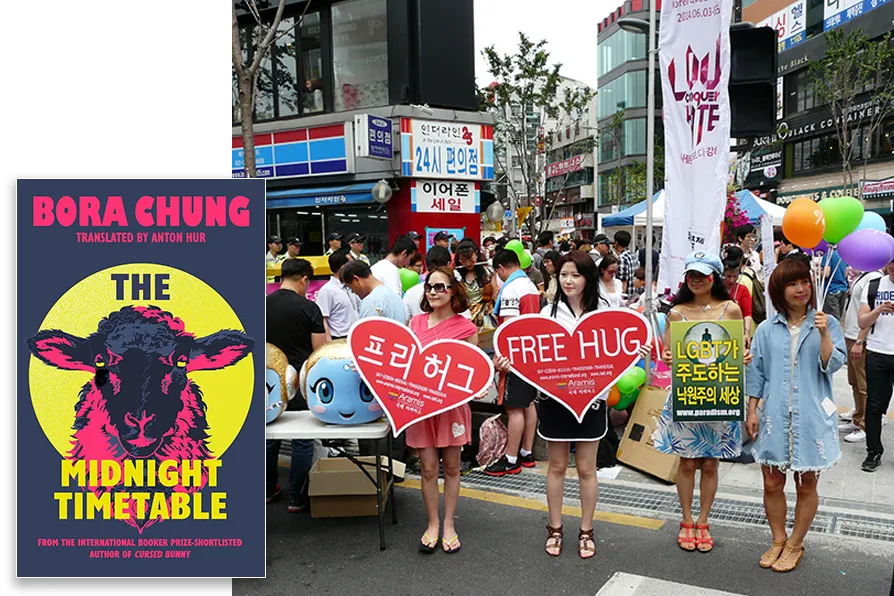 FIGHTING THE TIDE OF OPPRESSION: South Korea Queer Culture Festival 2014 [Pic: Piotrus/CC]

Comics are not just superheroes and spandex – it can be public art, telling public stories, suggests HARRIET EARLE
The bard serenades the Diggers of Wigan and their festive followers
ALEXEI SAYLE speaks to Angus Reid about a lifetime of protest, how to hone political art – and what to do now
ANDY HEDGECOCK, JAMES WALSH, LEO BOIX and MARIA DUARTE review Just An Illusion, Everybody Digs Bill Evans, Blue Film, Oasis: Don’t Look Back in Anger, and Runner
MARIA DUARTE recommends a nerve-wracking reconstruction of the 72 hours before the Normandy landings





The Midnight Timetable
Bora Chung, Dialogue Books, £14.99
INITIALLY, the new story collection from South Korean writer Bora Chung demands a high level of concentration, but once the reader tunes into its stylistic and structural quirks the effort is well rewarded.
Chung fuses the characteristics of the traditional folktale with those of contemporary short fiction. Characters are closer to archetypes than in-depth psychological studies; the notion of restless spirits is presented without explanation or critique; and the pacing is frenetic, with the focus switching from one supernaturally charged incident to another.
The style is terse but allusive and there are metafictional games — shifts of viewpoint, stories within stories, frequent digressions and unreliable narration.
Every story is linked to the Institute, a mysterious storage facility for haunted objects and creatures. Developing a mental map of the place is impossible: corridors shrink and extend; staircases and doors appear and disappear. Some narratives unfold within this weird and provisional architecture; others take place in distant localities or mythical realms but are narrated by Institute staff.
You Can’t Come In Here — a tale using the conventions and imagery of urban horror to examine the psychological damage caused by “gay conversion therapy” — introduces us to the main narrator and her “sunbae,” a Korean term for a workplace mentor.
The focal character is Chan, who defies the sunbae’s guidelines for surviving the Institute’s hazards and hauntings by making a sound recording of a phantom bird. As a result, his motorbike ride home becomes a nightmare. Lost in an endless tunnel, he considers suicide but comes to realise salvation may be found by embracing his sexuality.
In Handkerchief, the rejection of social obligation leads to a series of hauntings, not all of them supernatural. A man inherits the bulk of his late mother’s wealth but becomes fixated with an object she insisted should be cremated with her — a satin handkerchief embroidered with birds and flowering trees. His obsession triggers pursuit by a mob of blue faces. Meanwhile, his wife finds a blue-faced and green-toothed spectral woman in their bed.
The handkerchief resurfaces in Bluebird, an exploration of society’s subjugation of women in the form of a revenge-based fairy tale. The theme of vengeance recurs in Why Does The Cat, in which a man’s preoccupation with his sense of self leads to murder, animal cruelty and the fatal neglect of a child. The killer escapes the notice of the law, but not the attention of the dead.
Cursed Sheep features a man who gains employment at the Institute to gather material for his livestreaming channel. After breaking into a lab and stealing a training shoe, he is first subjected to subtle forms of menace — such as every small object in his home being moved to point at the door — and later to direct threats and surreal violence.
On the surface, Silence Of The Sheep, involves vivisection and haunting by a dead sheep, but its real theme is the struggle of the Institute’s deputy director to cope with economic discrimination and free herself and her daughter from a bullying husband. Her determination to survive is augmented by magical phenomena.
Sunning Day is a brief coda recapping the histories of the Institute’s haunted objects. It reminds us that human behaviour can be as chilling as any spectral activity. Chung is too shrewd a writer to explain all the mysteries of the Institute, but it’s clear her allegorical horror stories are critiquing power imbalances relating to sex, workplaces, money, status, family traditions, animal exploitation and the law.
The Midnight Timetable is a challenging but entertaining collection. Some stories are poignant, some funny and some genuinely unsettling. All are nuanced and provocative.
