ANDY HEDGECOCK and MARIA DUARTE review Late Fame, The Death of Robin Hood, Leviticus, and Gail Daughtry and the Celebrity Sex Pass


 Latest editorial

We are humans, not zombies
ELLIS RAE is persuaded that the advantages of the ‘talking cure’ are superior to the treatment of mental illness with drugs
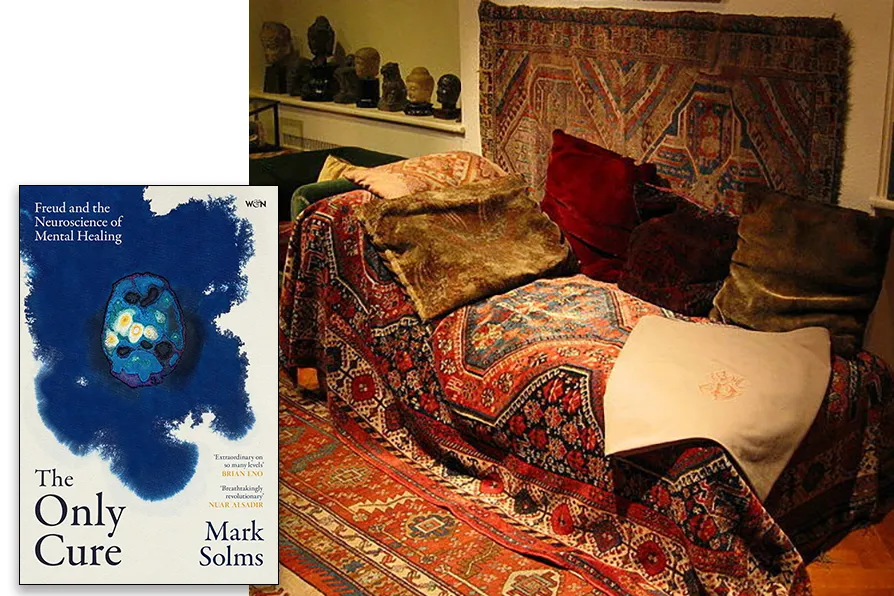 PLACE OF HEALING: Sigmund Freud's couch [Pic: ROBERT HUFFSTUTTER/CC]

GORDON PARSONS enjoys Kant’s ‘mind-boggling’ theory of human reality: that we create the reality we experience
DAVID RABY welcomes a biography that emphasises how Fidel’s unique characteristics became hallmarks of the ongoing Cuban revolutionary process
IAN SINCLAIR recommends a readable, if partisan, account of the astonishing campaign of New York's new mayor
MATTHEW HAWKINS witnesses a contemporary ballet that represents human life as subjected to artificial intelligence
by Marwa Paikan





The Only Cure: Freud and the Neuroscience of Mental Healing
Mark Solms, W&N, £25
IN the Only Cure, author, neuroscientist, and psychoanalyst Mark Solms poses a radical challenge to the way mental health is viewed and treated today.
The book is structured around the argument that mental health issues are not treated properly in modern society, with a strong implication that privatised healthcare bears responsibility for this.
Solms believes that psychoanalysis, a kind of talking therapy, is the real way to cure mental illness. This is because psychoanalysis treats the cause of mental illness, not just the symptoms. The Only Cure launches a critical appraisal of Freud, defending much of his thought, while attacking the parts that lack modern scientific grounds. Solms likens Freud to other thinkers, revolutionary in their field, yet often misunderstood, such as Nietzsche or Marx.
The Only Cure is a book that does a lot, part history, part science, and part autobiography. Solms’s dry wit cuts through the dense subject matter, often showing the ridiculous nature of scientific methods that leave human beings at the door in the search for scientific objectivity.
One such case is Solms’s account of research conducted upon rats. A group of rats are forced to swim in a tank and the first one to give up is studied, selected because it is said to emulate the effect of depression. He points out the obvious fact that a drowned rat is a poor substitute for a human being. He argues, instead, that if you want to understand and treat depression, talk to someone who is depressed.
Much like Freud, Solms gives examples from his clinical practice as a talk therapist, sharing his experiences with both practicing and going to therapy. One especially stark story comes from an account of Teddy P, not his real name, a young doctor he treated. Teddy P went to the doctor with depression who proscribed him drugs and then more drugs to treat the side effects of those drugs and more drugs to treat those side effects, and so on and so on. Poor Teddy P found himself zombified, unemployed, and dumped for his impotence. But with the intervention of talking therapy, Teddy P turned his life around.
As Solms explains, talk therapy works because it teaches us to understand what motivates us, and how to meet those needs in a healthier way.
In modern healthcare mental health problems are seen as “diseases,” the method of treating them being the proscription of drugs. Yet, we still don’t understand what many of these drugs actually do. They say that depression is caused by a lack of serotonin, but this is only because SSRIs (Selective Serotonin Reuptake Inhibitors) are effective when used. Solms likens this diagnosis to saying that someone with a broken limb should be treated with a pain killer, with the diagnosis being a lack of opioids in their system rather than their broken leg.
There are, however, some problems with his argument. Solms admits that the talking cure is too expensive, rarely being freely available. Social and economic factors, like class, are very significant when it comes to rates of mental illness. Where talking therapy can help, it is costly and requires time, whilst drugs are cheaper and more profitable to produce. Solms calls psychoanalysis a “civilisational” task, but he has little to say in terms of answers to these issues.
If it is symptomatic of capitalism that the treatment is commodified, then Solms’s dream can only become reality in a society that can surpass the market, a society that meets people’s needs.
The Only Cure is a fascinating read that is likely to convince you with much of its argument. It has certainly convinced me.
