

 Latest editorial
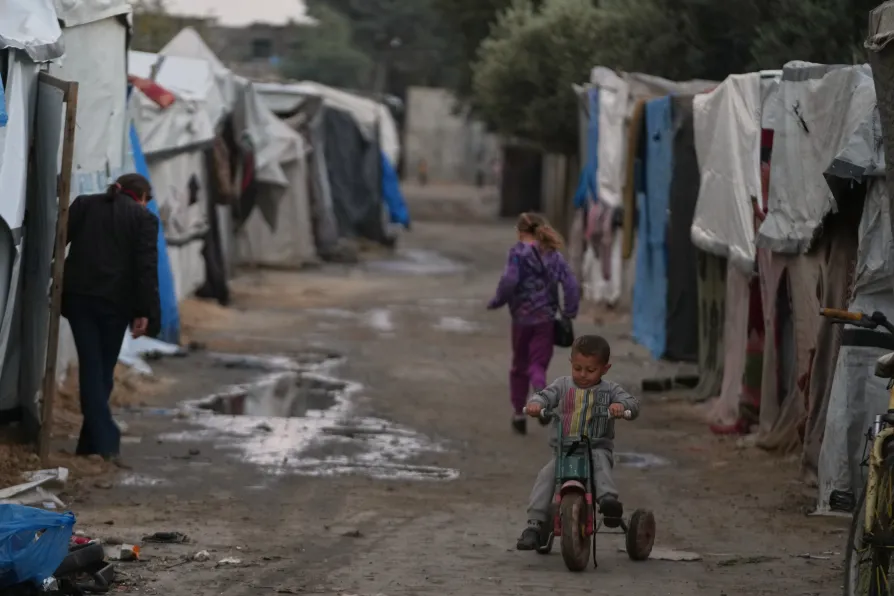 UNDER CONSTANT THREAT: A child rides his tricycle along an alley of a makeshift tent camp for displaced Palestinians in Deir al-Balah, central Gaza Strip






GAZA has suffered “extensive” contamination with unexploded bombs due to the destruction caused during the recent Israel-Hamas conflict being “so immense and wide-ranging,” the world’s largest landmine-clearing charity has warned.
The remarks came from the Dumfrieshire-based Halo Trust, as it plans to ramp up their operations to clear exploded bombs, missiles, shells and improvised devices from the Palestinian territory over the coming year.
Despite a ceasefire supposedly coming into force on October 10, Israeli forces routinely carry out attacks, including with drones, which have claimed the lives of hundreds of people and put those plans into jeopardy.
Halo Trust’s Paul McCann said: “There’s very modern, very sophisticated air-dropped weapons that take a good amount of understanding to deal with and to safely destroy.
“But then at the other end of the scale, you have improvised explosives that there’s no handbook, there’s no manual for them.
“They are often made in small workshops using parts gleaned from other devices and you don’t quite know what you’re dealing with.”
The charity’s workers have already been operating in small teams to check for explosive threats in areas of Gaza where refugees had sought shelter and work is now under way to provide “risk education training” to minimise casualties by showing people what kind of hazards to avoid.
The threat is substantial, with Halo Trust pointing out that despite its efforts to clear 9,000 mines, bombs and other explosive devices from Syria after the bloody civil war in that country, unexploded bombs have claimed the lives of 1,600 people — 600 of them children.
According to the charity, the scale of the devastation in Gaza is so great that it would require 100 bomb disposal teams five years to make the enclave safe for reconstruction efforts, at an annual cost of £60 million a year.
Warning that scale was not the only problem they faced, Mr McCann added: “The challenge there is that it’s so densely populated, so extensively destroyed, that some of the traditional methods — of using a wide cordon, excluding people and destroying something — will be complicated.
“Because you have so many people in such a confined space and nowhere for them to go.
“The destruction is so immense and wide-ranging that the expectation is that there will be an extensive amount of explosive contamination that needs to be dealt with before the place can be safely rebuilt.”
