

 Latest editorial

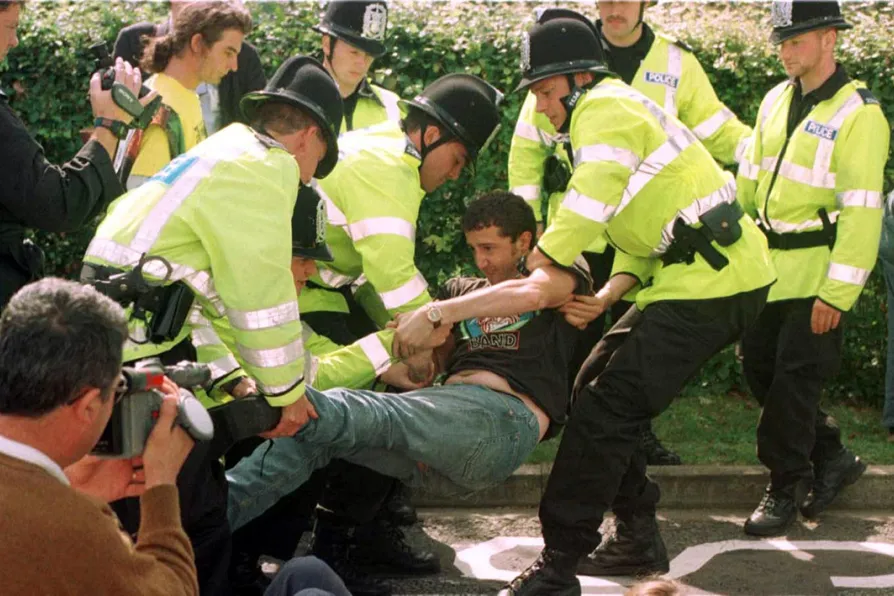 Police restrain Campaign Against Arms Trade protesters at the entrance to Farnborough airfield, hosting Britain's biggest annual arms fair, September 1, 1997





UNDERCOVER police officers were “authorised” to target anti-arms campaigners because groups were known to organise protests and demonstrations, the Undercover Policing Inquiry has heard.
Testimony given earlier this week revealed that cops who were part of the Metropolitan Police’s Special Demonstration Squad (SDS) were explicitly authorised to go after groups including the Campaign Against Arms Trade (CAAT).
Undercover cops were also given the green light for Disarm DSEI, which organises against the DSEI biennial defence exhibition in London, and protests at the RAF Fairford base.
Speaking at the inquiry, CAAT media co-ordinator Emily Apple described the impact of the Met’s spying activities on anti-arms trade and environmentalist groups.
Evidence was heard claiming an officer operating under the pseudonym “Jason Bishop” was given permission to target the groups, leading him to embed himself successfully to the point of managing Disarm DSEI’s bank account.
Internal police reports also showed that Mr Bishop’s activities, dating back to 2003, show the Met’s decision to focus on groups demonstrating against DSEI was motivated by worries their activities “could influence the financial wellbeing of the state.”
CAAT said these latest revelations make it clear they were the explicit target of Britain’s largest police force.
A spokesperson said: “The latest revelations from the Undercover Policing Inquiry provide yet more sordid details of the Met’s systematic, invasive and manipulative spying on anti-arms trade and environmentalist campaigners.
“It is now abundantly clear that Met police undercover officers were explicitly authorised to target CAAT, in brazen contempt for our right to protest and campaign against a corrupt and destructive arms trade.”
Referring to the inquiry’s dismissal of CAAT’s request to participate as a core participant, the group said these revelations “further call into question the inquiry’s refusal to include CAAT as a core participant.”
They added that it is “high time the inquiry corrected course and examined the links between corporate spies and undercover police.
“At a time when the British state is at its most authoritarian and repressive towards anti-war and anti-genocide campaigners, a full accounting of all skeletons in the Met’s closet is a must.”
The Undercover Policing Inquiry is examining how 139 undercover police officers who were part of the SDS spied on more than a thousand anti-war and environmentalist groups between 1968 and at least 2010.
