TUC president and POA leader STEVE GILLAN speaks to Ben Chacko on the eve of Congress 2026


 Latest editorial
Trump’s world of plunder is collapsing the old order – and Britain needs a new plan
As the dollar falters and US power turns predatory, Britain and Europe must abandon transatlantic illusions and build a collectivist alternative before the system implodes, writes ALAN SIMPSON
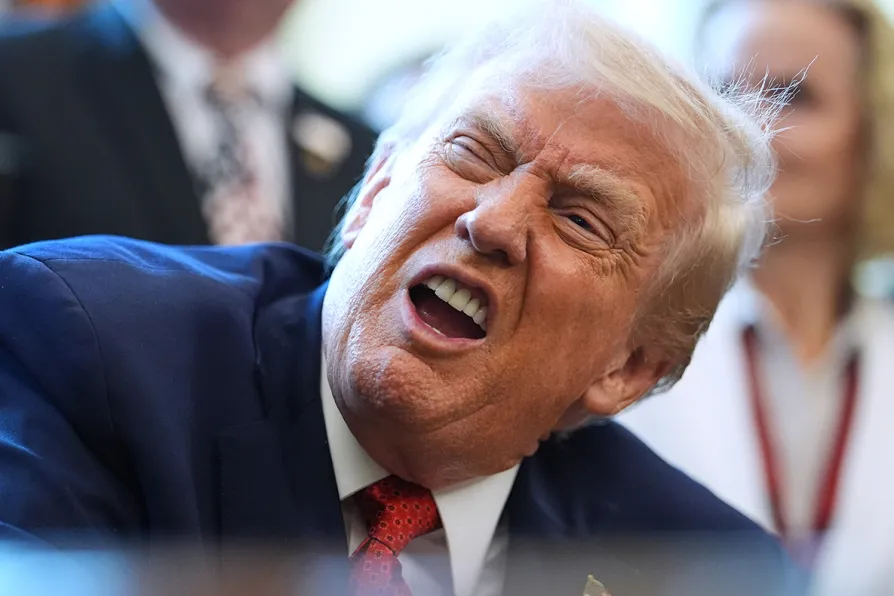 US President Donald Trump speaks to reporters after signing an executive order reclassifying marijuana as a less dangerous drug in the Oval Office of the White House, December 18, 2025


DOUG NICHOLLS welcomes a turning point at this year’s Congress, where many motions call for a co-ordinated plan to revive British industry, a perspective outlined in his new book
HOPE VIRGO of campaign Dump the Scales warns MPs voting today they should be alert to the threat legalised assisted death poses to people with eating disorders
The Together Alliance is hosting two summits, North and South, to build power and plan action against the scourge of racism peddled by the right. DANIEL KEBEDE urges mass participation
The drift toward militarisation in Europe is not inevitable, left-wing and peace movements can preserve sovereignty and prevent war, says DÁIRE HUGHES MP
Whatever differences exist among international sympathisers of the Bolivarian revolution about its current trajectory, they should unite against the imperialist power that is the source of an enforced retreat, argues ROGER D HARRIS
Trade unions need to step up and force a turn in the policies of the labour movement to effectively confront the far-right threat, argues NICK WRIGHT





LET’S BE clear. Donald Trump is not a Hollywood version of Jack Sparrow. His motivations are closer to those of Boko Haram than to international diplomacy. Seize what you want. Kill where you wish. Walk away from the consequences. And blame others for the chaos that follows.
Since September, Trump has had the US military conduct 22 strikes on vessels in the Caribbean, killing at least 80 people. Every strike was justified by unsubstantiated claims that the boats were involved in drugs smuggling; the tanker seizure, by claims of illicit oil trading. By anyone else, it would count as piracy.
In every instance, Trump sets himself up as judge and jury (and executioner). This is the new world disorder.
You could say the same about Gaza, Ukraine or any other part of the globe Trump casts his greedy eyes upon. Forget peace prizes. What Trump wants are asset seizures. It is the politics of imperial plunder. Those unhappy about where it is taking us must face the challenge of forming new partnerships and writing a different script.
The international community, however, has remained silent or paralysed. We appear nonplussed at the abrupt collapse of a nominal, rules-based, world order in the face of Trump’s corporate (or arbitrary) piracy. We are locked in a descent into corporate feudalism. Being nice to Trump will not rescue anyone. What we need is fresh political leadership; one which grasps that a more stable world order has to be constructed out of a world in fragments.
China is beginning to do so within the existing framework of Brics. If anyone has the power to bring Trump’s marauding to a halt, it is China. Far less clear is whether this would be just swapping one form of hegemony for another.
For Britain, in a much humbler context, the process must begin from abandoning our transatlantic delusions in favour of more meaningful commonalities within Europe. This will not be easy.
For a start, information sharing with the US now becomes precarious. Trump’s determination to support right-wing movements wherever he can find them offers zero-comfort to Labour. Courting him means giving his tech-bros access to all the public data they might need to monitor and manipulate public opinion. Their funding of the Tony Blair Institute already gives them direct access to Downing Street. They don’t need more privileges and they don’t come as socialists.
Trump wants Britain to embrace all his deregulatory obsessions in exchange for the same protections Epstein promised his victims. Worse than this, he expects us to subvert the collectivist framework of social policy-making in Europe so that he can destroy this too. Britain would become his Ghislaine Maxwell. Time for a better plan.
Homeland values
Brexit was a disaster, not least in blinding us to how much (culturally) we share with the rest of Europe. Personally, I’d hold a second referendum, but that’s not going to happen. At the very least, we have to get back into a single market. And not far behind comes the issue of Common European Security.
The US no longer underpins European security of any sort. This forces us to address a whole raft of common insecurities and technology gaps. Ukraine demonstrates how far drones are the new front line of conflict. The targeting of both troops and property has become almost an armchair activity, with devastating implications. Europe (with Britain included) must develop its own technology answers.
No less disruptive are today’s cyber attacks across the internet. Why worry about the army if you can disable the entirety of the NHS? And if British-EU energy interconnectors can be disrupted by a single submarine depth charge, where then do you create energy security?
The answers to these towering insecurities will be found in a new era of collectivism rather than corporatism. Instead of investing in transnational corporate projects, we have to develop new networks of more localised interdependencies. It is worth remembering that this is where the energy systems powering Britain’s town and cities originally began.
In the 19th century, Britain led the world in the growth of municipal energy companies. Today, we need to look elsewhere in Europe for the same leadership. Denmark and Germany have elaborate networks of decentralised energy systems. As clean-energy technologies evolve, these systems are expanding into energy sharing and energy storage. What comes with them are local jobs, local apprenticeships, local interdependencies and wider networks of how we share such gains with our neighbours.
The model can apply just as easily to food security. It places a virtue upon interdependency as an alternative to corporate fiefdoms. Of course the cartel lobbyists object. They have filled the corridors of parliaments for so long that MPs can be forgiven for forgetting they have other choices. But the public should not. And nor should erstwhile new political movements.
Which brings me to my point of sadness.
The politics of self-sabotage
Radical politics should be focusing on the threat of collapsing ecosystems, on democratic powers being usurped by the tech-broligarchy, and on the threat of a looming financial crash that will make 2008 look like a hiccup. Instead, mainstream politics sinks ever deeper into factionalism.
A quiet earthquake is taking place in the global economy and we need to wake up to it. Trump’s economics are crashing everything.
Servicing US debt costs them $3 trillion/year (over $1bn a day). It’s a staggering amount that the US never worried about because they had made the dollar the world’s reserve currency. The Fed could print as much as it wanted, knowing there would always be ready buyers elsewhere. Now, nation states (and private investors) are not so sure.
In Japan, the largest holder of dollar reserves, investors are racing to swap their dollar savings into silver or gold. US debt is sold at lower prices, and at higher interest rates. The cost will end up passed back onto the US economy.
China has reduced its dollar holdings to a 23-year low, while G7 countries join in the race to buy as much gold and silver from Shanghai as they possibly can. Intriguingly, none of this income flow is in dollars. China and Russia have developed an alternative reserve currency which bypasses the dollar. It is an option already being offered to other Brics nations and will no doubt be rolled out much further. As an icon, the dollar is dying.
And if that isn’t enough, we are about to have another stock market crash. 2008 was bad enough, when $6trn was sloshing about in wild derivative trading. Today, the figure is $600trn. Most of this going into equally wild AI overvaluations. The coming crash that economists are already warning about would be 2008 on steroids.
These prospects may be grim, but there are at least an emerging group of economic voices offering clear, alternative (socialist) choices. These are the conversations serious political parties ought to be engaged in. These are the upheavals that might yet save us.
So leave others to obsess about low-grade leadership squabbles. Put vanity politics aside. If we are rescue the planet (and the poor) we need a fundamental economic rethink. And we need it urgently.
Alan Simpson was Labour MP for Nottingham South from 1992-2010.

Similar stories
Growing instability in the US economy and financial markets could have serious consequences worldwide because of the central role of the US dollar and financial system, argues MICHAEL BURKE
The left needs a bold energy vision – because if it fails to provide one, others will shape the future in their own interests, argues ALAN SIMPSON

While politicians fixate on defence budgets, the real answers lie in peace-building and economic justice, says ALAN SIMPSON

The new plan sets out an uncompromising bid for global dominance, casting even allies as obstacles to be subdued, writes DIANE ABBOTT