ROB WARZYNIAK wades knee deep through a pile of ‘dead canaries’ of Trumpist policies which exacerbated the horrors of US capitalism domestically


 Latest editorial

Taking the Peace
ANSELM ELDERGILL looks at the legality of the wars in the Middle East and the means used to fight them. It is said that truth is the first casualty of war, so what is the truth with regard to the legality of America’s and Israel’s wars in Iran, Palestine and Lebanon?
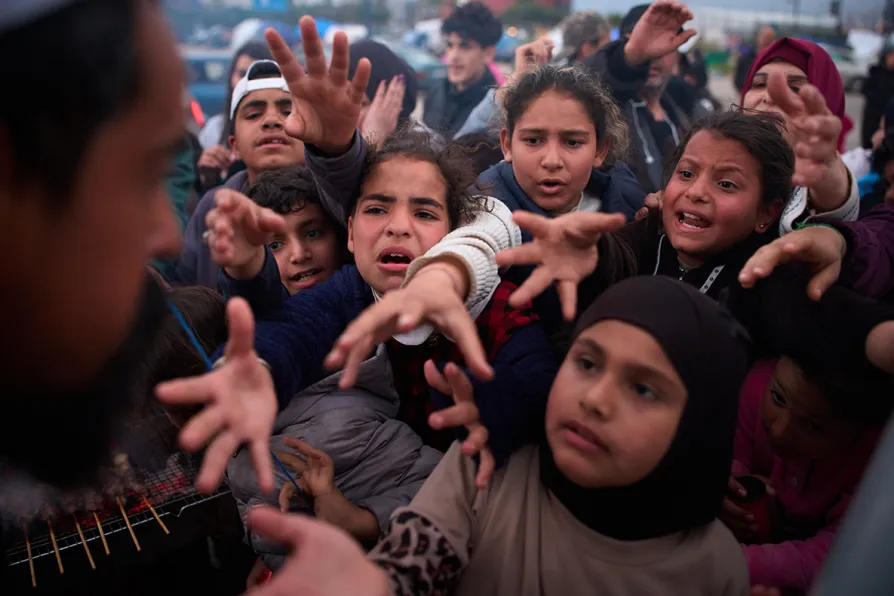 Displaced children wait for donated food beside the tents they use as shelters after fleeing Israeli bombardment in southern Lebanon, in Beirut, Lebanon, April 9, 2026

Without evidence or Nato consultations Berlin’s answer to the Leipzig incident is a rupture of relations. SEVIM DAGDELEN examines why
FRANCISCO DOMINGUEZ introduces the background to a conference on defending Latin America’s sovereignty
The glacier collapse in Nepal is yet another warning that a warming planet is making Himalayan disasters more frequent and destructive – but the countries facing the greatest risks are often those least responsible, says LI YANG
Nick Blair is set to benefit from a hugely lucrative contract to ‘virtually’ train the British army for its next war. Like father, like son, writes SOLOMON HUGHES
Even when tragedy strikes, Western media cannot resist the opportunity to turn it into a sordid propaganda opportunity, as the Nepal-China border tragedy shows, writes CARLOS MARTINEZ
Trade unions should be at the heart of the anti-racist push for reparations for the historic legacy and continuing impact of slavery, writes ROGER McKENZIE





CICERO wrote that laws fall silent in the midst of arms. From this perspective, the law of war is a paradox, for surely war is lawless and undertaken by states as a way of achieving their objectives outside international law and rules?
Nevertheless, since the beginning of recorded time, lawyers and others have sought to distinguish between just or legal and unjust or illegal wars, and to restrict what is permitted in war.
All legal systems, including our own, rest and rely on violence.
State-sanctioned violence is the means by which courts and the police enforce a society’s civil and criminal laws. We resign ourselves to this inevitability as long as the rules are just and justly applied.
The notion that violence is permissible to enforce just laws also gave rise to the concept of just wars, as a way of enforcing justice between nations.
Historically, just law and just war were both emanations of “natural law.” The Stoics and Christian theologians believed that there exists a universal “natural law” ― a rational, purposeful order to the universe ― applicable to all nations and people at all times.
With the emergence of modern nation-states in the 17th and 18th centuries, the natural law approach gradually gave way to a “voluntary law” approach called the “law of nations.” The new way of thinking viewed the legal rights and duties of nations as a human-created, voluntary law code based mainly on state practice and legal formalities.
By the 19th century, a calculation mentality predominated. War was no longer an instrument of justice but an instrument for advancing national interests in a world where no national interest had precedence.
Unsurprisingly, this kind of cynical, self-interested thinking led to, and was used to excuse, the widespread annexation of countries, the creation of empires, colonisation, financial exploitation and, ultimately, the Nazis and the Holocaust.
The revulsion engendered by these atrocities gave rise to the doctrine that people have certain fundamental human rights ― such as life, liberty and equality ― that are inherent, universal and not granted by any state.
This was humanist voluntary law masquerading as natural law. It formed the rock on which the post-war international settlement was built. At the Nuremberg and Tokyo Trials, individuals were judged and punished by an international court for war crimes and crimes against humanity. The United Nations was formed in 1945 and a Universal Declaration of Human Rights was proclaimed in 1948. Four new Geneva Conventions were adopted in 1949. Other significant treaties and declarations accompanied or followed these initiatives.
The new international order has done much good and, although often wishful or wasteful, little harm.
It is not perfect but for 80 years we have lived in a world of international rules and rights and avoided a third world war.
This history, taken from Stephen Neff’s War and the Law of Nations and Joseph Edwards’s The Law and Philosophy of War, is significant because it is apparent that President Trump, in pursuit of his “America First” agenda, does not consider the United States bound by the post-war order. For him, whether to go to war turns on whether it advances US national interests.
The law of war has two main branches: jus ad bellum (legal justification to wage war) and jus in bello (conduct in war).
Four core principles or compass points imbue the laws concerning the conduct of war: necessity, distinction, proportionality and humanity.
The principle of (military) necessity acknowledges that war is about defeating an enemy. It permits actions necessary to weaken the enemy’s armed forces, so long as they do not violate the principles of distinction, proportionality and humanity.
Distinction requires belligerents to distinguish between combatants and non-combatants (civilians) and to direct operations only against the former.
The massacre of civilians and taking of hostages on October 7 2023 involved the commission of war crimes and crimes against humanity. That was an act of terrorism. Nothing justifies it and there is no mitigation.
The list of international crimes committed by Israel and the US is a longer one.
The UN Charter is clear. The mere possibility of being attacked does not justify resort to defensive (preventive) war. It is only justified if the impending danger is reasonably clear and imminent. The view of the UN secretary-general and most jurists is that this was not the case. Israel and the US are unlawful aggressors, and Iran is acting in lawful self-defence when it repels their attacks (but not when it attacks neutral parties).
Israel is, and has long been, a terrorist state, as defined by the Terrorism Act 2000. It also operates a system of apartheid and so is a racist state. The law and evidence justifying these findings were set out in my column of May 10 last year.
Israel uses disproportionate force. It operates the Dahiya military doctrine, which advocates the use of massive, disproportionate force and the deliberate targeting of civilians and civilian infrastructure.
The Iranian Red Crescent recently reported that 67,414 civilian sites have been struck, of which 498 were schools and 236 health facilities. More than 3,500 civilians had been killed.
Additional Protocol I to the Geneva Conventions forbids attacks on “objects indispensable to the survival of the civilian population,” such as food, crops, and water supplies. However, the US and Israel have conducted strikes on oil and gas infrastructure and water desalination plants in Iran.
The US government is not fully committed to the laws of war. In 2025, Pete Hegseth, the US Secretary of Defence, boasted that the US military would now embrace “maximum lethality, not tepid legality” and not “fight with stupid rules of engagement. We untie the hands of our warfighters.”
Last month he referred to “no quarter, no mercy for our enemies,” although under international law it is “especially forbidden” and a war crime to “declare that no quarter will be given.”
The extensive Jewish settlements in Palestine contravene international law. This is the finding of International Court of Justice. Article 49 of Geneva IV prohibits an occupier from transferring parts of its own civilian population into the occupied territory.
Lebanon may also soon be subject to an “alien occupation.” According to Israel’s defence minister, Israel plans to occupy Lebanese territory from the border up to the Litani River, nearly 10 per cent of the country. All the houses in Lebanese villages near the Israeli border will be demolished “according to the model of Rafah and Beit Hanoun in Gaza.”
It is not anti-semitic to stand up for fundamental human rights and international law. Everyone is entitled not to be treated in the ways described.
The political omens are dire. At bottom, Prime Minister Netanyahu and President Trump are XL Bullies. It is pointless to appeal to international law or conventional morality given their obvious disdain for them.
Nor can Britain be a diplomatic brake. The self-deluding notion that we have a “special relationship” with the US is mere vanity. That has not been true for decades; we are their vassals.
Our future lies in a political, economic and self-sufficient military union with European allies and countries such as Canada that remain committed to the international order and civilised values.
Law without enforcement is only an aspiration and leaders with powerful allies often escape justice.
The legal position is therefore also difficult, but more promising. There are many examples of war criminals being tried by a court, dating back to 1474.
In recent years prominent national leaders have been convicted for war-related crimes by the International Criminal Court (ICC) or by international criminal tribunals. The Chilean dictator General Pinochet was arrested in London in 1998 under an international arrest warrant in connection with human rights violations.
Although Israel and the US are not members of the ICC ― fearing that their political leaders or troops could be prosecuted for genocide, crimes against humanity and war crimes ― Palestine is a party. In 2024, the ICC issued warrants for the arrest of Prime Minister Netanyahu, the then Israeli Defence Minister Yoav Gallant and Hamas leader Mohammed Diab Ibrahim Al-Masri in respect of their conduct of the war in Gaza.
Furthermore, the fact that Israel and the US also refuse to ratify the two Additional Protocols to the Geneva Conventions is not determinative. The International Court of Justice and the International Committee of the Red Cross have both affirmed that customary international law remains binding on states whether or not they have ratified particular treaties.
There are also other things we can do. The mobilisation of shame is a powerful tool, as the pro-Palestine protests and anti-apartheid movement demonstrated.
The US and Israel are driven by self-interest and therefore individuals, local authorities and public bodies should avoid Israeli goods and services, and push for state-imposed Boycott, Divestment, Sanctions laws.
The financial and other support the Labour Party and government receives from Israel and pro-Israel lobbyists must influence how we vote in future elections.
Wars are hatched by governments but it is the people who suffer. Most wars are also capitalist wars that seek to secure for the belligerent a greater share of the world’s land and resources.
Tolstoy observed in The Law of Violence and the Law of Love that “men are so accustomed to maintaining external order by violence that they cannot conceive of life being possible without violence.” We must eschew violence that is not authorised under the UN Charter and not permit the US and Israel to take the peace.
Anselm Eldergill was until recently a judge in the Court of Protection. He is a solicitor, an associate at Doughty Street Chambers and an Honorary Professor at Queen’s University Belfast.

Similar stories

The US is hell-bent on dismantling the International Criminal Court as part of its assault on global legal systems, but others also have valid reasons to seek its demise. BEN CHACKO provides the analysis

ANSELM ELDERGILL explains why the rule of law is fundamental to our liberty and welfare
ANSELM ELDERGILL examines the difficulties surrounding freedom of expression