
Working people across Britain are fighting back against austerity, war, repression and exploitation. The challenge now is to unite those struggles, says Communist Party of Britain assistant general secretary JOHNNIE HUNTER

Solidarity with Ukrainian workers: why Congress must back the NUM motion
CHRIS KITCHEN argues that the TUC should answer the call of Ukrainian labour movement organisations for support and solidarity with their cause
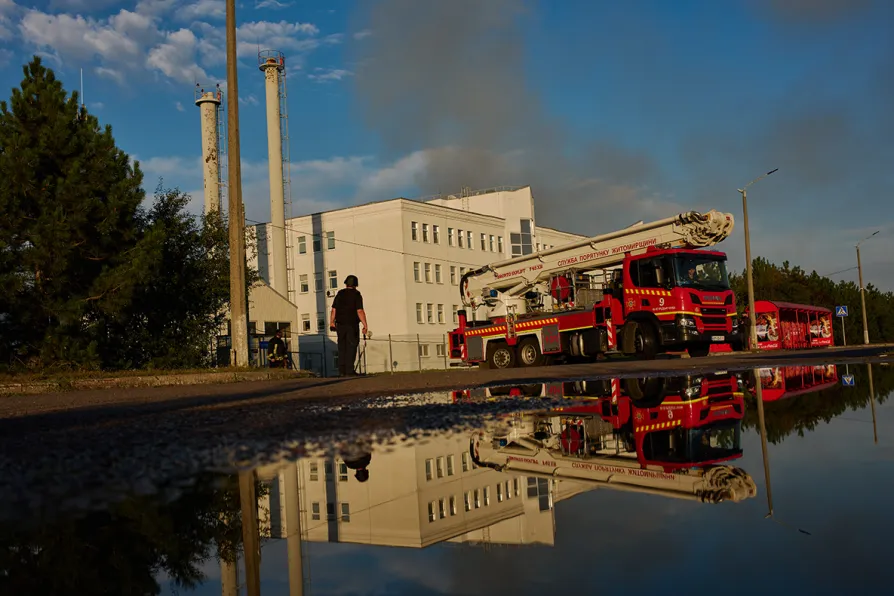
 Smoke rises from a damaged Coca-Cola factory after a Russian drone attack in Brovary, outskirts of Kyiv, Ukraine, Thursday, Sept. 3, 2026. (AP Photo/Francisco Seco)
Train drivers’ union Aslef general secretary DAVE CALFE speaks to Ben Chacko about his hopes that Burnham’s devolution agenda will include the importance of the railway
DIANE ABBOTT provides an analysis of the reasons for EU and British voters’ dramatic swing to the right
Some of the review’s proposals could make the benefits system less cruel and dehumanising. But its vague plans for services and non-cash support revive the threat that disabled people will lose control over the money we need to survive, writes DYLAN MURPHY
Believe it or not, there was a time when the US government built beautiful homes for working‑class Americans to deal with a housing shortage, writes ERAN BEN-JOSEPH
MAT COWARD has heaps of good advice on recycling garden and household waste over the winter





AT THIS year’s TUC Congress, the National Union of Mineworkers is calling on our movement to stand firmly with Ukrainian workers by supporting our motion, Solidarity with Ukrainian Workers.
Across Ukraine, workers are living and working under conditions no trade unionist should ever face. As the Confederation of Free Trade Unions of Ukraine (KVPU) reports, “not a single day in August passed without a Russian attack on Ukraine.” Workers in Kiev, Kryvyi Rih, Zaporizhzhia, Kherson and beyond endure relentless missile and drone strikes that make the daily journey to work a matter of life and death. In August alone, Russia launched “more than 6,000 drones… more than 200 missiles and over 5,000 aerial bombs against Ukraine.”
These are not abstract statistics. They are the lived reality of miners, steelworkers, railway workers, medical staff, emergency responders and logistics workers. KVPU reports that in August 2026, 48 workers were killed and 158 injured at their workplaces, with 301 killed and 1,303 injured since the start of the year. Mines in the Dnipropetrovsk region – where our sister union, the Independent Trade Union of Miners of Ukraine (NPGU), organises – were attacked more than 20 times in August alone.
But nowhere is the brutality more concentrated than at the Zaporizhzhia Nuclear Power Plant (ZNPP), Europe’s largest nuclear facility, seized by Russian forces in 2022. The occupiers have attempted to force workers to accept Russian citizenship and sign contracts with the Russian State Atomic Energy Corporation (Rosatom).
The Nuclear Energy and Industry Workers’ Union of Ukraine – Atomprofspilka, has reported 1,000 workers have been subjected to abuse and torture, and only 3,000 of the original 11,000 employees remain. Placing the safety of the plant at serious risk.
Most shocking has been the return of Stalin-era repression, with the abduction, torture and imprisonment of workers. Fifteen members of the Nuclear Energy and Industry Workers’ Union of Ukraine, Atomprofspilka – have been subjected to show trials and sentenced to up to 25 years on fabricated charges.
Among them is Serhii Potyng, a member of the youth council of Atomprofspilka, whose case symbolises the cruelty of the occupation. He was threatened for assisting residents and his fellow workers, his wife was detained and tortured before he himself was abducted, tortured, accused of “terrorism” and sentenced to 20 years’ imprisonment.
This is not simply an attack on individuals – it is a deliberate strategy to suppress trade unionism by Russian occupiers. Independent unions were banned in occupied Donbass after 2014. Russian forces murdered miners’ union leader Ivan Reznichenko in 2015.
The repression at ZNPP is a part of Russia’s murderous war against the Ukrainian people, which has targeted and killed thousands of civilians, including workers in the energy, mining, health, education, rail, fire and rescue and all killed while performing essential civilian duties.
The Ukrainian labour movement – KVPU and Federation of Trade Unions (FPU) – has appealed directly to us for solidarity. Congress must answer that call. Our motion commits the TUC to campaign for the release of the detained ZNPP workers, to highlight the plight of all workers in occupied Ukrainian territory, and to strengthen international trade union action through the ITUC and ETUC.
This is not a distant conflict. It is a struggle for the fundamental rights every trade unionist holds dear: the right to organise, to work in safety, to live free from persecution. Ukrainian workers are defending those rights under bombardment.
At Congress 2026, I urge delegates across our movement: support the NUM motion. Stand with Ukrainian workers. Demand freedom for the imprisoned trade unionists of Zaporizhzhia.
Chris Kitchen is general secretary of the National Union of Mineworkers.

Similar stories
Some British unions are making a strategic error in backing militarised solutions instead of working for a ceasefire and end to the war, argues LINDSEY GERMAN

Morning Star assistant business manager BERNADETTE KEAVENEY and international editor ROGER McKENZIE remember attending the 2001 TUC, suspended midweek after news of the World Trade Centre attacks
Andy Burnham offers unconditional support for Zelensky but no solutions to the underlying conflict between the Nato/EU bloc and Russia, says NICK WRIGHT