

 Latest editorial
Salah broke down barriers throughout his Liverpool career — his departure marks the end of an era, says JAMES NALTON
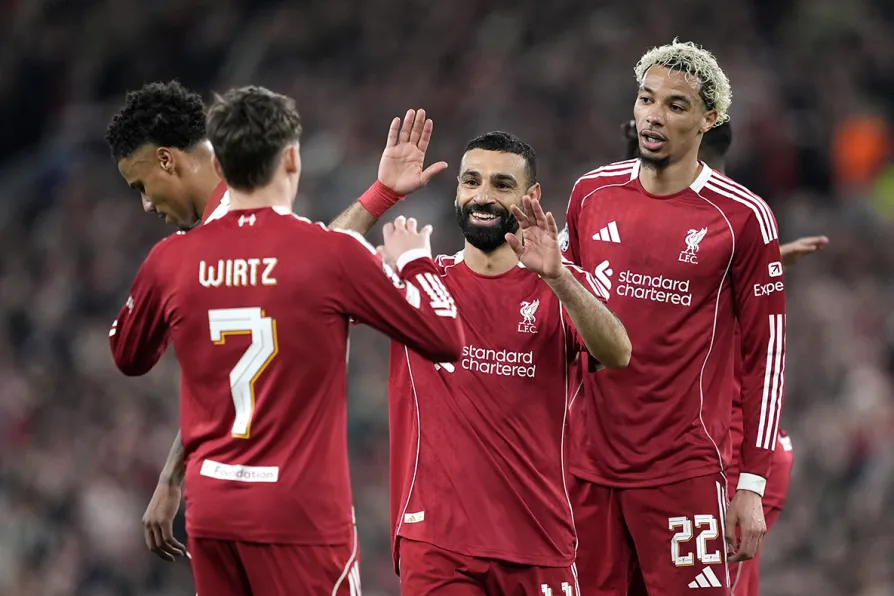 Liverpool's Mohamed Salah (centre) celebrates scoring their side's fourth goal of the game during the Uefa Champions League round of sixteen, second leg match at Anfield, Liverpool, March 18, 2026





MOHAMED SALAH’s announcement last week that he will leave Liverpool at the end of the season marks the end of an era that has resonated in both cultural and sporting contexts at the highest level of the world’s most popular sport.
Even off the back of one of his greatest-ever seasons in 2024-25, and more records broken in 2026 when he became the first African to score 50 Champions League goals, it still feels like the size of the impact Salah has had on football, and on the wider world through football, is yet to be fully recognised.
Arguments can be made for the recent era at Liverpool being their greatest ever. An all-time great manager Jurgen Klopp, not just at Liverpool but in the development of the sport as a whole. All-time great players in almost every position. A team who, at their best, as it so often was, were unbeatable and one of the best the English top division has seen. A team who at some point won every trophy available to them, including the Club World Cup for the first time in the club’s history.
Within that, Salah still stood out as the greatest of them all.
He was the era-defining player in an era-defining team, with the magic on the ball and an ability to make things happen that is rare at this level of the game.
It put him up there with the likes of Kenny Dalglish, Steven Gerrard, Ian Rush, John Barnes, Graeme Souness and Kevin Keegan at Liverpool. Crowned by the fans as Liverpool’s new king, AD, after Dalglish.
Other players from that Klopp team will join him in those lists, but Salah still led the way, ending up third on Liverpool’s all-time top goalscorers list behind Rush and Roger Hunt, and breaking records on what felt like a weekly basis.
There were echoes of Lionel Messi in his play and in the regularity of his achievements and records broken. The phrase “only Salah has more…” became a common line in any reporting of the other players’ achievements.
It is Salah’s cultural impact, though, that goes beyond that of his peers and beyond the sporting realm in conversations about greatness.
It is why his next move will be interesting. Where will he choose to take this greatness, and will that play a part in his decision? He has grown to represent more than the kind of individual branding attached to the biggest names in modern football, and more than the links to club, Liverpool, and country, Egypt, strong as they are.
Salah is seen as representing not just Egypt, but the whole of the Arab world, and has reached the upper echelons of the world’s biggest sport in a sphere usually reserved for Europeans and South Americans.
Salah’s profile has led to more understanding in the West of the Islamic faith, particularly in a sporting context, and especially around how Muslims in professional sport combine their job with their faith and how the two intertwine.
He has recently been an important voice in highlighting the plight of the Palestinian people, picking key moments to make short but powerful statements in support of those in Gaza.
When Uefa paid tribute to Palestinian footballer Suleiman Obeid, but refused to acknowledge that he was killed by an Israeli attack on Gaza, Salah posted the short but importantly forthright message in direct response to Uefa: “Can you tell us how he died, where, and why?”
The extent of Salah’s influence and popularity is probably still not fully appreciated in the West.
That there is still debate as to whether Salah is the greatest ever player for Egypt, and that the other player in this debate, Mohamed Aboutrika, is not so widely known, demonstrates the kind of barriers Salah has potentially broken for Egyptian, African, and Arab players in European football.
Many historic African greats were as talented and as successful in their own right as lauded European and South American counterparts, but are relatively unknown in comparison.
Finding his feet at Roma before unleashing them — the left one in particular — on opposition defences at Liverpool, Salah forced his way through those barriers thanks to performances on the pitch that could not be ignored, and to a point where he was celebrated globally across all cultures.
The longevity and recurrence of this greatness saw Salah win the FWA Footballer of the Year award three times. The only player to win their first and last FWA award in a longer timespan than Salah’s seven years is Stanley Matthews (15 years), and only Salah and Thierry Henry have won the award three times.
You could pick any criteria, any set of records that demonstrate Salah’s prowess as a footballer, but his contribution goes far beyond that.
Salah’s departure also epitomises a current problem at Liverpool. How do you improve on the greatest ever? How do you even maintain those levels? It’s pretty much impossible.
Liverpool hope the come-down won’t be too steep or too drawn out. They know about those, all too well, but the 2025/26 season has not been encouraging in this regard.
But while Liverpool address their own path forward, Salah now has to decide his. Wherever he goes, the past achievements earned on the pitch that he’ll take with him carry plenty of significance off it, and he still has a chance to add to that with his next choice of club, especially if it’s one back home in Egypt.
