TUC president and POA leader STEVE GILLAN speaks to Ben Chacko on the eve of Congress 2026


 Latest editorial
Remembering 1926: history that still speaks
A centenary tour of north-west England uncovers powerful exhibitions and archives connecting the history of the 1926 General Strike with the fights facing workers today. General Strike 100 national co-ordinator HENRY FOWLER reflects on his recent visit to partners in the region
 Stand Together! poster, 1977

DOUG NICHOLLS welcomes a turning point at this year’s Congress, where many motions call for a co-ordinated plan to revive British industry, a perspective outlined in his new book
HOPE VIRGO of campaign Dump the Scales warns MPs voting today they should be alert to the threat legalised assisted death poses to people with eating disorders
The Together Alliance is hosting two summits, North and South, to build power and plan action against the scourge of racism peddled by the right. DANIEL KEBEDE urges mass participation
The drift toward militarisation in Europe is not inevitable, left-wing and peace movements can preserve sovereignty and prevent war, says DÁIRE HUGHES MP
Whatever differences exist among international sympathisers of the Bolivarian revolution about its current trajectory, they should unite against the imperialist power that is the source of an enforced retreat, argues ROGER D HARRIS
Trade unions need to step up and force a turn in the policies of the labour movement to effectively confront the far-right threat, argues NICK WRIGHT





THE General Strike 100 national partnership brings together over 50 museums, libraries, archives and cultural organisations from across the country. Through an interactive website and a printed passport, we are inviting people to explore these sites during this anniversary year — connecting our struggles today with the history, culture and legacy of one of the most important moments in working-class struggle.
Through this series in the Morning Star, we’ll be shining a light on what our partners are offering throughout the year.
Our first stop on the General Strike 100 road trip took us to north-west England — home to two outstanding partners: the People’s History Museum and the Working Class Movement Library. Earlier this year, we also highlighted the Trailblazers of Manchester, whose event brought to life the vital role women played in the General Strike locally.
The Working Class Movement Library in Salford is a treasure trove for the labour movement. Its remarkable collection spans books, pamphlets, posters and archives — from local struggles to international movements — offering a powerful insight into working-class history.
Founded in the 1950s by trade unionists Edmund and Ruth Frow, the library began life in their home before moving in 1987 to Jubilee House, where it continues to thrive as a hub of learning, research and activism. With its reading rooms and vibrant event space — the “Annex” — it remains a living resource for the movement today.
To mark the centenary, the library is hosting a major exhibition: The Great Betrayal: One Hundred Years On — the lessons of the 1926 General Strike revisited. Visitors will be able to engage with an extraordinary collection of original materials, from photographs and pamphlets to rare, printed sources from the strike itself.
We were fortunate to be given a preview by Seth, a dedicated volunteer, who guided us through some of the exhibition highlights. Among them was the iconic image of Cramlington miner Bill Muckle upon his release from prison — a powerful reminder of the sacrifices made. We also explored editions of the British Gazette, the government’s strike-breaking newspaper, revealing the extent of official efforts to undermine and misrepresent the strike.
Moving through the our tour with Naomi (researcher, events and volunteer co-ordinator) we are shown the impressive “Irish Room,” as you quickly grasp the depth and richness of what is on offer across all floors. This is an exhibition not to miss.
The following day, we visited People’s History Museum (PHM) in Manchester — Britain’s national museum of democracy. PHM tells the story of how ordinary people have come together to fight for change, linking past struggles with the challenges of today and the possibilities of the future.
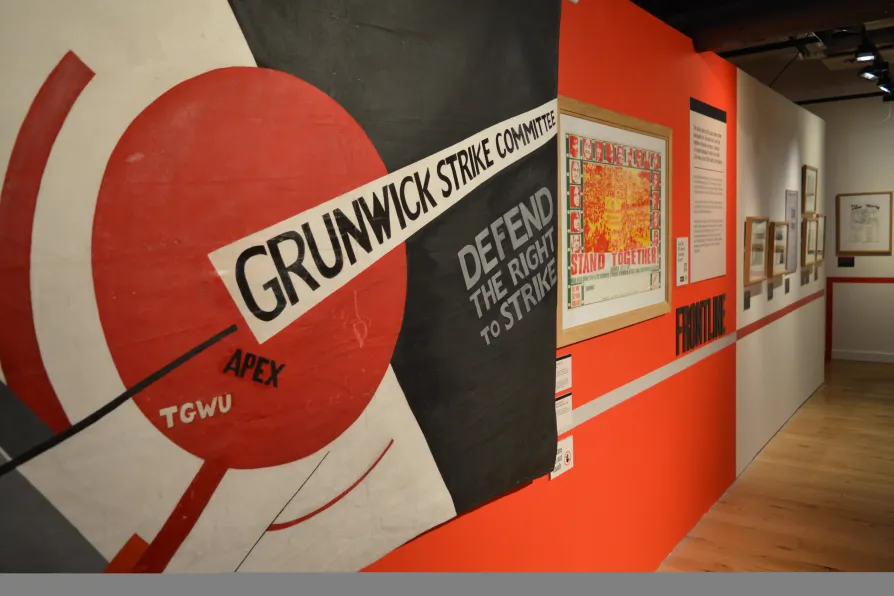
We were given an early look at their upcoming exhibition organised by the wonderful Paula (communications and marketing manager), On The Line: 100 Years of Strikes and Solidarity.
Drawing on 100 objects from the museum’s collection, it tells the story of strikes across a century — through the voices, creativity, and resilience of working people. From striking posters produced during the Grunwick strike, to a makeshift shelter used during ambulance workers’ strikes, to powerful material from Lesbian and Gays Support the Miners (LGSM), the exhibition brings solidarity to life. Organised around five themes — Crossing the Line, Lifelines, Battlelines, Frontline and Where is the Line? — it invites visitors to reflect on the meaning and impact of strike action.
At the heart of Battlelines sits Ewan MacColl’s miner’s lamp, presented to him on his 70th birthday by Arthur Scargill — a striking symbol of cultural and industrial solidarity. We were also grateful to speak with Jenny (head of collections and engagement), Dan (historian working across both north-west partners), Eleanor (collections manager) and Clare (museum director), whose insights brought the exhibition to life. Running until November 2026, this is another must-see.
Next in our series, we head to Bristol for the Radical History Festival (April 2026), exploring the enduring relevance of the General Strike for workers’ struggles today.
To explore the full partnership and plan your own journey, visit GeneralStrike100.com and find your nearest site.
