EWAN CAMERON picks out two fascinating music shows, fusing the Korean, and the Celtic, with the modern



Refreshingly lucid poetry from Scotland
ALISTAIR FINDLAY recommends the simple cadence, common prose, free verse, and descriptive power of a new collection by Julie McNeill

 Pro-Palestine demonstrators marching in Edinburgh, December 2023 [Pic: Pretzelles/CC]
BENJAMIN POTHIER suggests that Palaeolithic cave paintings in Spain point to the ceremonial use of hallucinogenic flora
The bard confirms that the right has a humour bypass, and replays the English Revolution on period instruments
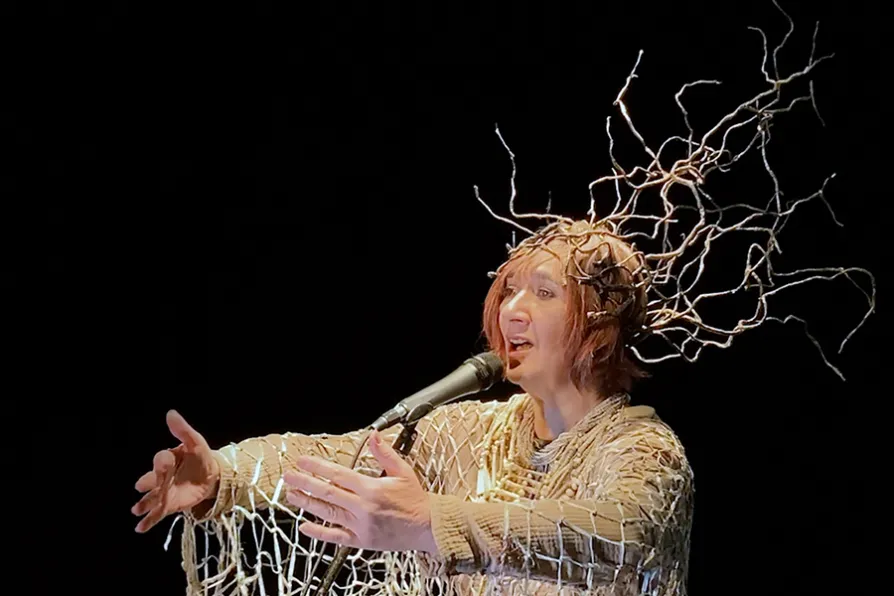
MARIA DUARTE and ANDY HEDGECOCK review Sunny Dancer, Tony, Songs of Forgotten Trees, and The End of Oak Street
JOHN GREEN relishes a powerful and moving drama that explores the lived realities of west London’s Punjabi community
MARTIN HALL welcomes a plea for greater compassion between believer and non-believer via the framework of philosophical enquiry





Love Goes North
Julie McNeill, Luath, £8.99
A NEW collection by the Scottish poet Julie McNeill, Love Goes North, is well worth a read for both budding poets and that once fabled and much sought after creature “the intelligent reader.”
The book is dedicated “to voyaging, in all its forms, and voyagers” which again is hailing and signalling itself towards poets and poetry readers in all their varied forms, an appeal that I think is more than justified.
Her previous publications have ranged from Mission Dyslexia to We Are Scottish Football, the latter a brilliant take on Scottish women’s football, a new sport and profession requiring something like a new poetics to be constructed, that is informed in her case by being both Poet-in-Residence for St Mirren FC and the so-called Gaffer of The Hampden Collection.
Her poetic range also extends to having two of her poems chosen for the Morning Star’s coveted Thursday Poem slot, one of which was selected for the new Morning Star poetry anthology recently published Who We Are, available from the Morning Star online shop.
The new poems are all written in English — as are most of those written by the last three Scottish women Makars, or Poet Laureates, Liz Lochead, Jackie Kay and Kathleen Jamie — and like them she uses simple cadence, common prose, free verse, and descriptive power combined with the rigour of traditional verse forms (for example, if the poem begins with a 4 or 5 line verse it continues like that throughout), all of which combine poetically well, as in Anster Sea Wall:
I don’t know how long you have been standing
or how many times they put you back together –
you have pieces which look the wrong way round,
or upside down, your veneer has peeled away
exposing all your mechanics and, honestly, it
doesn’t look that well thought through.
Another fine feature of the collection is the inclusion of private references to her children in several poems, the usual difficulties and delights of parenthood selectively and skilfully handled; the personal, intimate thoughts and reflections which all parents may sometimes think to themselves but never actually say, as in She Is Too Young To Die: “we swop/ stories/ of raising teenage/ boys: should/ we still be tying/ their ties?/ She wonders/ quietly/ who will do them/ when she is gone./ When she is gone.”
The poems range and flow from the private to the public, as in this captured set of moments in the opening verses of Queen Street Station Piano, which of course is in Glasgow — where many other of her love poems to that city and the boldness of its people are set — with its mix of public and private, genders and generations, class, style, activity, peace, music:
People mill like ants
rushing from one feast to the next
as he plays the piano
in Glasgow’s Queen Street Station.
Today he wears a black waterproof jacket
a small rucksack flung at his feet
yesterday he was a retired woman
in a red sweater, the day before a teenage boy.
There are left political poems included too, of course, one based on the regular pro-Palestinian demos occurring regularly across Scotland including one in Edinburgh titled The Morning Bus To Portobello. The poem chosen for the Thursday Poem, Future, is expansive enough to include that gaping wound along with many of the other causes our readers, and probably most people, commonly support and hope for.
