
Washington’s inability to subjugate Iran is an example of how it is trying to preserve a regional order that no longer exists, argues RAMZY BAROUD


The pushback against the US militarisation of East Asia
MIKE MARTIN surveys the regional opposition to US attempts to force the region into a military confrontation with China
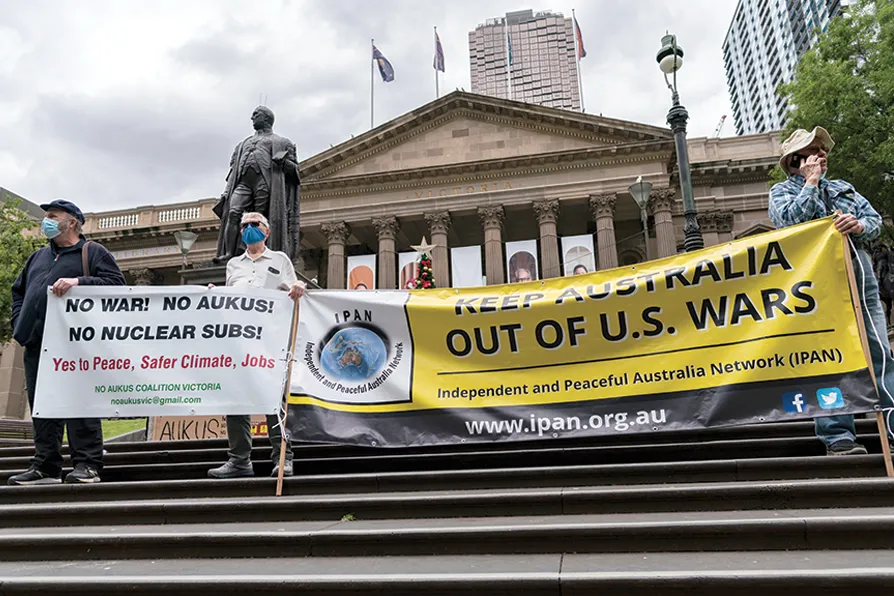
 NO FROM THE OUTSET: Independent and Peaceful Australia Network rally to oppose the AUKUS security pact in Melbourne in December 2021 / Pic: Matt Hrkac/CC
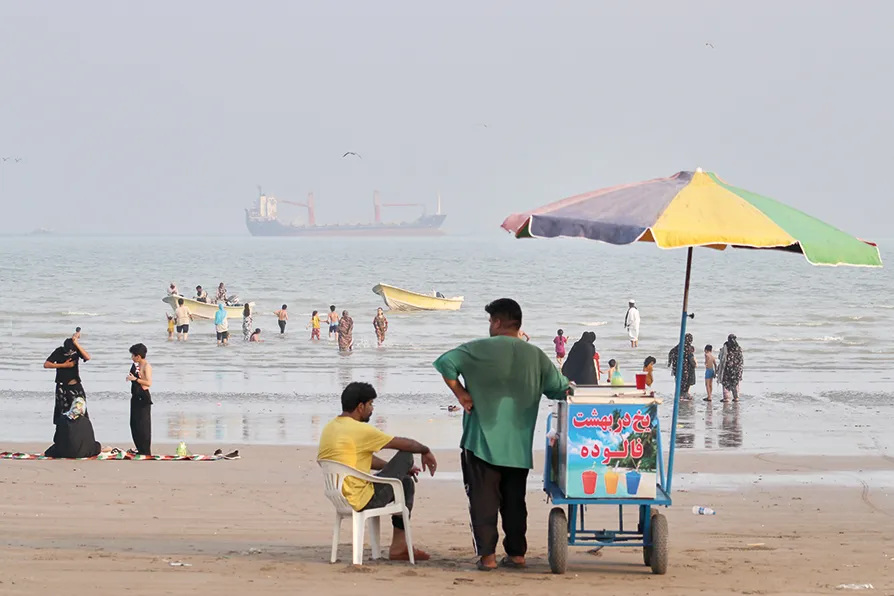
US financial instability is exposing the limits of a dollar-dominated global economy — and giving the Global South a historic chance to build an alternative, says MURAD QURESHI
DOUG NICHOLLS says the parasitic finance markets must be challenged or another British government could be toppled
The late country singer’s Imagination Library has put hundreds of millions of books into children’s hands. We should build on that legacy by defending the libraries at the heart of our communities, says BRENDA AITCHISON
Deprivation is a fundamental factor in criminal behaviour that must be addressed but, KENNY MacASKILL argues, there needs to a major rethink in sentencing to tackle overcrowding
MML director MEIRIAN JUMP outlines the recently refreshed library’s busy autumn schedule that ranges from book sales, archival exploration, community work with online education and the ever popular site tours
TONY BURKE surveys the shifting political landscape and the challenges Labour needs to address if it is to prevail in the 2028 federal elections





US DEFENCE Secretary Pete Hegseth tells Asian allies to spend 3.5 per cent of GDP on defence and quipped “more ships, less Shangri-La.”
During the latest Shangri-La Dialogue in Singapore, Hegseth urged Washington’s Asian allies to spend 3.5 per cent of their GDP on defence, arousing concern throughout the region.
This aggressive push for militarisation could trigger a regional arms build-up unmatched since the end of the Cold War.
Acceding to Hegseth’s demands carries profound economic consequences. Following the Cold War, south-east Asia pivoted from military readiness to commerce and investment, accelerated by deep regional integration via the Association of South-east Asian Nations (ASEAN) and more recently, the 2020 Regional Comprehensive Economic Partnership (RCEP).
This shift transformed the area into a global manufacturing hub, driving rapid economic development that fuelled wider international growth.
The US’s principal military target in Asia is not Iran but the People’s Republic of China (PRC), which is a leading trade partner of most countries in the region as well as neighbouring Australasia.
Given China’s centrality in the region’s industrial supply chains, any aggression against it would disrupt the entire development paradigm of East Asia. On the other hand, the US remains the principal military patron of Australia, Japan, South Korea and the Philippines, as well as a major export market for them.
The US is also a major export market for the Taiwan province of China as well as its main provider of military equipment.
Washington’s insistences create a contradiction whereby the countries that are most deeply integrated into China’s economic dynamism are simultaneously being drawn into military structures designed to confront China.
These include new missile systems, military exercises, bases, naval fleets on patrol in contested waters, and military budgets that soar as social budgets stagnate.
However, in each of the named countries countervailing social forces strive to push back the drive to confrontation and conflict in the Indo-Pacific.
In Australia the peace movement strongly opposes the Aukus pact, a trilateral security agreement between Australia, Britain and the US. Anti-war and peace organisations criticise the deal for escalating regional tensions, driving nuclear proliferation, exorbitant costs and compromising national sovereignty:
• Prominent political campaign: Get Out of Aukus is led by the Australian Greens who have 11 seats in the upper house and won 12.2 per cent of the popular vote on a 90.7 per cent turnout at the last House of Representatives election.
• Independent Public Inquiry: Frustrated by the bipartisan political support for Aukus, the Australian Peace and Security Foundation launched a major crowd-funded, citizen-led inquiry which allows Australians to actively review the impacts of Aukus on regional peace. Its findings are scheduled to be released in October.
• Community Engagement: Groups like The Australia Institute host regular webinars calling for greater transparency and public oversight in relation to Aukus and other policy issues.
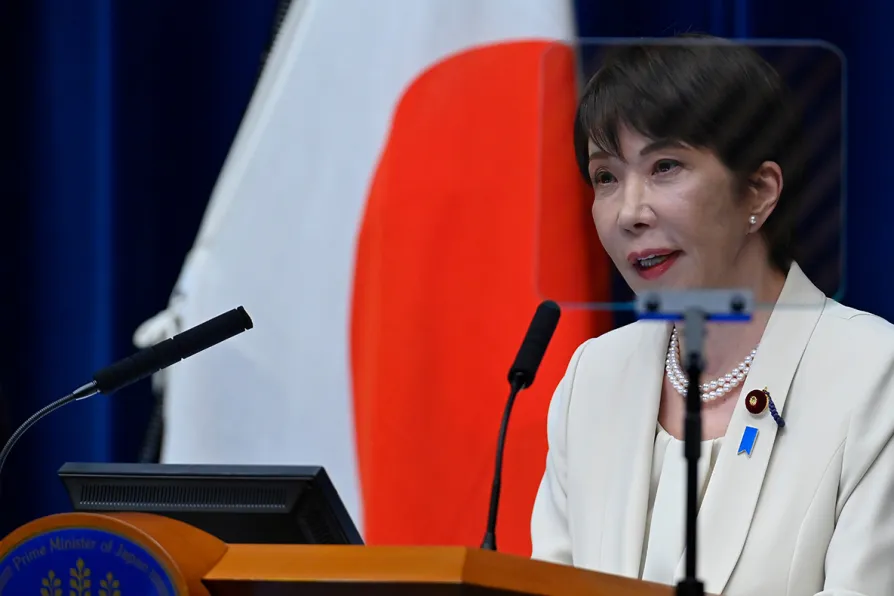
In Japan the February 2026 House of Representatives election saw the hard-line conservative Prime Minister Sanae Takaichi’s Liberal Democratic Party (LDP) secure a historic supermajority, winning 316 of the 465 seats. This massive majority allows her coalition to comfortably override the upper house.
In this unproportional voting system, the LPD won 68 per cent of the seats on 49.09 per cent of the popular vote whereas the Japanese Communist Party won only 0.8 per cent of the seats on 4.05 per cent of the vote.
The voting system results in the splintering and frequent recombination of smaller parties thus diluting pro-peace sentiments in the population.
Driven by Takaichi’s controversial push to remilitarise, Japan’s peace movement is mounting its largest wave of anti-war protests in decades around key actions:
• Mass Street Demonstrations: Tens of thousands of demonstrators, notably swelling numbers of younger people brandishing penlights and No War signs, have repeatedly rallied outside the National Diet Building in Tokyo to defend the country’s pacifist Article 9.
• Targeting Arms Exports: Activist groups have mobilised to condemn the government’s historic decision to scrap the blanket ban on arms exports and allow the sale of lethal weapons to other states.
• Condemning Regional Escalations: Anti-war coalitions have organised rallies near Tokyo Tower and US military bases to oppose the record-high defence budget, demanding immediate diplomacy over ongoing international conflicts in west Asia.
• Okinawa’s Unique Struggle: Okinawa hosts a significant portion of US military bases in Japan, and local peace activists there continue a long-standing “battle for justice” against the presence and expansion of these military installations.
The Philippines is in the midst of Vice-President Sara Duterte’s impeachment trial which is notionally on charges of mishandling government funds and making threats against President Ferdinand Marcos Jr.
However, what is rarely reported in the global North media is that the trial is underpinned by disagreements over foreign policy, with Duterte criticising Marcos over his lack of a “clear” independent foreign policy, pointing out that the constitution states that the Philippines should not side with any foreign country.
She noted that during Marcos’s official visit to the US in July 2025, Trump had said that the Philippines had “tilted towards China” and is now “tilting towards the US.” She went on criticise the government over its actions in the West Philippine Sea, saying that the Philippines should instead “talk” with Beijing regarding the 2016 Permanent Court of Arbitration award on the South China Sea.
One of the priorities of the Philippine peace movement is the 2014 Philippine Enhanced Defence Co-operation Agreement (EDCA) that allows US troops rotational access for extended stays to designated Philippine military bases.
It operates under the 1951 Mutual Defence Treaty to boost interoperability, modernise the armed forces, and improve humanitarian and disaster response.
The EDCA also gives Philippines personnel access to US ships and aircraft as well as allowing the US to build and operate facilities on Philippine bases for both US and Philippine forces although the US is not allowed to establish any permanent military bases.
On January 12 2016, the Philippine Supreme Court upheld the agreement’s constitutionality in a 10–4 vote which was confirmed with finality on July 26 2016.
South Korea has a strong history of mass mobilisations and “candlelight protests” that have repeatedly shaped the nation’s political landscape. The most recent example is the massive civilian demonstrations that helped overturn the December 2024 martial law decree, leading to the impeachment of former President Yoon Suk Yeol.
Peace organisations are numerous and diverse:
• Action for Korea United (AKU): A large coalition (nearly 1,000 NGOs) promoting peaceful reunification via economic aid for defectors, cultural campaigns (like the One K Concert), and unification education.
• Peace Foundation (PF): A volunteer-driven organisation (including Korean Minutemen for Peaceful Unification-KMPU) focusing on national consensus for peace, education, and unification efforts.
• Korea Peace Now! (KPN): A US-based network, including Women Cross DMZ, advocating for an end to the Korean War by building political will in the US to support a peace agreement.
• BDS Korea: A feminist group focused on anti-imperialist solidarity, linking Korean struggles to Palestine’s liberation through boycotts and severing ties with Israel.
• Global Peace Foundation (GPF): Promotes a vision for a free, democratic, and unified Korea through campaigns like “One Korea Global Campaign.”
By building up the military capacity of its allies in the region and exploiting unresolved jurisdictional disputes, the US appears to be seeking to set up the means to provoke a conflict with China over its Taiwan province.
Public opinion polling by National Chengchi University’s Election Study Centre reveals that only 3.8 per cent of the population, the lowest since 2002, support “immediate independence,” with 1.2 per cent supporting immediate unification.
Meanwhile, 83–88 per cent prefer the status quo, with a record high of 33.2 per cent wanting the “status quo indefinitely.”
The government is currently led by the minority Democratic Progressive Party (DPP) which favours close ties with the US and Japan and seeks to increase military expenditures.
Among other measures, the DPP’s confrontational posture with the mainland was intensified with the 2019 Anti-Infiltration Act, aimed at curbing China’s alleged political influence on the island.
The majority opposition Kuomintang (KMT) and Taiwan People’s Party (TPP) favour stable relations with the PRC.
On December 5 2025 the KMT and TPP postponed placing the government’s £30 billion special defence budget in the Legislative Yuan, Taiwan’s unicameral parliament.
The DPP now lacks both a legislative and a popular mandate.
Notable civic and political entities calling for stable relationship with the People’s Republic include:
• The Cross-Strait Peaceful Development Forum: A coalition of civic groups and political figures that regularly organises rallies and public forums calling for the resumption of cross-Strait dialogue and advocating against arms purchases.
• Taiwan’s Labour Party: Frequently collaborates with grassroots groups, trade unions, and pro-unification advocates to campaign for economic co-operation and peaceful development across the Taiwan Strait.
• Academics and Think Tanks: Various independent policy institutes and cultural exchange groups in Taipei publish proposals emphasising the importance of institutional dialogue, trade normalisation, and avoiding actions that could escalate into military conflict.
In conclusion, our task is to build the largest possible global majority for peace, both here in the UK and wherever else we can. We are already in the foothills of WWIII which will be fought with nuclear weapons and poses an existential threat to humanity. We must not relent in our efforts.
Readers may find these recent articles of interest:
• East Asia’s Double Bind: Contradictions and Possibilities in the New Cold War
from the Tricontinental: Institute for Social Research
• Hands off Asia! A People’s Call for Sovereignty and Solidarity on the conference which took place in Colombo on July 16, 17, and 18
Mike Martin is a member of Scottish CND’s trade union network.

Similar stories
JENNY CLEGG looks at the key points that defined the China-US relationship, for now

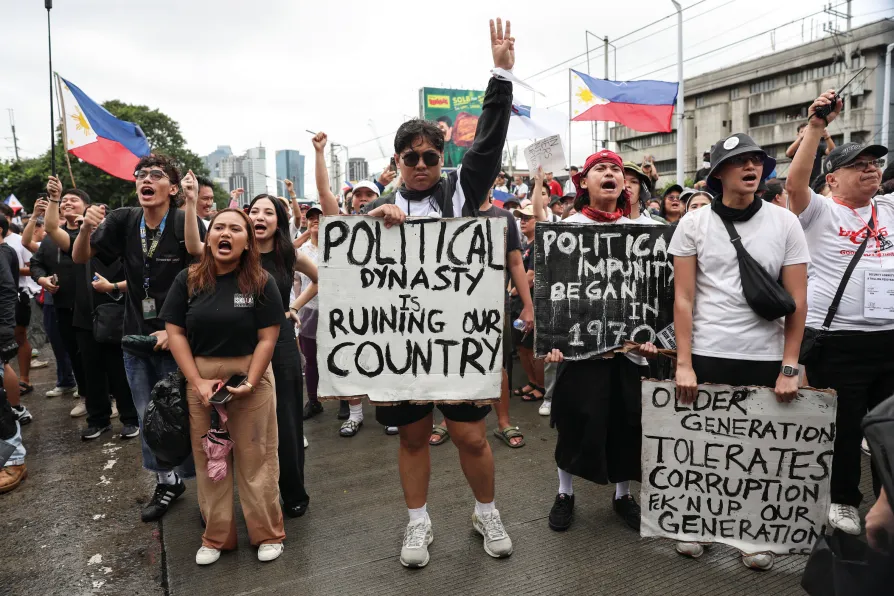
Huge protests against corruption and preventable deaths during flooding have rocked the government — the masses are not likely to be able to take direct control in their own interests yet, writes KENNY COYLE, but it’s a promising show of people power