After months of uncertainty over printing and distribution, the first Scottish-printed edition of the Morning Star is soon to roll off the presses


 Latest editorial

The party of devolution — or its undoing?
Labour’s approach to Scotland reveals a long-running tension between rhetoric and reality, warns PAULINE BRYAN
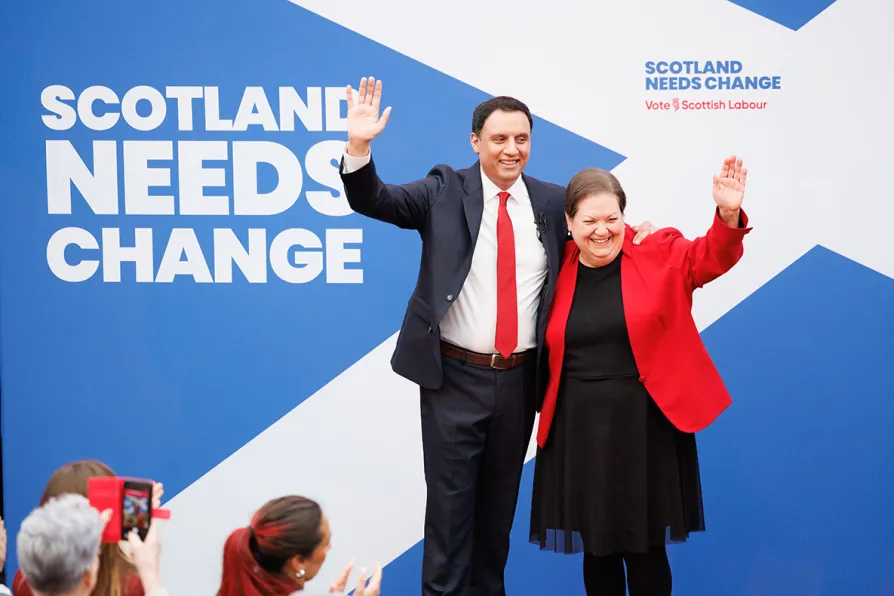 Scottish Labour leader Anas Sarwar and Jackie Baillie MSP at the launch of the party's 2026 Scottish Parliament election campaign Barras Art and Design, Glasgow, March 26, 2026

Some thinkers and authors on the right are openly discussing the possibility that the historically successful party of the British ruling class may be exhausted
Class struggle is the motor of history but the direction and detail of change at any time and place is the outcome of many factors, suggests the Marx Memorial Library and Workers’ School
Merseyside’s proud tradition of internationalism is being kept alive through events organised by trade unionists and allies in the region, writes ROBERT MACDONALD
JOHNNIE HUNTER reports from the German Communist Party’s (DKP) weekly Unsere Zeit (Our Newspaper)-organised Peace Days festival in Berlin last weekend
Les Preger was one of Manchester’s first volunteers to volunteer in support of republican Spain, writes his daughter JANEY PREGER
TONY BURKE surveys the shifting political landscape and the challenges Labour needs to address if it is to prevail in the 2028 federal elections





THE Scottish Labour Party describes itself as “the party of devolution” but is that commitment shared by this Labour government?
The Tories were accused of conducting a “power grab” of devolved rights. Are we seeing a continuation of that approach by Labour?
The first elections for the Scottish Parliament and the Welsh Assembly in 1999 resulted in a honeymoon period with Labour in government in Scotland, Wales and across the UK.
While the electoral systems adopted for the devolved administrations was designed to ensure no overall majority for one party, the architects must have thought that Labour would be the biggest party in Scotland and Wales into the foreseeable future.
How wrong they were. Labour’s dominance in Scotland only survived for two elections before it was overtaken by the SNP in 2007. Just four years later the SNP achieved what was supposed to be impossible, an overall majority, giving Alex Salmond the credibility to demand an independence referendum.
This miscalculation that Scotland was innately Labour almost certainly came from the influential Scots in Tony Blair’s front-bench team.
The announcement of a referendum on devolution, made while Labour was still in opposition, was fronted by George Robertson, Donald Dewar, Gordon Brown and Robin Cook.
A significant part of that statement launching the policy was that sovereignty would remain at Westminster.
George Robertson had claimed that the devolution they had designed would kill demands for independence “stone dead.” His aim had been to devise a form of devolution that was “integrationist and the death knell for separatism.”
Meanwhile, those Labour Party members and others who had campaigned for devolution over decades were sidelined.
One has to question the political judgement of those involved including Gordon Brown who 20 years earlier had edited the Red Paper on Scotland with authors such as Tom Nairn and David Gow. He ought to have had the insight and political understanding to realise this strategy was misguided.
A badly thought-through, half-hearted devolution that did not adopt a federalist structure was only going to lay the ground for future problems.
The 1997 general election had given every indication that Labour in Scotland was on a roll. The Scottish Conservatives were wiped out, failing to win even one Scottish seat in Westminster.
At the May Day celebrations the following weekend, there was palpable joy that the Tories, who had run Scotland from Westminster for 18 years, had gone. The policies of rate caping, the poll tax and the reorganisation of local government which had undermined the right of Scotland to make local decisions on raising and spending local taxes had been rejected by the Scottish electorate.
At the first Scottish parliamentary elections in 1999 the combined first past the post and PR voting arrangement gave the SNP a firm base from which to build and allowed the Conservative Party a re-entry into representation from which it went on to become the main opposition in 2016 and 2021, pushing Labour into third place.
The miscalculation made was never properly explored or analysed by either Scottish or UK Labour. So, when David Cameron gave the go-ahead for an independence referendum to be held on 2014, the Scottish Labour Party was unprepared.
Because Scottish Labour leaders had never fully accepted that the Scottish Parliament should honour the “Claim of Right” adopted by the Scottish Constitutional Convention in 1989 for “the sovereign right of the Scottish people to determine the form of government best suited to their needs…” it was unable to pose an alternative to either nationalism or unionism. Instead, it adopted a unionist position and joined the Tories in “Better Together.”
Ever since, Scottish Labour has been in a downward spiral. It had a slight reprieve in the 2017 Westminster elections and made significant gains in 2024, but in the Scottish Parliament it has lost support and seats at every election and that is expected to continue in May this year when it could have as few as 18 MSPs and possibly drop to fourth place.
In 2020 Gordon Brown established the Commission for the UK’s Future. Both the process and the report had many faults, but it did contain one clear proposal that was deliverable by a future Labour government and that was that the House of Lords should be replaced with a new second chamber called the assembly of nations and regions.
It was to be directly elected and have powers to safeguard the constitution and give a direct voice in the UK Parliament for the nations and regions. At the launch of the commission’s report in December 2022 Keir Starmer committed himself to include the replacement of the House of Lords with an elected assembly in the next Labour Party manifesto.
Unsurprisingly there was no such commitment in the manifesto. In fact, it was the first manifesto since 2010 that didn’t include a commitment to an elected second chamber.
Since Starmer’s election as leader in 2020 there have been so many examples of firm pledges not being kept that it is now expected.
Steve Reed, Starmer’s Secretary of State for Housing, Communities and Local Government, should actually be called the secretary of state for England as his department’s responsibilities are devolved. But he has been sidestepping the devolved administrations by using Pride of Place funding to deal directly with Scottish and Welsh local authorities and in the process distorting local priorities and directing money that would have come anyway into ringfenced projects.
The thinking behind this has become quite explicit in a recently leaked memo in which Starmer warned his Cabinet against an “overly deferential” approach to the Welsh, Scottish and Northern Irish governments.
Far from being the party of devolution, Labour is adopting the Boris Johnson approach and is rolling back 27 years of devolution.
Local government in Scotland was already at the mercy of the Scottish government’s centralising tendencies and is now receiving the same treatment from the UK government.
Unfortunately, despite his much-publicised break with Starmer, Anas Sarwar does not appear to be using the opportunity of the Scottish elections to reassert Labour’s claim to home rule.
Pauline Bryan is a Labour peer.
