KEN COCKBURN traces the one original language – that of the Yamnaya pastoral nomads – from which all European and Indian languages derive


 Latest editorial
Overplaying the playboy
MARY CONWAY is disappointed by a production whose design and cartoonish acting overwhelms the close scrutiny of characters
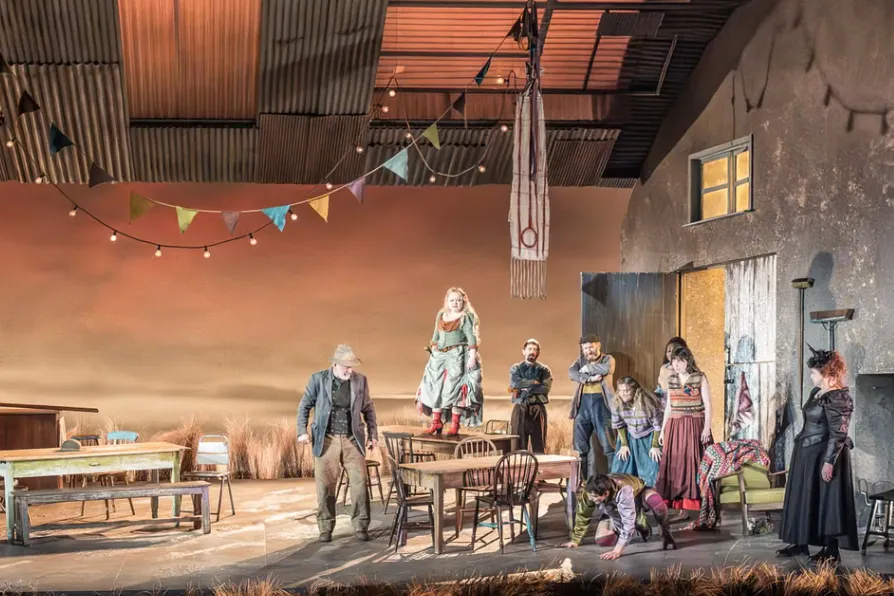 STEREOTYPES OF WESTERN IRELAND: The Playboy of the Western World [Pic: Marc Brenner]
PAUL DONOVAN is fascinated by the debunking of the iconic British war hero
ALEX HALL recommends a searing panorama of our global predicament
Comics are not just superheroes and spandex – it can be public art, telling public stories, suggests HARRIET EARLE
ALEXEI SAYLE speaks to Angus Reid about a lifetime of protest, how to hone political art – and what to do now
The bard serenades the Diggers of Wigan and their festive followers





The Playboy of the Western World
National Theatre - Lyttleton
⭑⭑⭑☆☆
AT the heart of Synge’s The Playboy of the Western World sits a wildly comic concept: a central absurdity, effective only when earthed in deep reality.
And it is that reality that caused an uproar when the play first premiered at the Abbey Theatre Dublin in 1907. It portrays the people of western Ireland, not as a polite and friendly, gentle-talking folk, but as a pretty crazed lot, a rendition that belies sentimentality and popular expectation. Synge, you see, had travelled through County Mayo and set out to tell it as it is, which was a brutal shock to those wanting dignified conformity and moral overtones.
The story charts the arrival in a remote Irish pub of Christy Mahon who – while uninspiring in appearance – brings sensational news. He tells us, in wretched tones, that he has killed his father, a detail so extreme it engulfs the local populace in an ecstasy only possible for people deadened by tedium, poverty and isolation. Indeed, their wild frenzy transforms Christy in their minds from pathetic vagrant to – absurdly – sex symbol and star. It’s a farce but, even as we laugh, we also absorb the desperate longings of the locals for novelty and escape.
Caitriona McLaughlin’s National Theatre production is one of energy and verve with vivid, memorable visuals and a hand-picked Irish cast. The play opens on to designer Katie Davenport’s rustic pub which – unlike in Conor McPherson’s terrific The Weir – carries nothing of the small, claustrophobic space associated with Irish get-togethers. Instead, the wide backdrop reveals sheets of grim rain, a landscape edged with grassy spikelets, sodden land reaching to the skies, and spooky straw-clad, musicians drifting past with fiendish intent. The result of this powerful design is, sadly, to diminish the pub and its people in the face of unforgiving geography and paganism.
This is a shame, as it’s close scrutiny of the people that matters.
The play is celebrated for its poetic language and authentic dialect but enunciation is often wanting in this production, rendering much of what is said as simply indecipherable and the characters as cartoonish. In other words, we laugh but don’t necessarily fully engage.
Eanna Hardwicke does embody something of the woebegone Christy’s desolate hopelessness, though, and Siobhan McSweeney delivers the pulsating, orgasmic Widow Quin with great aplomb, set off by an ardent troupe of eager local groupies. Pegeen, however – she who falls for the prized Christy and captures his heart – never quite captures ours in Nicola Coughlan’s albeit central performance, despite the actor’s star billing and Derry Girls credentials.
To know whether Christy’s father is actually dead, you need to see the play. Suffice to say that Declan Conlon does a fine, upstaging turn in the role. But here over-ardent direction sometimes interferes with the simple lustre of the script, often risking authenticity and empathy for the characters in the interests of visual diversion and pantomime.
Trust the writer and the play’s great; compete with him – as happens here – and we get the basics but not the superlatives.
Runs until February 28. Box Office: 020 3989 5455, nationaltheatre.org.uk
