Growing instability in the US economy and financial markets could have serious consequences worldwide because of the central role of the US dollar and financial system, argues MICHAEL BURKE


 Latest editorial

One last chance?
MATT KERR takes stock of a night of by-elections, where the long repeated warnings for Labour and the political class remain stubbornly unheeded
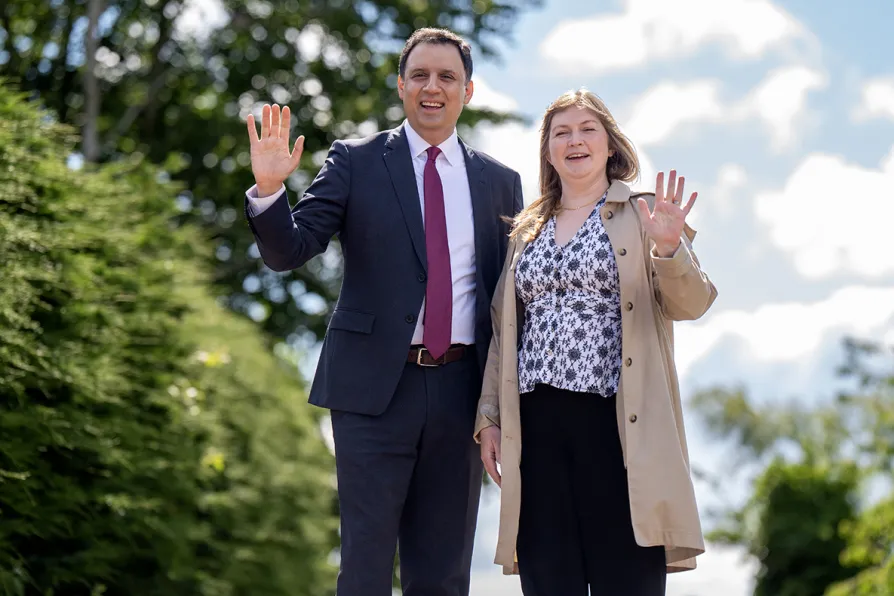 Scottish Labour leader Anas Sarwar (left) with party candidate Heather Doran (right) whilst campaigning for the upcoming Arbroath and Broughty Ferry UK Parliamentary by-election in Broughty Ferry, Dundee, June 10, 2026
Despite Andy Burnham’s declaration defending the continued partition of the island, all major international and internal trends are converging to make Irish reunification inevitable
The left needs a bold energy vision – because if it fails to provide one, others will shape the future in their own interests, argues ALAN SIMPSON
From Margate to Deal, mining memories are being kept alive. National co-ordinator for General Strike 100, HENRY FOWLER continued his nationwide tour of partner organisations in the Garden of England
Humans are part of the ‘animal kingdom’ – and of nature in general – but also distinct from it and labour (work) is part of what makes us unique, declared Engels. His insights 150 years ago into how our species came to be and how we differ from the rest of nature, are as important today as they were then, says the MARX MEMORIAL LIBRARY
Boxes of books, family photos and heirlooms, labour movement anniversaries, along with nostalgic memories of glorious childhood days on the Ayrshire coast still leave room for a wistful MATT KERR to hope for a better future





FOR some reason, sleep deprivation makes me thirsty. I’ve no idea if that’s normal or not, or even if it’s a new development.
There was a time when seeing the sun come up with a drink in my hand was the sign of a night well misspent, but alas it’s not quite the same with a mug of hot chocolate and retinas burning from watching the telly.
I’m sure that in my lifetime they were called “bye-elections” here like they still are in Ireland, but the “e” has been dropped. Maybe one day the hyphen will go the way of the one that used to live in “to-day,” I wonder.
“Will I be around to see that?”
Bubbles bursting in the kettle snap me out of it. On the screen there are people with clipboards wandering keeping tally on the ballots to glean whatever information they can on how the votes shook down box-by-box. In the touchscreen age, it’s still pencil and paper before it’s all fed into the various parties’ expensive sausage machines.
They’ll use it to better guess where their vote is and better target future campaigns, a modus operandi that over the years has been wildly successful in shrinking the electorate to fit the plummeting numbers of activists, narrowing the political horizons, and reducing us all to the status of fodder.
There’s no machine politics like by-election politics. Lack of time offers the perfect excuse to dispense with niceties like actually engaging with messy, complicated conversations with actual human beings and focus on “getting our vote out” — with the emphasis on “our.”
It’s a phrase used so routinely across the parties at elections; entitlement in the plainest of sight, staring out from the mirror as they strain to lose eye contact.
Three by-elections were taking place. In Aberdeen South, Arbroath and Broughty Ferry, and Makerfield; two defended by the SNP, one by Labour.
In two out of three, “the vote” was dragooned to the polls by individuals’ vaulting ambition to take the leadership of their parties.
In Scotland, both elections were sparked by their MPs being elected to Holyrood last month. In the case of former Aberdeen South MP and SNP Westminster leader Stephen Flynn, the move is undoubtedly to scratch his itch to be first minister. As a newly minted cabinet minister though, he will soon realise the difference between the comfort of being in guaranteed perpetual opposition against bad things, to being het for government policy to slash — according to the STUC — up to 20,000 public-sector jobs this term.
Maybe he will take the STUC up on their vision for an alternative path? I do hope so.
The by-election he caused was won by a Tory ex-MP, after a campaign dominated by the question of new oil licences for the North Sea. In the centre of Britain’s oil and gas sector — by all accounts haemorrhaging 1,000 jobs a month — it’s perhaps not a surprise that the “drill baby drill” message was heard over the SNP’s “case-by-case” policy.
Clearly focus-grouped to within an inch of its life, that line manages the feat of infuriating both those who rightly see the “climate test” clause in it as utterly absurd, and those who rightly see an industry collapsing around them while both governments fail to deliver a serious plan to keep skilled workers in the country and at work as we move away from fossil fuels.
In Arbroath, the seat was won comfortably by a middle-class lawyer and SNP adviser, a member of three minority groups that for so long have languished in under-representation on the green benches of Westminster. Up the workers!
Makerfield saw Andy Burnham change horses from Greater Manchester mayor back to MP.
Despite fears that Reform could have overturned the 5,399 majority enjoyed by Labour Together alumnus Josh Simons, Burnham managed 9,231, or 6,130 if we roll up Restore Britain and Reform votes.
Unlike the other two by-elections, the turnout had even gone up.
His victory speech was first interrupted by someone who had clearly been given a laminating machine for Christmas and was determined to hold up its produce. Alas, the detail of an A4 sheet does not carry well on TV, but I could at least make out the letters “BBC” with a red line through it.
The man spoke a series of words into a microphone that had been switched off as Burnham walked out. The confusion in the studio was one of the highlights of the evening, but soon Burnham returned to the platform for his big moment. The one he’d waited for since the last time he had been defeated in a Labour leadership race.
On his right flank, intergalactic aristocrat Count Binface took a somewhat more restrained approach, clapping politely as he presumably contemplated the long drive home having coaxed 95 people to vote for his pledges to rephase the traffic lights on Liverpool Road, cap the price of a Wigan Kebab at two pounds, and rename HS2 as FFS1 — a platform not without merit.
Burnham offered the usual thanks, before making his own declaration “to build a new politics based on unity and hope.”
Joyously, every mention of “hope” was echoed by cheers of “hope” from the elderly Official Monster Raving Loony candidate, one Howling Laud Hope — who had, cane in hand, staked his claim at the lectern even before the declaration. Just polite enough not to be escorted off but, like echoing someone’s laugh, enough to deliver unanswerable laser-guided irritation to the victim.
Mr Hope is nothing if not experienced.
Burnham had the good grace to acknowledge people who had supported other parties just a few weeks ago had lent him support, but in a passage as directed at the leadership of the Labour Party as the entirety of his last six weeks of campaigning, he said: “To my own party: this is a final chance to change.
“This is what people said directly to me on the hundreds of doorsteps that I stood on.
“We must hear it, we must act upon it and we must get it right.
“There will be no second chance.”
A bold statement for a man about to launch his third tilt at leadership, but he’s right.
My mind raced back to knocking doors for Labour in Pollok in 2010.
Over and over again, the phrase “last chance” came up. The result came in and the machine closed down.
A year later, the SNP turned a one-seat lead in Holyrood into an outright majority.
In 2014, friends of mine looked baffled as they saw Glasgow vote for separation, saying things like “folk said to me ‘always voted Labour’,” — too few canvassers hung around for the end of the sentence.
The results came in and the machine shut down.
By 2015 Labour had one MP left in Scotland and this year the party celebrated the milestone of going 27 years since gaining a single seat in a Scottish parliamentary election.
Even then, the result came in and the machine shut down.
The thousands who flooded into Makerfield in the hope of defeating Reform and Starmer in one fell swoop will now be heading home while Burnham plots a course to a new one, but like Flynn, being against carefully selected bad things will no longer be enough.
He can offer a few cheap kebabs and functioning traffic lights, or he could do something different and unashamedly turn state power to the service of humanity.
His election was a triumph of hope over experience.
No saviour will deliver for the working class unless the case is not only unanswerable, but causes laser-guided irritation to the tenant of No 10.
That’s our job.
Only then will hope actually deliver.
