MARIA DUARTE recommends a remarkable study of the friendship between a Palestinian and a Pakistani, broken by a hostile state


 Latest editorial

‘Music, like our world, is many and one at the same time’
CHRIS SEARLE speaks to Mexican/Uruguayan drummer GUSTAVO CORTINAS about the ecological conscience expressed in his new album
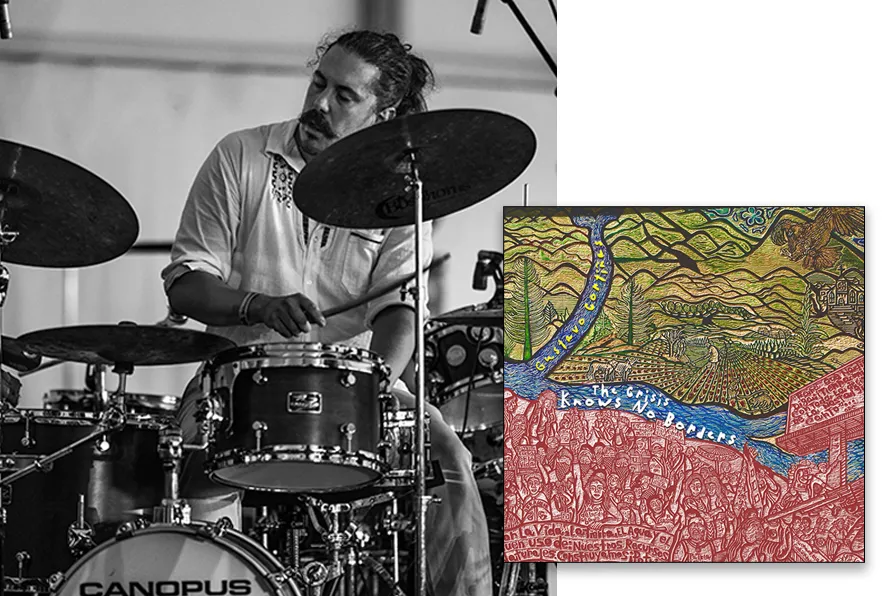 Gustavo Cortinas [Pic: Kevin Matthews]

MATTHEW HAWKINS rakes through un-fancy words and flair-free summaries to find who and what might be flamboyant
PETER MASON is exhilarated by an exciting, well-considered and historically minded tribute to the great Trinidadian instrument
Reducing historical lives to ‘male’ and ‘female’ roles, we lose the nuance of those lives and a clearer understanding of past societies, suggests CLAIRE ISABELLA GILMOUR
CHRIS SEARLE relishes the genius of pianist Alexander Hawkins, his many ensembles, and his new album





THIS record’s illuminating message is in its title: The Crisis Knows No Borders, created by a quartet of superfine musicians with provenances in Mexico, Uruguay, the Philippines and across the US via the birthplace of jazz, New Orleans, where the foursome’s instigator went to study music, at Loyola University.
As in Max Roach’s epochal 1960 album of Civil Rights, We Insist!, the album’s sleeve, illustrated by Honduran artist Alexy Lanza, depicts its theme with signal brilliance — a mass demonstration for life, the earth, water and the best use of our natural resources. What could be more urgent, coming from the belly of Trump’s America, with its opening track called The Basic Economic Farsity, expressing “the prioritising of the luxurious wants of a few over the essential needs of the many.”
The leader of this quartet is the Mexico-born drummer Gustavo Cortinas, his father a Uruguayan university professor, his mother a Mexican elementary school teacher. He moved from New Orleans to Chicago, the city of violinist Mark Feldman — who has made 200 studio recordings and played in the symphony orchestra of Nashville, Tennessee. The guitarist is Dave Miller from Little Rock, Arkansas, with his blood mixed with the blues, and the insurgent saxophonist Jon Irabagon, whose parents were from the Philippines: quite a worldspan is here.
I asked Cortinas about the genesis of their album. “When we talk about climate justice,” he replies, “there is no status quo but actually a regression on the part of world leaders (political and corporate) to lean into a worldview and practices that are simply unsustainable and an existential threat to our humanity. The climate crisis is one that knows no borders, its consequences are real and felt all around the world. At the same time the competitive edge of the capitalist system leads these ‘leaders’ to ignore this call to action in the name of economic growth.
“The music of this album also transcends borders and you could say it is genre-defying. It puts together influences of jazz, rock, punk, classical music, renaissance counterpoint, Latin American folkloric, Aztec music, m-base and beyond. It is my hope that all these influences come together to tell a cohesive story without any desire to delineate the differences between these styles, but rather to bring them together and show that music, like our world, is many and one at the same time.”
Hear Feldman’s dramatic solo violin and caustic bow-work and pizzicato on the opener, or how Miller’s blues-baked guitar and Feldman’s agonising notes ultimately erupt into the unpredictability of free improvisation on The Growth Imperative, expressing the menacing demand for perpetual growth without sustainability or redistribution.
Or the track called Skepticism, involving a palaver between Irabagon’s deep, worrisome sounds and his exchanges with Feldman’s spiky violin. Or in Sea Level Rising where the two of them play as if they were exchanging instruments with supercharged energy, before Miller’s chinking guitar continues with the same ominous mood: four virtuosi voicing, in diverse unity, the same intuitive messages.
Cortinas says of his bandmates: “It is an honour to work with these three humans. Jon is a master musician whose energetic creativity is bound to no one style and is ever curious and explorative. Mark is literally one of the trailblazers for bridging classical music and jazz. He brings these and other musical worlds together beautifully and creatively. Dave is a genius of textural mastery and is the boat that carries this band through landscapes, styles and journeys.”
Irabagon’s opening solo on The Man Of Flesh And Bone is full of humane, spontaneous melody that is the sound of hope, shared bountifully with Miller’s guitar underpinning, a presage to Cortinas’s Meditation For The End Of Times, in which he melodises the drums in a cosmic anthem of drumspeak and drumsong.
I ask him whether he saw his album as an echo of the 1960s and 1970s campaigning albums of Roach, Charles Mingus and Archie Shepp.
“Jazz has a brave history of activism,” he replies, “and as a social music has shown a power to reflect the grievances of our society. Schoenberg, on a different paradigm, also expressed the necessity for music to reflect the chaotic and dissonant nature of our world.
“I resonate deeply with the work and mission of these human beings whom I deeply admire, and at the same time — perhaps like them — find it inevitable to be disturbed/inspired by what’s going on, and consider it an exercise of sanity, integrity and love to speak up and reflect this in my music.”
The Crisis Knows No Borders is released by Desafio Canente Records
