KEN COCKBURN traces the one original language – that of the Yamnaya pastoral nomads – from which all European and Indian languages derive


 Latest editorial
Music for the eyes
JAN WOOLF surveys a national hoard of silver and gold
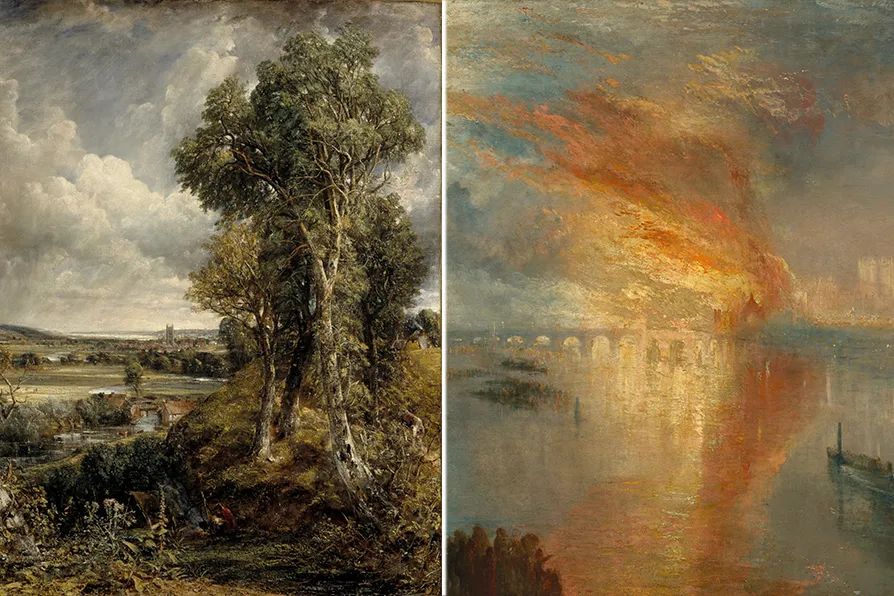 (L) John Constable, Dedham Vale, 1828. Detail. (R) JMW Turner, The Burning of the Houses of Lords and Commons, 16 October 1834 [Pic: © National Galleries of Scotland/Antonia Reeve; Cleveland Museum of Art]
PAUL DONOVAN is fascinated by the debunking of the iconic British war hero
ALEX HALL recommends a searing panorama of our global predicament
Comics are not just superheroes and spandex – it can be public art, telling public stories, suggests HARRIET EARLE
ALEXEI SAYLE speaks to Angus Reid about a lifetime of protest, how to hone political art – and what to do now
The bard serenades the Diggers of Wigan and their festive followers





Turner and Constable: Rivals and Originals
Tate Britain, London
★★★★★
“Mr Constable’s works present no stronger contrast… than they do with Mr Turner’s… the first is all truth, the last all poetry: the one is silver, the other gold.” London Magazine, June, 1829.
Aye to that, I say.
The writing on the wall is in the last room of this incredible exhibition to mark the 250th anniversary years of the births of JMW Turner and John Constable, and their entwined lives. From radical 19th century painters to Lords of the biscuit tin lid, pontiffs of place mats, Turner and Constable have become part of our national story.
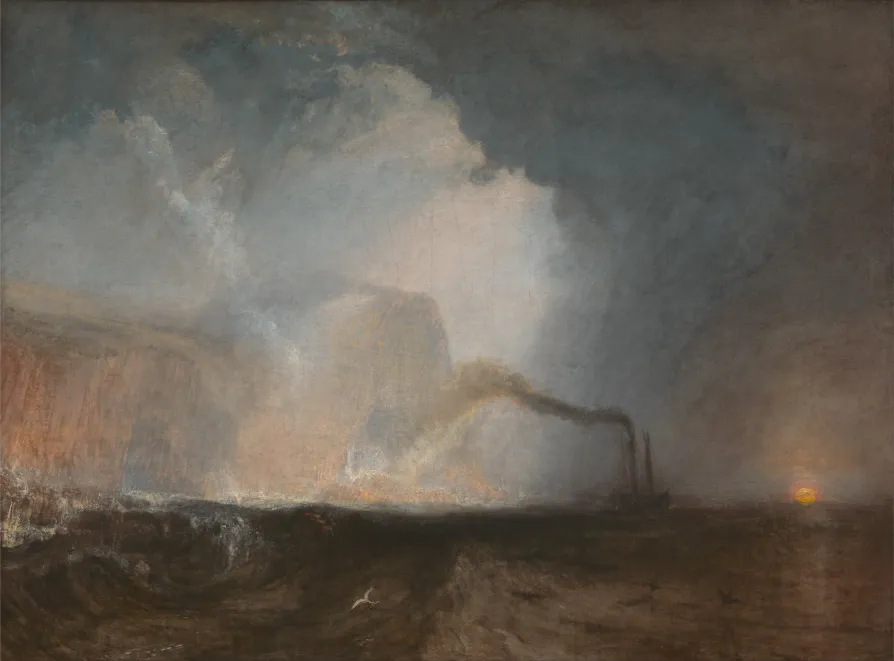
I once took my mum to see the Constables in Tate Britain — to see the originals of the lids — and she was amazed, loving the way the paint stood out a bit. TC (top cats?) are both — to use John Berger’s famous phrase “ways of seeing.” They are also states of consciousness, for in Constable we exist, but in Turner we find the existential — like the steam from the steamboat fusing with the rain cloud in his Staffa, Fingal’s Cave.
Image
They are earth and air, and in Turner’s case a fascination with light. See his watercolor, A Transparency: Moss-Covered Cottage and Shed, with a Man Smoking and a Lantern. Likewise the oil sketch View of Dedham Lane Leading from East Bergholt Church to Flatford that Constable knocked out in the lid of his portable paintbox.
The show is full of unfamiliar treasures like these. Study the sketchbooks — such liveliness and lack of inhibition in them. Liberating, private — no pressure — skipping stones of the soul. Diluted paint running onto and into dampened paper.
The exhibition features over 190 paintings and works on paper, from Turner’s epic The Burning of the Houses of Lords and Commons, 1835, lent by Cleveland Museum of Art and not seen in Britain for over 60 years, to Constable’s The White Horse 1819, last exhibited in London two decades ago.
Image
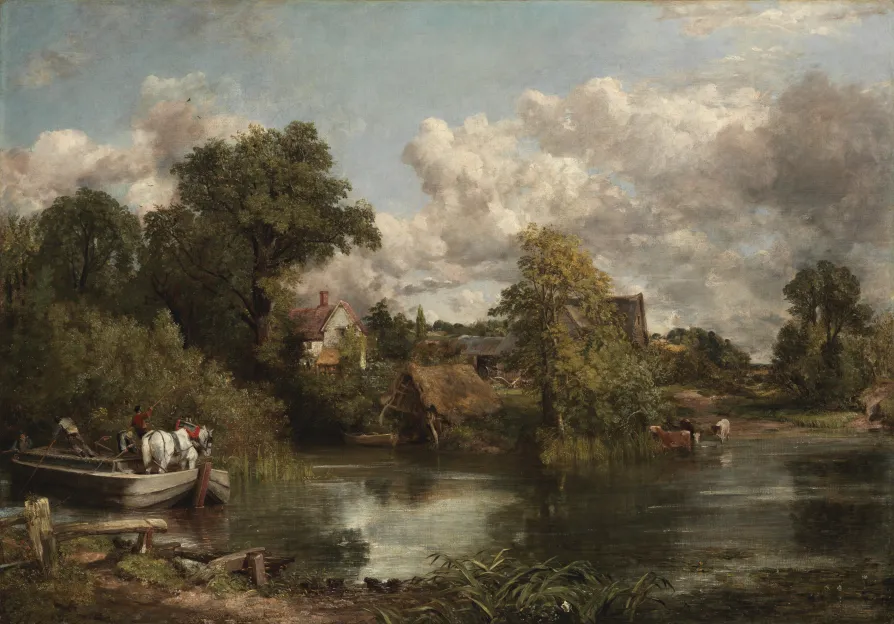
Don’t get into who is better. Try the magic circle trick. Make an O of thumb and forefinger and pass this over any Constable painting – without touching it of course and setting off alarms — everything you see in that O is beautiful, the paint work as delicious as Francis Bacon’s.
Less so with child prodigy Turner, where you need the whole to “clock it” internally, as he might have said in his native Cockney.
Constable is about materiality; earth — gates, chains, locks, bricks. Turner is about the tone, the mood, mythology and sometimes the glamour. His disasters at sea and the great arcs of storms and tinted steam make for wonderful compositions.
The differences between their work urged the critics of the day to pit them against one another, presenting them as rivals. In 1831 Constable himself played into this, placing his and Turner’s work side by side at the Royal Academy exhibition. The juxtaposition of Turner’s Caligula’s Palace and Bridge and Constable’s Salisbury Cathedral from the Meadows, prompted comparisons between the sun-drenched heat of Turner’s mythical Italian scene and Constable’s damply atmospheric Britain; they were “fire and water.”
Back to the title. Originals certainly, but Rivals suggests that we concentrate on the art the wrong way and pick our favourite — someone with a clip board at the exit firing off “Turner or Constable?” and then ticking a box.
Here’s an idea for a piece of performance art. Gilbert and George with the clipboards with actors playing and Constable and Turner respectively. “Turner!” snaps Turner. “Constable!” growls Constable, rolling his eyes. Then they’d go off, arm in arm, arguing about how to use cobalt blue in a sky, or “Why did you put a rabbit in the foreground? You call that art? Nice bit of colour wash — but that elephant? And mine’s a pint.”
The show features a scene from Mike Leigh’s 2014 film Mr Turner, starring Timothy Spall. Varnishing day at the Royal Academy, 1832. The two painters are bickering. So are their paintings, Helvoetsluys; the City of Utrecht, 64, Going to Sea and Constable’s The Opening of Waterloo Bridge, hanging side by side.
Image
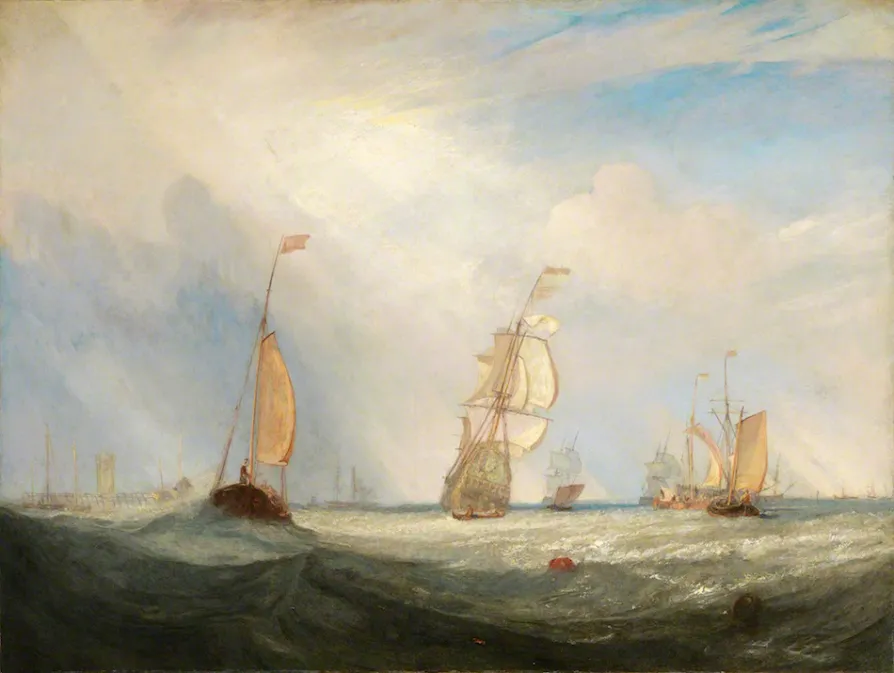
A petulant Mr Turner splodges some red in his sea, in the form of a buoy, and conquers the room. Why was this so powerful? It was the point rouge, that little red mark that draws in the eye. Like an infant’s to a nipple? This deep inner knowledge is in all their work — that the “other mother” is the land.
Both men wanted to “belong,” to be recognised by the art establishment, at the time personified by the Royal Academy. I wonder what Saatchi would have made of them. And they of him. It was about sales as much as recognition, but what makes each of them great is the inner force of consciousness and love of nature.
It would have been interesting to see what Constable would have made of “abroad” — especially the Middle East — and Turner if he’d stayed home more. His paintings of the atmospheric pollution of London and the Midlands chart the origin of our current climate crisis.
In their time landscape had become popular, like the Barbizon school in France. But TC wanted to push it further. They were emotionally invested. Constable in the Suffolk countryside, Turner in the city and the Thames. Constable is specific and grounded, Turner cosmic. Wherea Constable’s paintings are slightly aerated with flicks of white, Turner’s have an epic quality, spiritual in the literal meaning of “that which is not matter.”
If the paintings were soundscapes, you might hear the water gurgling in Constable’s woods and fields, and in Turner some choral music — whatever the individual mind supplies in resonance with each painting.
There is an interesting film of contemporary artists talking about their artistic relationship with TC — including Emma Stibbon, carrying the weight of the world via her love of the earth — and water — and ice. She is the heiress of TC and is hugely significant as artist-in-residence of a melting planet.
The “rivalry” between T and C might have been dare I say — dialectic. I often make this point, but it was Courbet who said “all art owes more to other art than it ever does to nature.” An accompanying friend said it was like following two rivers. Nice one.
Who was the magician and who the wizard? Turner — the man with the prize named after him — all epic gold, fire and light — and commercially minded, would be the wizard. The Constable Prize would not have had the same ring to it, a tad homespun, which of course he was.
But please don’t chase the misguided hare of rivalry, enjoy the world of each painter. It’s not about how “real” they are but how truly they reach the nervous system and connect with our love of the elements. And if they were rivalrous at times, this would have been healthy enough and we are the beneficiaries.
Runs until until April 12. For more information see: tate.org.uk.
