Growing instability in the US economy and financial markets could have serious consequences worldwide because of the central role of the US dollar and financial system, argues MICHAEL BURKE


 Latest editorial

The message from Makerfield
Voters have delivered a stay of execution for Labour and exposed limits to Reform’s advance. But will Burnham offer a political alternative rather than just a different face at the top, asks ANDREW MURRAY
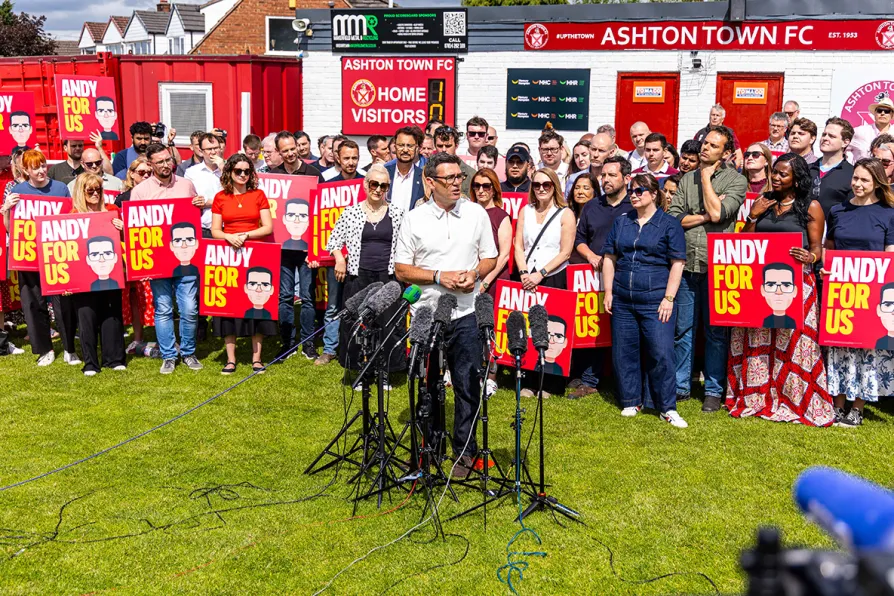 Andy Burnham speaks to supporters outside Ashton Town Football Club after winning the Makerfield by-election, June 19, 2026 [Pic: Neil Terry]

Despite Andy Burnham’s declaration defending the continued partition of the island, all major international and internal trends are converging to make Irish reunification inevitable
The left needs a bold energy vision – because if it fails to provide one, others will shape the future in their own interests, argues ALAN SIMPSON
From Margate to Deal, mining memories are being kept alive. National co-ordinator for General Strike 100, HENRY FOWLER continued his nationwide tour of partner organisations in the Garden of England
Humans are part of the ‘animal kingdom’ – and of nature in general – but also distinct from it and labour (work) is part of what makes us unique, declared Engels. His insights 150 years ago into how our species came to be and how we differ from the rest of nature, are as important today as they were then, says the MARX MEMORIAL LIBRARY
Boxes of books, family photos and heirlooms, labour movement anniversaries, along with nostalgic memories of glorious childhood days on the Ayrshire coast still leave room for a wistful MATT KERR to hope for a better future





LABOUR has ordered another round in last-chance saloon.
The Makerfield by-election victory, by an almost-handsome majority, extends a chance of renewal to a party that has, under Keir Starmer, pushed itself to the brink of collapse as a viable political enterprise.
It has also indicated the possibility, but no more than that, of a path to the defeat of the far right. The result in the Lancashire constituency has at least broken the Reform-Restore momentum.
So Andy Burnham, so-called “King of the North,” will ride into Westminster on Monday as far more than another by-election winner.
He could be weeks, or even days, away from entering Downing Street as prime minister with a huge weight of expectation — from a battered country and a despairing party — on his shoulders.
First, of course, the stubborn incumbent needs to be persuaded to stand aside. The Prime Minister is still talking of contesting any leadership race.
It may take the threat of mass Cabinet resignations to bring him to his senses, but every sentient soul in Westminster knows that Keir Starmer’s time is up.
The mere fact that he could not block Burnham from standing in Makerfield, a manoeuvre he pulled off just a few months ago, speaks to his broken authority. He has long since lost the dressing room, the stadium and the passing traffic in the streets outside.
Then there is Wes Streeting, already out there with his pitch for “progressive capitalism,” which may have sounded cool when Oasis were still making decent records but could now only be championed by someone who has missed the last 20 years of British life.
The Blairite contender may yet be talked out of a contest by some deal with Burnham. If he does force the issue, there is not a single indication that he might win. His only hope would be Harriet Harman’s demand that only MPs get a vote while members and unions get ignored, a proposal without warrant or sanction in the party’s rule book.
But it looks like the crown is there for Burnham’s taking. And what then? Well, who knows. If every action provokes an equal and opposite reaction, then the same is true for every policy position taken by Burnham.
However, he does not wait for his opponents to negate his proposals, he does it himself, often within 24 hours — fiscal rules, defence spending, Waspi women and more.
And Manchesterism? Good for buses, fair on tackling homelessness, very good for property speculators but hardly a programme for national government.
On the other hand, Burnham’s recognition that the socio-economic arrangements of the last 40 years have been a failure is the foundation of all political wisdom right now. Turning insight into action is where the glass turns murky.
One problem with an uncontested ascent to the premiership is that Burnham’s platform, or what there is of it, will not be tested in front of the labour movement. The socialist left seems to have opted out of running a candidate to make their arguments.
That would be the first Labour leadership contest this century without a socialist candidate — John McDonnell in 2007, Diane Abbott in 2010, Jeremy Corbyn most famously in 2015 and Becky Long Bailey in 2020 having all flown the flag.
That is an indicator of the lasting damage Starmer’s rule has done to the party. The hope must be that Burnham as party leader might allow the space for a more plural party.
Perhaps, if he recommits to electoral reform, a more plural politics too. In any event, the left needs to find a louder voice to shape the future.
So far, Burnham is vibes, the vibe being peace and goodwill to everyone. But when he makes it to No 10 he would do well to choose a few enemies early on — privatised water, big tech barons, Benjamin Netanyahu and bad landlords would be my list, although the last may be tricky given the number of such people on Labour’s back benches.
And, of course, Nigel Farage and Rupert Lowe. Starmer couldn’t decide whether their parties were raising justified grievances or were a menace to social cohesion.
Makerfield is clearly bad news for Farage. It was Reform’s sixth-highest polling seat in 2024 by share of vote, and the sort of constituency it must win to have any chance of securing a Commons majority. It swept the board in the local elections in the area just last month.
To lose by such a large margin, on an increased turnout, and even with Lowe’s near-fascist Restore Britain’s vote added in, indicates that Reform’s vote has a definite ceiling and it may now be near it.
One of Farage’s problems is his inability to find plausible candidates able to withstand the added scrutiny that comes with a by-election. He was undone in Gorton & Denton by the choice of the implacable Islamophobe Matthew Goodwin in a constituency with tens of thousands of Muslim voters.
And Robert Kenyon in Makerfield was a hard sell, despite plumbers being in fashion as election candidates. He not only entertained explicit fantasies about Carol Vorderman but also, in the modern way, felt obliged to share them with the world.
Perhaps more seriously, he was an unrepentant misogynist whose views on abortion — again, not shared with his mates in a pub but broadcast as far and wide as possible — turned many women against him.
Moreover, the hapless Kenyon seemed uncertain as to whether he had voted Leave in the 2016 EU referendum, equivalent in Reform to a cardinal in the Catholic church doubting the resurrection.
Nevertheless, Reform’s vote still advanced on 2024 and in a general election lots of Kenyons could slip by more-or-less unscrutinised. Nor will Burnham be their main opponent in every seat.
The larger difficulty for the far right is that voters have figured out that they need to unite to defeat it. In the Caerphilly by-election to the Welsh Senedd last year, that meant voting for Plaid Cymru.
In Gorton & Denton it handed victory to the Greens. And in Makerfield, a part of the world where Zack Polanski’s party was never going to be competitive, Labour was the beneficiary of the anti-Reform consolidation.
As leading pollster Peter Kellner put it yesterday: “What is ominous for Nigel Farage is not just those bald facts, but the signs in all three contests of voters deliberately wanting Reform to lose, voting accordingly, and achieving their goal. Such seat-by-seat tactical voting at the next general election would cost Reform dear.”
And that is before the continued irritation of Rupert Lowe is factored in. The far-right businessman may have cornered the market in those who are totally fine with the sort of pogrom unleashed in Belfast this month, but his real motivation appears to be personal animus to Farage — ego-driven bosses falling out — and that may not sustain his operation as far as the next general election.
But tactical voting is far from unalloyed good news for Labour. In Scotland, in Wales, in many big-city constituencies, including in London, another party is better-placed as the option to keep Farage out as things stand.
That is the reality Burnham, and the labour movement must address. Immediate disaster — a Reform victory in Makerfield — has been averted.
More potential disasters litter the road ahead. The first would be failing to speedily dispatch the wretched Starmer, prolonging Labour’s paralysis.
The second would be a Burnham takeover that nevertheless reproduces Starmerism, the acquiescence in the status quo on the Treasury, Trump, the bond market, militarism, and Gaza. Breaking with Starmer means more than jettisoning the man, it means discarding his whole mindset and policies as well as a good deal of his Cabinet.
Failure on that front and Reform’s setback this week will only be a temporary stumble. The racist incendiaries will resume their march, backed by the US government, the world’s richest man and much of the media.
But the message from Makerfield is — they can be beaten at the polls if they are beaten in the workplaces and on the streets.
