On the day of the election, MARTIN GOLLAN reflects on the perennial relationship between the far-right and the back-hander


 Latest editorial

A lyrical account of life in Gaza
RUTH AYLETT recommends that this mixture of memoir, diary and poetry by a young Gazan writer be read as widely as possible
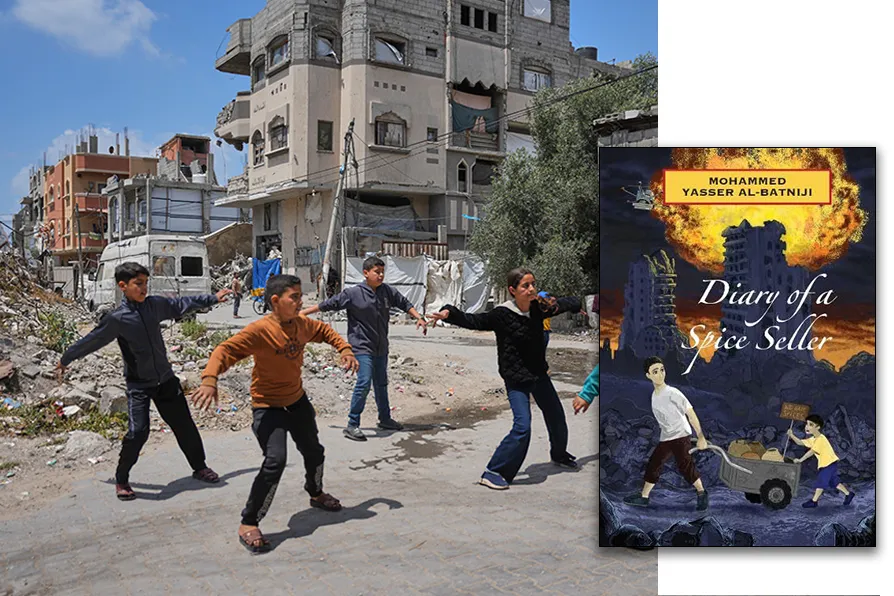 Palestinian children practice breakdancing outside a dance studio in Nuseirat, central Gaza Strip, May 4, 2026 [Pic: AP Photo/Abdel Kareem Hana]
MARY CONWAY is gripped by the powerful emotional journeys portrayed by the parents of the perpetrator and victims of a mass shooting
LEO BOIX reviews a novel where shadows deceive and mortality looms, and a poetry collection that refuses to dim
ROBIN STYLES welcomes a boundary pushing work of fiction exploring the life and ideas of the godmother of modernism
PAUL DONOVAN recommends an energetic adaptation of Ken Kesey’s novel, that emphasises how psychiatry is a tool in the hands of a racist agenda
ED WAUGH introduces a special event to commemorate the centenary of the 1926 General Strike
Reviews of Charlotte Cornfield, Michael Weston King, and Gun Outfit





Diary of a Spice Seller
Mohammed al-Batniji, Drizzle-Dazzle, £10
WE know all too well that to carry out a genocide the perpetrators must convince themselves that their victims are not human like themselves but can be treated like “things.” Racism is integral to genocide. And even for those opposing genocide, there is a tendency to view its victims as an abstract and undifferentiated mass.
It follows that humanising people and turning them into living, breathing individuals is also a fight against genocide. This is the profound service rendered by the young author of Diary of a Spice Seller, Mohammed Yasser al-Batniji.
Mohammed first met British poet, Jonathan Wonham over Instagram in August 2024, getting on for a year into the Gaza genocide. A 16-year-old, he was energetic and full of projects. Learning that Jonathan was selling his own books to raise money for Palestinian charities, Mohammed eventually suggested that he could write a book himself. Though the term is not used, his book fits the new literary form now known as a lyric essay, mixing memoir, diary and poetry.
In it you share Mohammed’s hopes and dreams — to become a nurse, to study at university — and meet his family and friends. His first project began in March of 2024, selling spices and seasonings — hence the book’s title. This was much more than a way of trying to make a living of some kind: “It meant trying to keep some meaning in our lives, it meant steadfastness and it meant, ‘We are still here!’”
While he was working at selling spices, Mohammed decided to start an Instagram account and run live broadcasts. Through this he was able to make many distant friends, who in turn helped with small sums of money. Mohammed was therefore eventually able to buy a solar panel, which he used to charge phones as a supplementary business. These panels are extremely valuable in conditions of displacement because they are portable enough to move with people and give them access to power. This of course is why the Israelis have restricted their import and why the IDF destroys them.
Donations also allowed Mohammed to buy rice for 35 families in tents close to his own and his pleasure at being able to help others shines out.
The mixture of small pleasures with the desperation of multiple displacements and then starvation and the horrors of witnessing bodies shredded by bombing is reminiscent of A Day in the Life of Ivan Denisovich, by Solzhenitsyn. The difference is that because of the cold war, the sufferings of the Gulags were widely publicised in the West, while because of the complicity with the genocide from nearly all Western powers, the even greater suffering of Palestinians is hidden. At one point Mohammed’s Instagram account was abruptly closed and he had to start again.
This book finishes in mid September 2025. In the last piece, Mohammed imagines a future in which Palestine is free and a child can run through the grass of a vast green land. He says that one day he will read this poem to his children and grandchildren.
Although, as the book progresses, conditions get worse and worse, Mohammed is currently still alive and well. He is working on a second book that will continue the story of his life including his family’s escape from Gaza City in September 2025. And in spite of everything the Israelis have done, Mohammed successfully completed his end of school exams and is now studying at university in Gaza.
He demonstrates the human capacity for hope and creativity under the most difficult of circumstances. You should read this book.
Diary of a Spice Seller by Mohammed Yasser al-Batniji is currently only available to buy via facebook.com/JonathanWonhamPoet.
