ROB WARZYNIAK wades knee deep through a pile of ‘dead canaries’ of Trumpist policies which exacerbated the horrors of US capitalism domestically


 Latest editorial

Lessons from Germany on rebuilding the peace and communist movements in Britain
JOHNNIE HUNTER reports from the German Communist Party’s (DKP) weekly Unsere Zeit (Our Newspaper)-organised Peace Days festival in Berlin last weekend
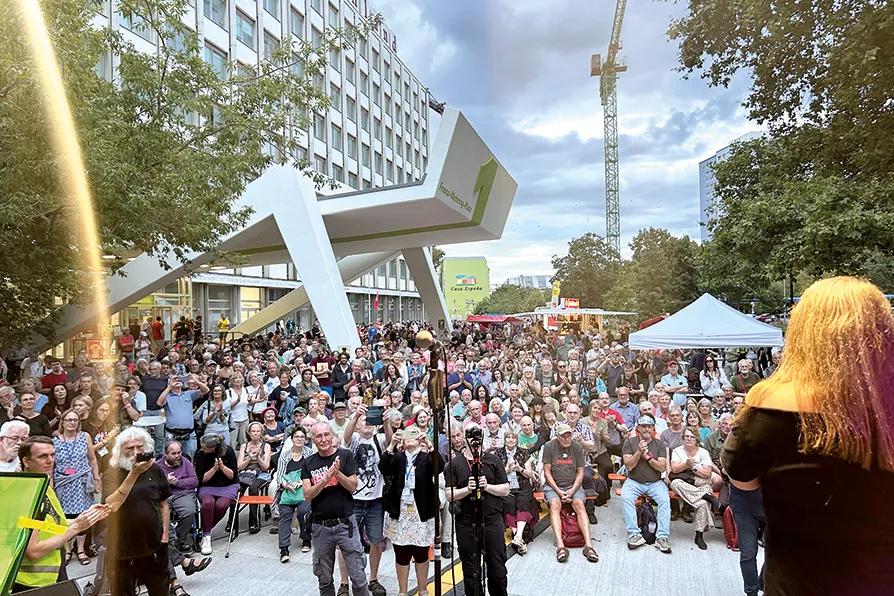 Speeches were keenly listened to in the forecourt of the UZ HQ in the Neues Deutschland modernist office building at Franz-Mehring-Platz 1 [Pic: Author supplied]

Without evidence or Nato consultations Berlin’s answer to the Leipzig incident is a rupture of relations. SEVIM DAGDELEN examines why
FRANCISCO DOMINGUEZ introduces the background to a conference on defending Latin America’s sovereignty
The glacier collapse in Nepal is yet another warning that a warming planet is making Himalayan disasters more frequent and destructive – but the countries facing the greatest risks are often those least responsible, says LI YANG
Nick Blair is set to benefit from a hugely lucrative contract to ‘virtually’ train the British army for its next war. Like father, like son, writes SOLOMON HUGHES
Even when tragedy strikes, Western media cannot resist the opportunity to turn it into a sordid propaganda opportunity, as the Nepal-China border tragedy shows, writes CARLOS MARTINEZ
Trade unions should be at the heart of the anti-racist push for reparations for the historic legacy and continuing impact of slavery, writes ROGER McKENZIE





FOR decades Berlin was perhaps the most consistent flashpoint of the cold war, a global emblem of the international struggle between US imperialism and its opponents and the constant risk of escalation.
In 2026 it has reclaimed that mantle.
As here in Britain, there is a drive to war across the Nato countries and the imperialist camp both for continuing the war with Russia in Ukraine and in preparing for a future war with China.
Germany plays a leading role in this context as the EU’s biggest economy and increasingly dominant power.
The remilitarisation of the West German state was of course a central policy of US-Nato imperialism following WWII and we are seeing that same process mirrored today in real time.
Friedrich Merz, Germany’s CDU Chancellor in power for just over a year now, is in the process of putting the country on a hot war footing with a determination to make the German Bundeswehr “Europe’s strongest conventional army.”
This is a chilling prospect for anyone with even an elementary knowledge of the history of the 20th century.
Back in March, using dubious Bundestag procedure, Merz forced through changes to Germany’s debt rules thereby allowing the creation of a massive €100 billion (£86bn) war fund. Germany’s military budget is set to quadruple the military budget to €153bn (£131bn) by 2029.
There are clear comparisons with the same drive to push up war spending to higher proportion of GDP as we are seeing here in Britain.
As was reported in this paper at the time, and again just as in our own country, the German left warned that this spending would directly deprive public services and lower working-class living standards.
As predicted Germany’s 2027 budget plan does just that, with civilian infrastructure also being slashed – for example over 90 rail projects are at risk of being cancelled as part of the effort to divert funds to war.
There are also plans to grow the German army, currently circa at 180,000, to 460,000 personnel by 2035.
Shockingly, in an apparent prelude to enforcing full conscription, the government has introduced measures requiring men over 18 to register their readiness for military service — an initiative to limit the ability of fighting age men to leave the country for more than three months was back-peddled on also.
Conscientious objector applications have skyrocketed in response, with far more applications this year (5,862) than in the entirety of 2025 (3,867).
Following all this have been the latest shadowy claims of a Russian drone attack on Leipzig Airport swirling in the press this week. This being used to ratchet up paranoia and war fever not just in Germany but across Europe — so much so that one could also forget that it is European and British-made drones and weapons that are striking military and civilian targets en masse in Russia, just as is being done in Ukraine.
Noting the parallels between the situation in Germany and Britain in all of this would be a trite understatement.
It was against this backdrop that the German Communist Party (DKP) and its newspaper Unsere Zeit held their annual UZ-Friedenstage 2026 (UZ Peace Days) festival in Berlin August 28-30 2026.
I had the warm privilege of attending as a guest on behalf of Britain’s Communist Party.
The history of the DKP is intimately tied to the struggle for peace. With its predecessor, the KPD, banned under the Nazis, facing a similar ban under the unrepentant West German state in 1956 for opposing the post-WWII status of West Germany, its Nato membership and remilitarisation.
The DKP reconstituted in 1968 but faced and continues to face the risk of being declared illegal.
Unsere Zeit, a sister paper of the Morning Star, has a similar and intimately linked history in Germany of fighting Nato militarism and building a mass movement for peace.
For decades the UZ Peace Days have provided a pole for the left and peace movement in Germany even during the black days of capitalist restoration in the East of the unified country.
The major focus of this year’s edition of the UZ Peace Days was of course combatting Germany’s new supercharged drive to war and the associated attacks on working-class living standards, the laying of the foundations this year for conscription, the spreading of Russophobia and pro-war propaganda.
International delegates received an update on the current political situation where the DKP explained their characterisation of Germany imperialism as a force with specific aspirations in terms of its domination of the EU and the war in Ukraine, but also still reliant on and working in concert with increasingly erratic US imperialism.
As the DKP warned at the festival that the German ruling class would attempt to make working people to pay for the rearmament, that very weekend a video went viral of Merz declaring that “with work-life balance and a four-day week, long-term prosperity in our country cannot be maintained.”
The DKP and allies can point to significant initiatives in combatting this ruling-class offensive.
The communist SDAJ (Socialist German Working Youth) and allies have played a leading role in organising school strikes and mass demonstrations in the spring which saw 50,000 school students leaving classrooms and demonstrating in more than 130 cities across Germany against the drive to conscription.
This year’s festival saw a massive increase in young people and SDAJ members in attendance reflecting the advances made by the movement in Germany and its central role in the struggle for peace.
SDAJ speakers from the festival platform declared the Merz’s drive to war would be met with more school strikes and demonstrations until the threat of conscription was defeated and reversed.
German communists are also playing a leading in revitalising Germany’s longstanding peace movement, fighting for a clear class conscious line which demands withdrawal from Nato and links the drive to war with attacks on working-class living standards.
Mass demonstrations are planned in Berlin and other German cities this autumn where these demands will be championed.
Work is also underway to win broad support for this position in the German trade union movement where many unions are directly linked to the pro-war Social Democratic Party of Germany, Merz’s coalition partner.
Significant elements in Germany’s left and labour movement resist properly opposing the pro-war policies of the SPD and the government argue that stopping the rise of the AfD is the only priority — ignoring the fact that it is the very policies put forward by the SPD which are giving fertile ground to the far right.
Historically German communists both prior to, during and since partition, have faced some of the most brutal repression and anti-communist state propaganda of any communist movement. But that has not stopped them in their determination to rebuild a strong and influential communist party — a task so fundamental in Britain also.
With a significant increase in attendance and a younger age profile than in previous years, the future for UZ Peace Days — as well as the Rosa Luxemburg Conference next scheduled for 2027 — look bright.
Key lessons can be learned for our context in terms of the fight for peace, linking the youth and student and trade union movements that struggle, combatting the opportunism and defeatism of social democracy and the importance of unity building festivals and events for the left.
The parallels with our situation here in Britain are direct and the lessons which can be learned and applied here in our own country are also direct.
In 2026 the imperialist drive to war is not German or British, it is truly global and it needs an international proletarian response. Working people and our movement must answer the call and play our part.
Johnnie Hunter is the assistant general secretary of the Communist Party

Similar stories
NICK WRIGHT returns to Berlin and finds a city in darkness and political turmoil

The federal government’s plans to finance the war in Ukraine with Russian assets, and a possible deployment of German troops, put the population in Germany in the highest danger, argues SEVIM DAGDELEN
German Chancellor Friedrich Merz is pouring €11.5bn into the Kiev swamp, blocking Trump’s peace plan, and pushing Nato right up to Russia’s borders – no matter if it costs hundreds of thousands of lives, warns SEVIM DAGDELEN
The CPB's congress aims to build the united front against monopoly capitalism, utilising the YCL’s promising new generation of militants — but our party remains far from the strength history requires of it, despite recent progress, writes JOHNNIE HUNTER