


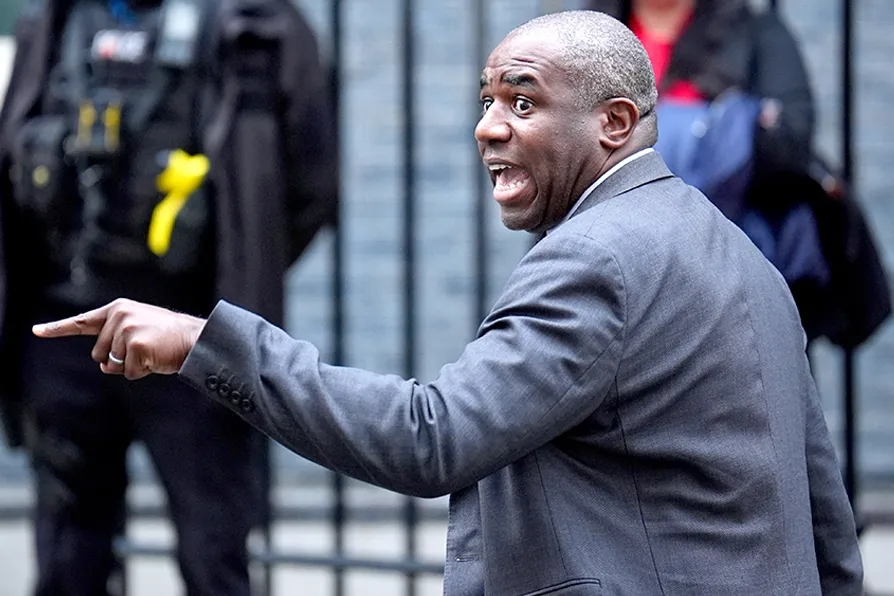
 RENEGADE: Deputy Prime Minister and Justice Secretary David Lammy on a visit to Downing Street briefing on Monday February 9 2026






AS ONE of the first black MPs elected in post war Britain, Bernie Grant was in the thick of the fight for justice and for his defence of the rights of people, especially young black people, he was extensively traduced and misquoted.
Every year tribute is paid on the anniversary of his election as MP for Tottenham. One tribute described him as an all-round Tottenham legend and pioneering campaigner for social justice and equality.
These words were written by his successor as MP for Tottenham David Lammy — presently justice secretary in Keir Starmer’s Cabinet — who went on to say: “His legacy will never be forgotten.”
It would have been impossible for Lammy to have been selected as Bernie Grant’s successor if the electorate had even the faintest sense that Lammy’s professed admiration for his predecessor hid a rank opportunism that today distinguishes him as perhaps the minister most servile to the imperatives of the Establishment.
We can measure Lammy’s abandonment of such principles as he once espoused by taking a look at his proposals to end jury trials for a huge number of defendants in Britain’s chaotic and underfunded justice system.
The ostensible reason for this drastic diminution of our human right to be judged by our peers is the backlog of cases in the courts system with many cases scheduled for years ahead.
Successive governments have diminished funding for the justice system so that — from the probation service to prisons, from reduced court staffing numbers to cuts in legal aid — the class bias of the legal system, which puts those with limited financial means under pressure to abandon their right to due process, is ever more intense.
But, opinion is hardening that introducing judge-only trials for many criminal cases would further increase the risk of miscarriages of justice.
Lammy proposes limiting jury trials to accusations of rape, murder and certain “public interest” cases. His plan is for most defendants to be tried by a single judge able to pass sentences up to five years in prison.
This is a direct repudiation of the point made just last year by the minister for courts and legal services, Sarah Sackman, who told Parliament: “Let me be clear: jury trials will always be a cornerstone of British justice. This government will do whatever it takes to protect the fundamental right to a fair trial.”
She went on to argue that: “The vast majority of cases in our courts are already heard without juries. Around 90 per cent of all criminal cases are dealt with robustly and fairly by magistrates, with no jury.”
This rather begs the question, what is the necessity to further reduce the role of juries in delivering justice if restoring proper funding could restore the timely delivery of justice?
The answer lies in the recent tendency of juries to take a common sense and principled approach and acquit in cases where citizen action against war and enterprises servicing genocide falls victim to overweening state power.
“Jury trials are fundamental to the justice system … fundamental to our democracy. We must protect them.” These words of Lammy were quoted against him in a parliamentary debate just before Christmas by the then shadow justice secretary who told MPs that Lammy was “plotting to discard centuries of jury trials without so much as a by-your-leave.”
It is a measure of this government’s political disarray that a valid, if cynically hypocritical, criticism of Lammy’s illiberal measure — designed to strengthen the power of the state against its citizens — can be so easily gifted to a right-wing Tory defector who now sits among Boris Johnson’s Cabinet as a Reform UK MP.
